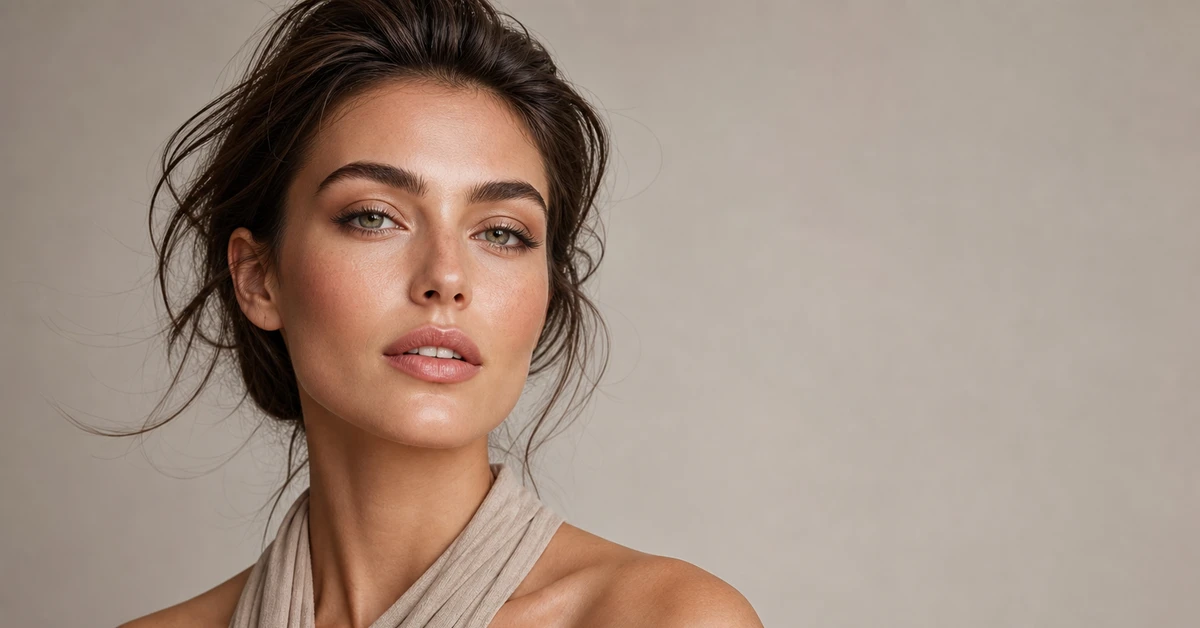
There's a kind of face the camera seems to switch a light on behind, warm-toned, fresh, the skin almost luminous, with eyes and hair that read golden rather than ashy. You see it in early photographs of Nicole Kidman before the platinum era, when her hair was a warm strawberry-copper and her skin glowed against coral; you see it in Amy Adams whenever she's photographed in warm leaf green or peach. That golden warmth, paired with a clear, vivid brightness, is the signature of True Spring.
True Spring Celebrities
By ToneLalaUpdated July 12, 2026
Contents
I spend my days draping fabric under people's chins and watching what their faces do, so playing the celebrity guessing game is a bit of a busman's holiday for me. But it earns its keep, because famous faces give us a shared reference point. When I say a color is "True Spring", you can picture someone. The catch, and I'll say it more than once, is that none of these people have sat in my chair. Everything below is an informed reading of photographs, lighting and styling, not a verdict.
True Spring is warm, light-to-medium and bright, golden and sunlit rather than icy or dusty. If that sounds like you, find your season before you take any celebrity comparison as gospel, and see the palette below.
What makes someone a True Spring?
In the 12-season system, every season has a dominant characteristic. For True Spring it's warmth: the coloring is golden and yellow-based, with no blue pulling through the skin. The secondary trait is brightness, clear, saturated color rather than anything grayed or dusty. Depth sits at the lighter end of the middle: sunlit and fairly light, never the inky darkness of a Winter or the deep richness of an Autumn.
Put those together and you get a recognisable physical pattern. Skin tends to be warm and golden, often with a peachy or freckled glow, and it usually tans rather than burning straight to pink. Hair leans warm, golden blonde, honey, warm light brown, or a fresh strawberry-copper, frequently with natural gold catching the light. Eyes are commonly warm: clear blue-green, golden green, topaz, or a light warm hazel where the gold wins. Contrast between the three is medium, not stark. Nothing about a True Spring face is heavy; it sparkles.
Why we link certain celebrities to True Spring
A handful of names surface again and again in color-analysis communities, and it's worth naming them while being honest about the hedging. Nicole Kidman in her early career, the warm red-gold hair, the way fresh coral and warm green lit her up, is a perennial example. Amy Adams gets cited constantly for the same reasons: warm copper hair, golden skin, and a face that comes alive in clear, sunny color. Blake Lively's warm golden coloring lands her here in many people's eyes, as does Isla Fisher with her warm strawberry tones, and Cynthia Nixon for that fresh, golden, clear-skinned look.
Here's the important bit. These are best guesses built from edited photographs, makeup, dyed hair and studio lighting, every one of which can shift how a person reads. A celebrity going platinum for a role, lit coolly for a magazine cover, or wearing a stylist's choice of cool burgundy, can look like a completely different season from one frame to the next. So treat the list as a mood board for the warm-bright look, not a database of confirmed seasons. The value isn't in the names; it's in training your eye to spot the pattern they share.
The colors a True Spring wears best
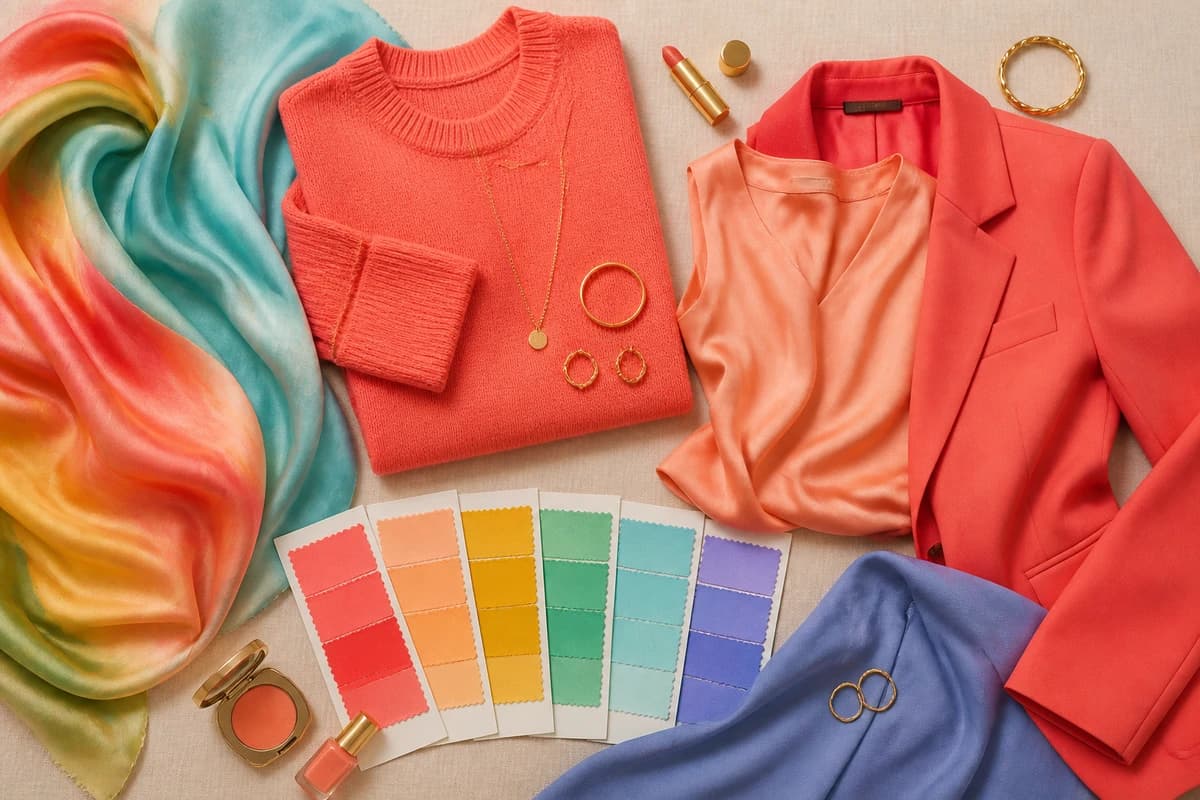
The True Spring palette is the wardrobe equivalent of those faces: warm, clear, light-to-medium and full of life. Picture late-April sunshine on new leaves rather than a misty autumn morning. Warm corals and coral-reds, golden yellow, fresh leaf and warm grass greens, a warm turquoise and aqua, peach and a clear salmon pink.
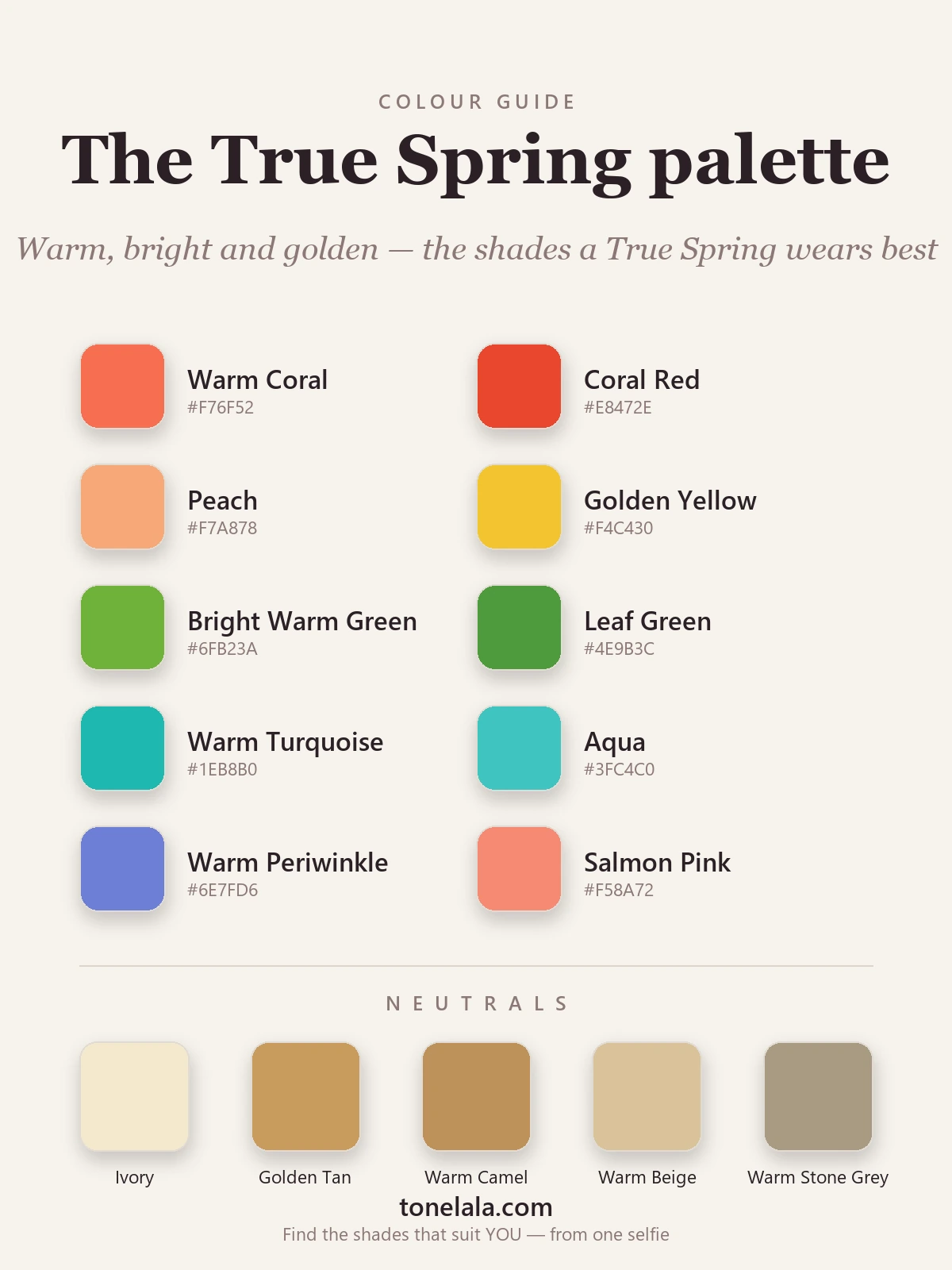
What unites them is that golden-but-vivid quality. None of these shades is grayed or chalky, there's always warmth and clarity, which is exactly what flatters a True Spring's fresh, sunlit coloring. Muted or icy colors tend to flatten the face; these clear, warm shades let the skin look lit and the eyes brighten instead. If you want the full breakdown with styling notes, the dedicated True Spring color palette guide goes deeper on combinations and how to build outfits from it.
Neutrals, metals and the colors to approach carefully
True Spring neutrals are warm and golden. Reach for ivory rather than stark white, golden tan and warm camel in place of cool gray, and a warm beige for everyday layering; a warm stone gray covers you when you genuinely want something cooler. These give an outfit structure without the heaviness that pure black brings to a Spring face, and on a True Spring, warm camel or leaf green plays the role a "dark" usually would.
On metals, yellow gold and a warm bright gold are the natural home, and a light copper is lovely too. The shades to handle with care are the cool and the heavy ones: black, charcoal, icy blue, fuchsia, cool gray and anything described as "dusty" or "muted". They don't ruin a True Spring, but they compete with the face rather than support it, and you'll usually notice the color draining the skin before you notice the person, the opposite of what these celebrities pull off so well.
Curious whether you share their coloring?
Find your color season →True Spring versus its neighbours
The most common mix-up is True Spring and Bright Spring. Both are warm and clear, so the celebrity lists overlap. The difference is which trait leads. True Spring is warm first, bright second, so it glows in golden, sunlit color. Bright Spring leads with brightness, carries more contrast and a cooler edge, and can take icier, more electric brights that would feel sharp on a True Spring. If a clear golden yellow looks alive on someone, I lean True Spring; if they need the very highest-contrast, almost neon brights to come alive, I lean Bright.
The other neighbour is Light Spring, which shares the warmth but sits lighter and a shade softer. Where a Light Spring feels like a watercolor washed in sun, a True Spring feels like the same scene at full midday, a little deeper, a little more saturated. Getting this distinction right is most of what an analysis actually does, and it's why a thirty-second photo guess is no substitute. You can explore the differences across all of these in the color analysis guides.
How to tell if you share their season
Forget the names for a moment and look in a mirror near a window. Hold something warm and clear, a coral, a fresh leaf green, near your face, then hold something cool and muted like a dusty mauve. If the warm option makes your skin look lit and golden while the muted one seems to gray you out or pull shadows under your eyes, you're showing Spring behavior. Add in a sunlit, light-to-medium coloring, warm-reading veins at the wrist, and eyes that brighten against gold, and True Spring becomes a real possibility.
That said, undertone is genuinely hard to judge on yourself, especially in mixed lighting, and the line between the three Springs is subtle. A proper analysis tests dozens of drapes against your actual skin to settle it, which is exactly what finding your season sets out to do.
The takeaway
The celebrities people pin to True Spring, Kidman in her copper years, Adams, Lively, Fisher, Nixon and the rest, are useful precisely because they show one coherent look: warm, bright, golden and fresh, never heavy or cool. Use them to train your eye, enjoy the parlour game, but don't crown yourself a True Spring on the strength of a resemblance to a face in a magazine. Photos lie, lighting flatters, and stylists make choices the rest of us never see. Your own skin, under honest light, is the only reference that counts, and confirming it is the difference between guessing and knowing.
Frequently asked questions
What does it mean to be a True Spring? True Spring is one of the three Spring seasons in 12-season color analysis, and the most purely warm of them. The dominant trait is warmth, supported by brightness, colors that are golden, clear rather than muted, and light-to-medium in depth. Skin, hair and eyes usually share that warm, fresh, sunlit quality, with medium contrast between them.
Which celebrities are often described as True Spring? Names that come up regularly in color-analysis circles include Nicole Kidman in her early warm-red-haired years, Amy Adams, Blake Lively, Cynthia Nixon and Isla Fisher. These are educated guesses from photos rather than professional drapings, so treat them as illustrations of the warm-bright look rather than confirmed verdicts.
What is the difference between True Spring and Bright Spring celebrities? Both are warm and clear, but True Spring leads with warmth while Bright Spring leads with brightness and carries higher contrast and a cooler edge. A True Spring glows in golden, sunlit color; a Bright Spring can take icier, more electric brights that would feel sharp on a True Spring's gentler, warmer face.
Can True Spring celebrities wear black and white? Not at their best. Pure black is too dark and too cool for True Spring's light-to-medium warmth and tends to drain the face, while stark optic white reads a touch cold. Warm camel, leaf green and a soft ivory do the structural jobs without the harshness, and that swap is one of the quickest tells you are looking at a Spring rather than a Winter.
How do I know if I share True Spring coloring with these celebrities? Check whether warm, clear shades make your skin look lit and golden while cool or muted colors seem to gray you out. Look for a sunlit, fairly light-to-medium coloring, warm-reading veins and eyes that brighten against coral or warm green. A proper analysis confirms it, you can start one at tonelala.com/onboarding.
Frequently asked questions
What does it mean to be a True Spring?
True Spring is one of the three Spring seasons in 12-season color analysis, and the most purely warm of them. The dominant trait is warmth, supported by brightness, colors that are golden, clear rather than muted, and light-to-medium in depth. Skin, hair and eyes usually share that warm, fresh, sunlit quality, with medium contrast between them.
Which celebrities are often described as True Spring?
Names that come up regularly in color-analysis circles include Nicole Kidman in her early warm-red-haired years, Amy Adams, Blake Lively, Cynthia Nixon and Isla Fisher. These are educated guesses from photos rather than professional drapings, so treat them as illustrations of the warm-bright look rather than confirmed verdicts.
What is the difference between True Spring and Bright Spring celebrities?
Both are warm and clear, but True Spring leads with warmth while Bright Spring leads with brightness and carries higher contrast and a cooler edge. A True Spring glows in golden, sunlit color; a Bright Spring can take icier, more electric brights that would feel sharp on a True Spring's gentler, warmer face.
Can True Spring celebrities wear black and white?
Not at their best. Pure black is too dark and too cool for True Spring's light-to-medium warmth and tends to drain the face, while stark optic white reads a touch cold. Warm camel, leaf green and a soft ivory do the structural jobs without the harshness, and that swap is one of the quickest tells you are looking at a Spring rather than a Winter.
How do I know if I share True Spring coloring with these celebrities?
Check whether warm, clear shades make your skin look lit and golden while cool or muted colors seem to gray you out. Look for a sunlit, fairly light-to-medium coloring, warm-reading veins and eyes that brighten against coral or warm green. A proper analysis confirms it, you can start one at tonelala.com/onboarding.
Related guides
Bright Spring Celebrities
A color analyst on Bright Spring celebrities, who likely fits the warm, clear, high-energy season, why the lists disagree

True Winter Celebrities
A color analyst on True Winter celebrities, the cool, deep, high-contrast look, why the lists disagree, the palette they share, and how to type yourself.
True Summer Celebrities
A color analyst's look at the soft, cool, smoky palette often linked to True Summer celebrities, plus how to tell if you share the season.
Light Spring Celebrities
A color analyst on Light Spring celebrities, who's often typed Light Spring, why the lists disagree, the palette they share, and how to find your own season.
Deep Winter Celebrities
A color analyst on Deep Winter celebrities, who likely fits the cool, deep, high-contrast season, why the lists disagree
Bright Spring vs True Spring: How to Tell the Difference
A color analyst on Bright Spring vs True Spring, how they differ on undertone, value and chroma, the colors that separate them
Prefer in person? Find color analysis near you
Browse local color analysts by city, or get the same season, palette and best-colors breakdown online from one selfie.
See your colors on a photo of you
Upload one selfie and ToneLala reveals your season, your full palette, and your best hair, makeup, jewelry and outfits, styled on you.