In a sentence: dark auburn hair suits warm, rich coloring best and looks most striking against deep, warm shades and the teals and greens that complement red, teal, forest green, rust, mustard, terracotta, deep coral, olive, petrol blue, aubergine and warm cranberry. Skip to the best outfit colors or find your most flattering colors.
Dark Auburn Hair Color: Who It Suits & the Best Colors to Wear With It
By ToneLalaUpdated July 5, 2026
Contents
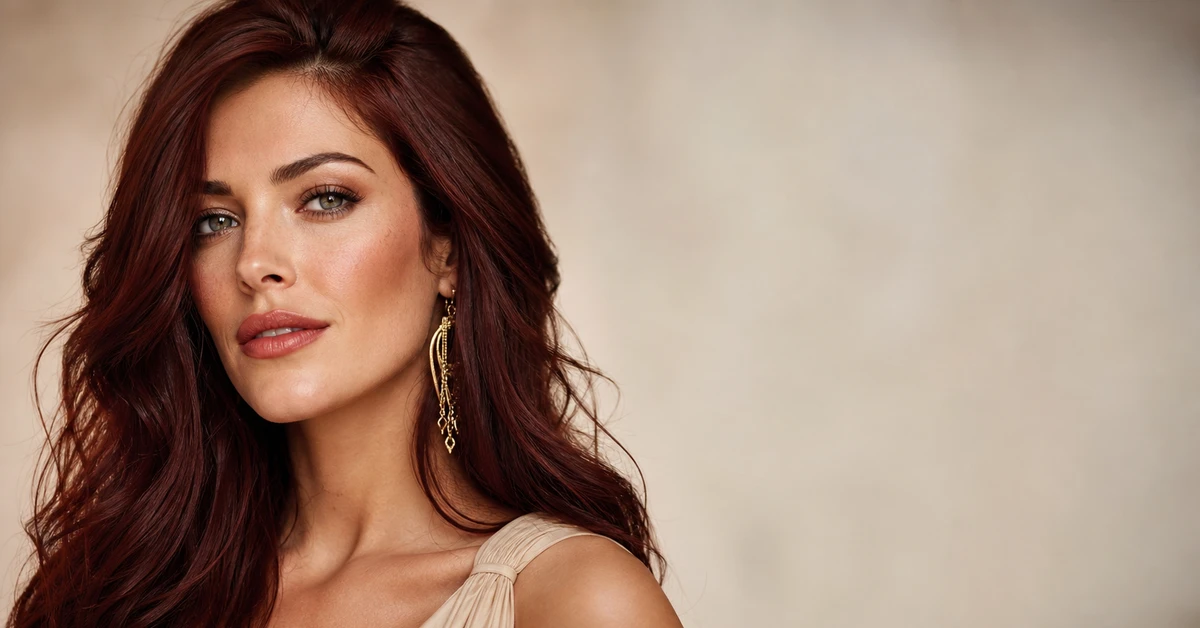
Dark auburn is the shade I reach for when a client wants red but doesn't want to shout. It's a deep red-brown, think of polished mahogany, or a conker fresh out of its shell, and it does something a bright copper can't: it adds richness without taking over the whole face. The color reads expensive precisely because it's restrained. There's red in it, plainly, but it's folded into enough brown that it flatters far more people than a pillar-box ginger ever could.
That depth is the whole point, and it's also what most "what to wear with auburn hair" advice gets wrong. Dark auburn is darker and warmer than the strawberry-and-copper crowd, so it can carry colors that would swamp a lighter redhead, proper forest greens, deep teals, a warm cranberry. Treat it as a deep, warm coloring rather than a "red-hair" coloring and you'll dress it far better. The ten shades below are the reliable shortlist; your skin's undertone decides which of them is genuinely yours.
Who dark auburn hair suits
Dark auburn flatters warm and warm-neutral skin most easily, golden, peachy and olive complexions, very often freckled, frequently paired with warm hazel, green or amber-brown eyes. The warmth in the hair echoes the warmth in the skin, and the two settle into each other so the whole face looks lit from the same source. This is the coloring that makes auburn look like it grew there.
What sets dark auburn apart from lighter reds is its depth, and that widens the net considerably. Because it's a deep red-brown rather than a bright copper, it holds up beautifully on medium and deeper skin, where a light ginger would simply vanish. It also gives cooler, neutral skin a far more wearable route into red, a vivid copper can look stark against pink-based skin, but a darker, slightly plummier auburn reads rich rather than fancy-dress. Genuinely cool, rose-pink complexions are the one group who should choose carefully: lean to the cooler, burgundy-leaning end of auburn rather than the golden-copper end, and it behaves.
The shade range itself runs from a deep coppery red-brown, through warm mahogany, into a cooler wine-tinged burgundy-auburn. Warmer, more copper versions suit golden and peachy skin; cooler, plummier versions flatter neutral and slightly cool skin. The deciding factors are the same two that decide everything in color analysis, how deep your overall coloring is, and which way your undertone leans.
The best colors to wear with dark auburn hair
These ten flatter the broadest range of dark auburn coloring, deep, warm-leaning shades plus the greens and teals that complete red, all kept rich enough to balance the depth of the hair.
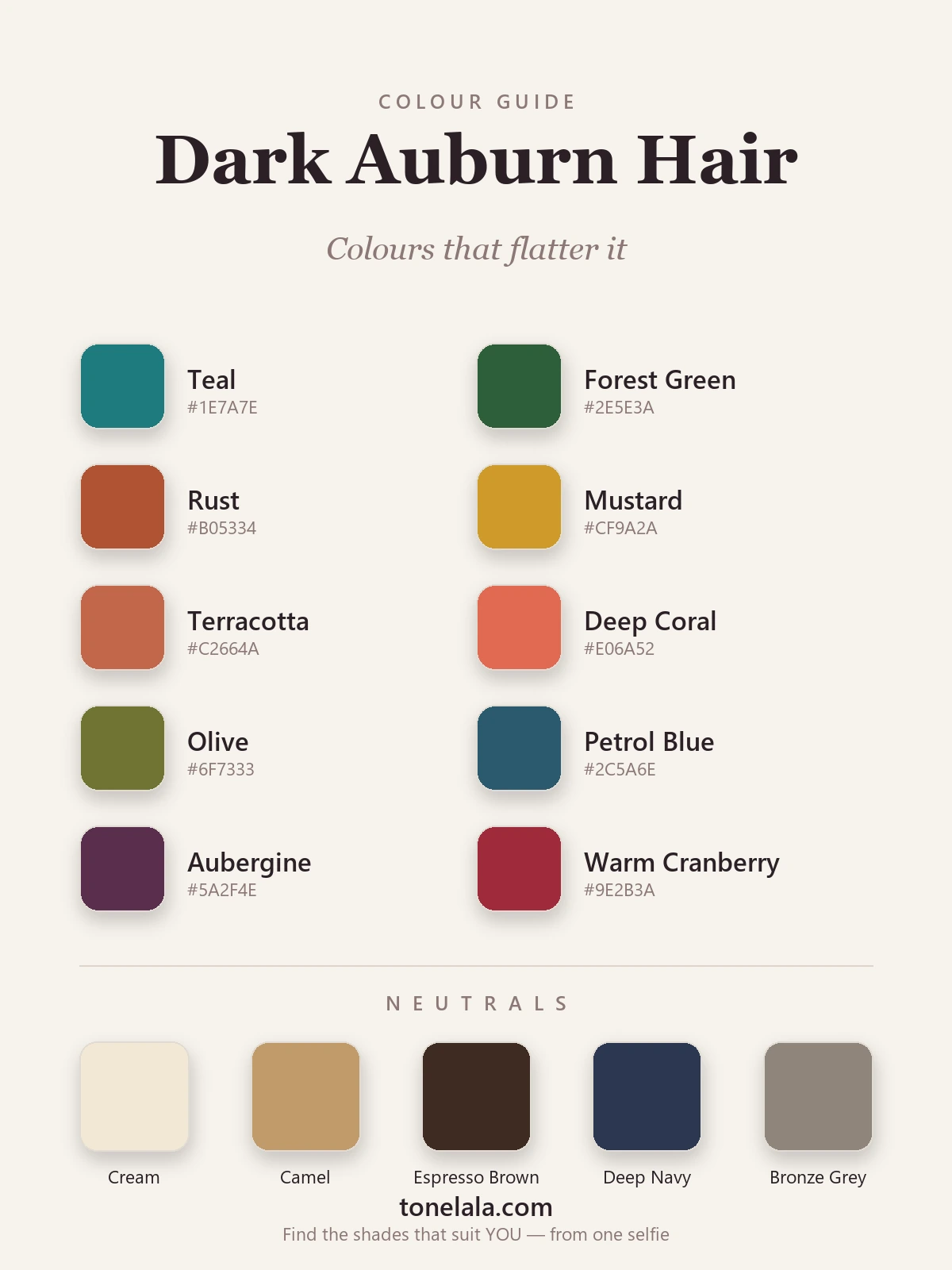
| Color | Hex |
|---|---|
Teal #1E7A7E |
A deep blue-green that brings out every bit of richness in auburn, as a cousin of red's complement, it makes the hair glow while staying fresh. My single most reliable pick. |
Forest Green #2E5E3A |
Red's complementary family at full depth; it makes dark auburn read more vivid and the skin clearer at once. The classic auburn color, and for good reason. |
Rust #B05334 |
A deep brick red-orange that echoes the warmth in the hair without competing with it, earthy, grounded and quietly luxurious against mahogany tones. |
Mustard #CF9A2A |
A golden ochre-yellow that picks up the copper in auburn and warms the skin. Worn near the face it makes the hair look glossier. |
Terracotta #C2664A |
A muted clay-orange in perfect harmony with deep auburn, rich, warm and very wearable, especially on golden and olive skin. |
Deep Coral #E06A52 |
A warm, deepened pink-orange that lifts the complexion and gives a healthy flush; the saturated version flatters auburn far better than a pale pastel coral. |
Olive #6F7333 |
A golden, earthy green that practically belongs to auburn hair, grounded, expensive-looking and brilliant for warm coloring. |
Petrol Blue #2C5A6E |
A deep teal-blue that cools a look without going icy; it gives contrast and depth while letting the hair stay the star. Easy on nearly every auburn. |
Aubergine #5A2F4E |
A deep warm purple that delivers drama and depth without the harshness of black, sophisticated and rich beside dark auburn. |
Warm Cranberry #9E2B3A |
A deep, slightly warm berry-red that lets you wear red with red, close enough to harmonize, deep enough not to clash. A confident, grown-up choice. |
Best neutrals: Cream #F2E8D5 instead of stark white; Camel #C19A6B for a warm base that makes auburn look luxe; Espresso Brown #3E2C22 in place of black when you want depth near the face, it flatters far more than black does; Deep Navy #2C3851 for a cooler dark that still suits warm coloring; and Bronze Gray #8F857A for a modern, warm-leaning neutral that won't fight the hair.
Want YOUR most flattering wardrobe colors?
Find your color season →Colors to avoid with dark auburn hair
- Cool, blue-based brights, fuchsia, electric blue, icy pink. They clash with the warmth in auburn and tend to throw a pink or cold cast over the skin. If you love pink, deepen and warm it: a cranberry or deep coral sits far more happily near the hair.
- Stark, optic black and pure white at the neckline. Both are harsher than warm auburn coloring and can flatten the richness right out of the hair. Reach for espresso brown or cream instead, or break black up with one of your palette colors at the neck.
- Bright, washed-out pastels, baby blue, mint, pale lemon. They're too light and too cool to balance the depth of dark auburn, so the look goes faded and the hair carries the whole outfit. Go for the saturated, earthier versions of those colors instead.
Dark Auburn hair and your color season
In the seasonal system, dark auburn hair points most often to the warm and deep families, Deep Autumn first of all, then True Autumn, with the cooler, plummier versions occasionally edging toward Deep Winter. The logic is straightforward: auburn is warm, and "dark" means depth, so deep-warm seasons are the natural home. Rich coppery auburn with golden, olive skin tends toward Deep Autumn (teal, forest green, rust, mustard); slightly softer, more mahogany coloring leans True Autumn (the same earthy palette in gentler form). A cooler, wine-tinged dark auburn on neutral skin can occasionally read Deep Winter, where the palette holds the same depth but turns cooler and clearer, think pine, true teal and deep berry rather than rust and ochre.
That tipping point between a warm Autumn and a cooler Deep Winter comes down to undertone, and it's genuinely hard to call by eye, which is exactly why guessing rarely lands. If you want to understand how depth and undertone combine to place you, the color analysis guides walk through each season in detail, and a proper analysis tells you precisely which one is yours.
Shades & upkeep
Dark auburn isn't one color so much as a small family, coppery red-brown at the warm end, mahogany in the middle, and a cooler burgundy-auburn at the other. Pick by undertone: warmer, copper-leaning shades for golden and peachy skin, cooler, plummier ones for neutral and slightly cool skin. Wherever you land, know that red pigment fades faster than any other, so dark auburn needs a little tending to stay rich rather than drifting to a dull brown. A gloss or toner every four to six weeks keeps it luminous, with a fuller refresh every six to eight; sulphate-free color-safe shampoo, cooler water and heat protection all stretch the time between. The good news is that the deeper, more brown-balanced versions hold their color longest, so if low maintenance matters, lean darker and more mahogany.
Putting it together
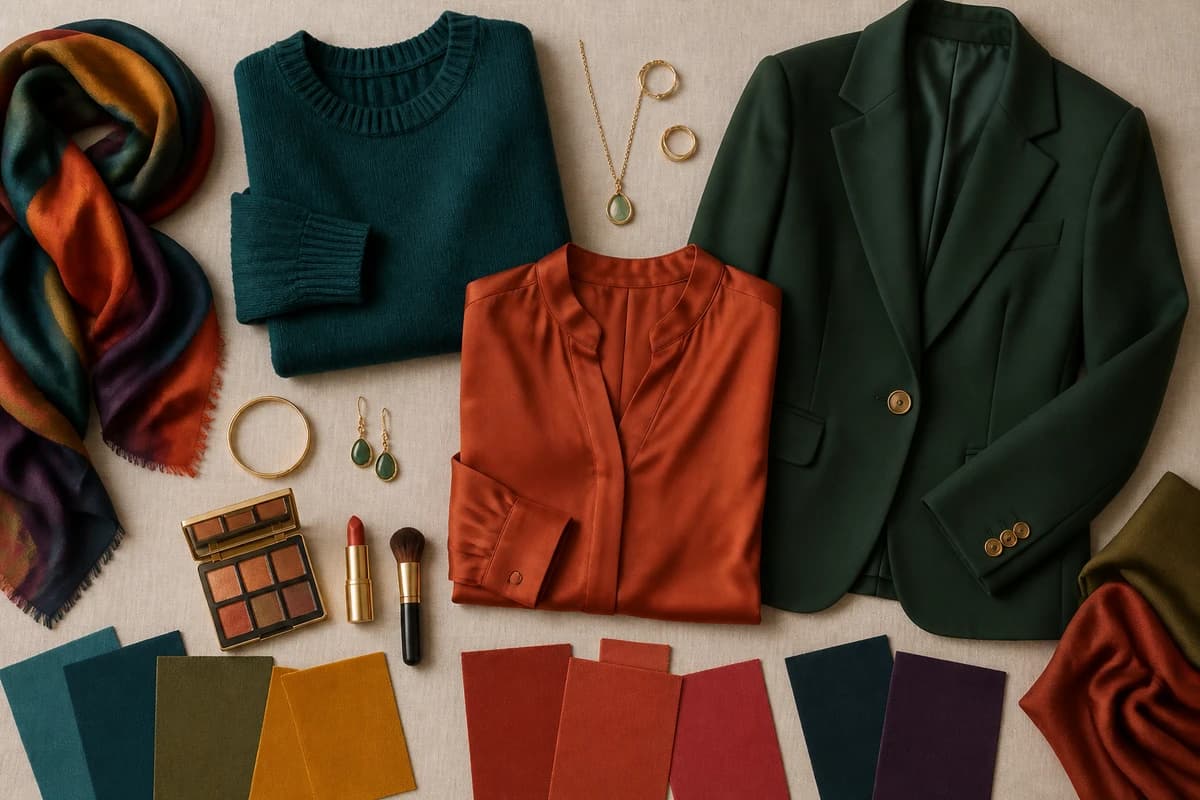
Dark auburn is a coloring to dress with confidence, not caution. It's deep and warm, so it can carry proper depth, forest green, deep teal, warm cranberry, espresso brown, where lighter reds would be overwhelmed. Lean into the greens and teals that complement it and the earthy rusts, terracottas and mustards that match its warmth, choose warm neutrals like cream, camel and espresso over stark black-and-white, and the hair does exactly what it's meant to: glow like polished wood. Pick three or four colors above plus a couple of those neutrals and you've a wardrobe that flatters on autopilot. The fastest way to find your exact best shades, the right teal, the right rust, the version that's genuinely yours, is a personal color analysis.
Frequently asked questions
Who does dark auburn hair suit?
Dark auburn hair suits warm-toned skin most readily, golden, peachy or olive complexions, often with freckles, and frequently with warm hazel, green or brown eyes. Because it's a deep, rich red-brown rather than a light copper, it also carries beautifully on medium and deeper skin where lighter reds can look washed out, and it gives cooler, neutral skin a manageable way to wear red. The constant is warmth and depth: dark auburn rewards people whose coloring has some richness to it, which is why it sits so comfortably on the Autumn seasons and on deeper warm coloring generally.
What colors look good with dark auburn hair?
The most flattering colors for dark auburn hair are deep, warm-leaning shades plus the greens and teals that sit opposite red on the color wheel, teal, forest green, rust, mustard, terracotta, deep coral, olive, petrol blue, aubergine and warm cranberry. Greens and teals are the standout because they're red's complement, so they make the hair look richer; the earthy oranges and golds harmonize with its warmth. The single best version depends on your skin's undertone, but those ten flatter the broadest range of dark auburn coloring.
What skin tone is best for dark auburn hair?
Warm and warm-neutral skin tones flatter dark auburn hair best, from fair-but-warm and freckled through to golden-olive and deeper warm complexions. Its depth means it holds up on medium and dark skin far better than a bright copper does, and it gives genuinely cool, pink-based skin a softer, more wearable red than a vivid ginger. If your skin has a clear blue-pink undertone, a slightly cooler, plummier auburn tends to sit more easily than a golden one, which is exactly the kind of nuance a color analysis pins down.
What are the shade variations of dark auburn hair?
Dark auburn runs from a deep coppery red-brown through warmer mahogany and into cooler, plummier burgundy-auburn. Warmer versions read more copper and gold and suit golden, peachy skin; cooler versions read more burgundy and wine and tend to flatter neutral or slightly cool skin. There are also mahogany-leaning takes that balance brown and red almost evenly. The right one for you comes down to depth and undertone, how dark your coloring is overall, and whether your skin leans warm or cool.
Is dark auburn hair high maintenance?
Red pigment fades faster than any other shade, so dark auburn does need upkeep to stay rich rather than drifting to a flat brown, expect a gloss or toner every four to six weeks and a color refresh roughly every six to eight. Sulphate-free, color-safe washing, cooler water and heat protection all slow the fade. The deeper, more brown-balanced versions of dark auburn hold their color longer than bright copper does, so a darker, mahogany-leaning auburn is usually the lower-maintenance choice.
Related guides
Auburn Hair Color: Who It Suits & the Best Colors to Wear With It
A color analyst's guide to auburn hair, who it suits, the flattering shade range, and the 10 best outfit colors plus 5 neutrals to wear with it
Mushroom Brown Hair Color: Who It Suits & the Best Colors to Wear With It
A color analyst on mushroom brown hair, who it suits, the flattering shade range, and the 10 best wardrobe colors to wear with it (with hex codes).
Platinum Blonde Hair Color: Who It Suits & the Best Colors to Wear With It
A color analyst on platinum blonde hair, who it suits, the flattering shade range, and the 10 best wardrobe colors (with hex codes) to wear with it.
Chestnut Brown Hair Color: Who It Suits & the Best Colors to Wear With It
A color analyst on chestnut brown hair, who it suits, the flattering shade range, and 10 best outfit colors plus 5 neutrals to wear with it, with hex codes.
Caramel Hair Color: Who It Suits & the Best Colors to Wear With It
A stylist's guide to caramel hair: who it suits, the flattering shade range, and the 10 best wardrobe colors to wear with it (plus 5 neutrals, hex codes).
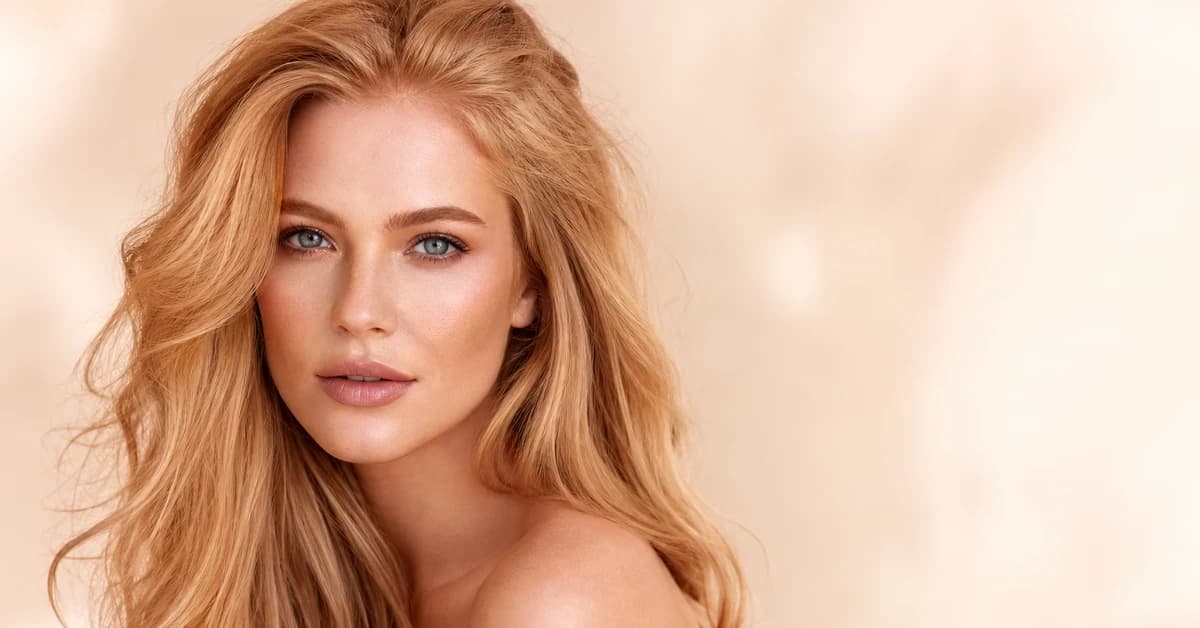
Strawberry Blonde Hair Color: Who It Suits & the Best Colors to Wear With It
A color analyst on strawberry blonde hair, who it suits, the flattering shade range, and the 10 best wardrobe colors (with hex) plus 5 neutrals to wear
Prefer in person? Find color analysis near you
Browse local color analysts by city, or get the same season, palette and best-colors breakdown online from one selfie.
See your colors on a photo of you
Upload one selfie and ToneLala reveals your season, your full palette, and your best hair, makeup, jewelry and outfits, styled on you.