In a sentence: Deep Autumn celebrities tend to share one look, dark, warm hair, deep eyes and golden skin that lights up in rust, mahogany and dark gold, but every celebrity season is an educated guess, so use them as inspiration, not a verdict. See the palette or find your season.
Deep Autumn Celebrities
By ToneLalaUpdated July 11, 2026
Contents
Pull up a red-carpet photo of a Deep Autumn in a deep rust gown and you can almost feel the warmth coming off the screen, the skin glows, the eyes deepen, the whole frame settles. Put that same person in icy silver-blue under a different light and something goes flat; the face turns slightly gray and the dress wears them instead of the other way round. That swing, more than any single feature, is what color analysts are watching when they try to type a famous face.
Here's the honest framing before any names get mentioned: nobody analyzing a celebrity from photographs is doing a real color analysis. The lighting is unknown, the hair is almost certainly dyed, the makeup is built for cameras, and two skilled analysts will happily land on two different seasons for the same person. So this guide isn't a list to copy, it's a way of seeing. I'll walk through what makes a face read as Deep Autumn, why the lists contradict each other, and how to borrow the lesson without borrowing the verdict.
What "Deep Autumn" means in the first place
Deep Autumn, also called Dark Autumn, is one of the twelve seasons in personal color analysis, and it sits on three dials:
- Undertone, warm-leaning-neutral. Golden at its core, with enough neutral depth to carry very dark color without tipping cool.
- Value, deep. One of the darkest palettes there is; the colors sit low and rich, closer to dusk than daylight.
- Chroma, rich and saturated. Full-bodied and earthy, never dusty, never neon.
Add it up and you get deep, warm, vivid coloring that's flattered by deep, warm, vivid color. If True Autumn is late-October light, Deep Autumn is the hour just after sunset. The full breakdown, every hex code, the neutrals, the colors to avoid, lives in the Deep Autumn color palette guide; here I'm using it as a lens for reading faces.
What Deep Autumn celebrities tend to have in common
When a face keeps getting filed under Deep Autumn, it's usually carrying the same few markers:
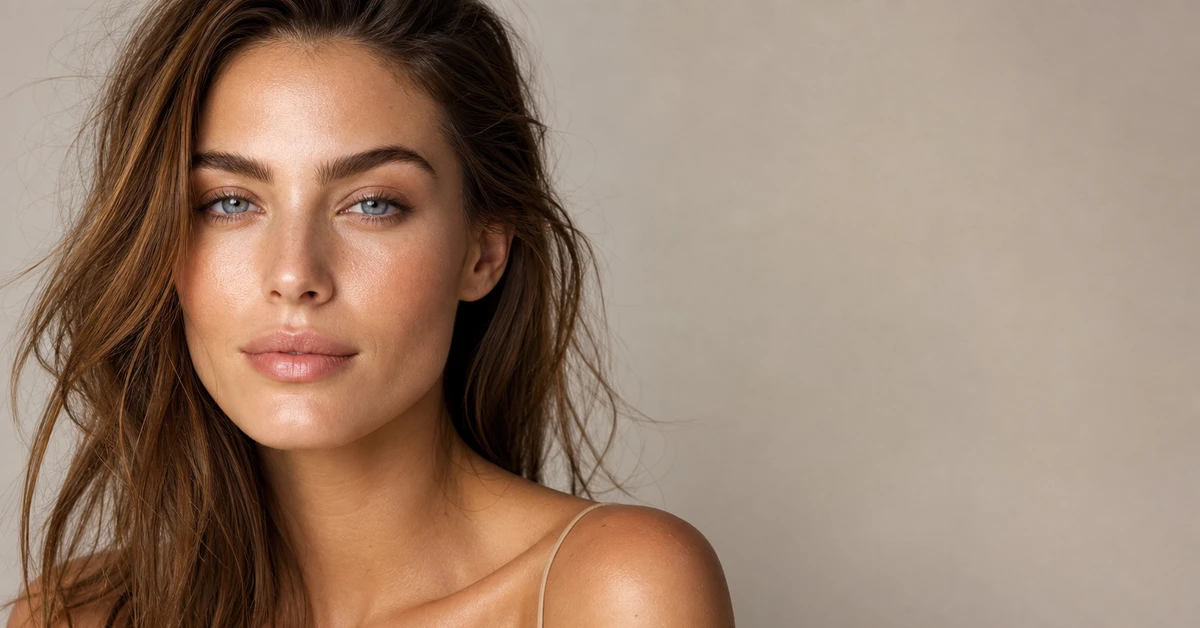
- Dark, warm hair. Rich espresso, deep chestnut, warm dark brown, mahogany or deep auburn, dark, but with a warm rather than ashy or blue-black cast.
- Deep eyes. Dark brown, black-brown or a deep warm hazel; eyes that hold attention rather than fade.
- Golden or olive-golden skin with real depth. It can be fair-golden or genuinely deep, but the undertone reads warm, and the face comes alive against rich earth-jewel tones.
- A look that can take drama, warmly. These are people who wear deep, saturated color and look intentional in it, not overwhelmed. The drama is warm, not icy.
You'll notice this describes a fair range of people, not one narrow type. Deep Autumn turns up across every skin depth and plenty of ethnicities, what unites the faces is warmth plus depth plus the ability to carry contrast, not a single complexion.
The palette
Deep, warm, saturated, every color reads like a jewel that's been left to age. These are the shades a Deep Autumn celebrity tends to look most "switched on" in.
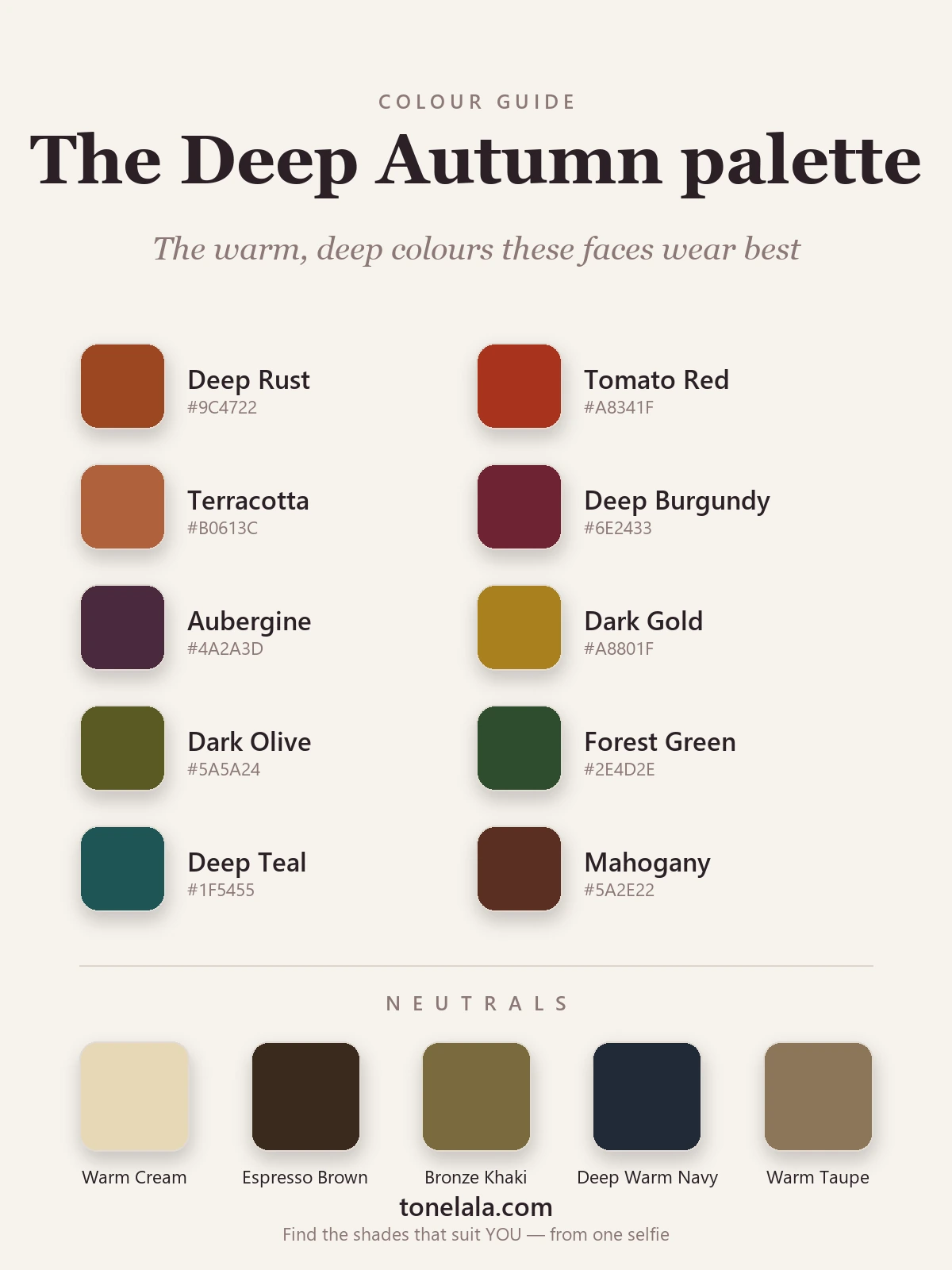
The signature colors
| Color | Hex |
|---|---|
| Deep Rust | #9C4722 |
| Tomato Red | #A8341F |
| Terracotta | #B0613C |
| Deep Burgundy | #6E2433 |
| Aubergine | #4A2A3D |
| Dark Gold | #A8801F |
| Dark Olive | #5A5A24 |
| Forest Green | #2E4D2E |
| Deep Teal | #1F5455 |
| Mahogany | #5A2E22 |
The neutrals: warm and deep, never stark: Warm Cream #E7D7B6, Espresso Brown #3A2A1E (the best "dark," and far kinder than black), Bronze Khaki #7A6A3C, Deep Warm Navy #222A38 and Warm Taupe #8C7558.
The metals: antique gold, copper and bronze sit most naturally against this coloring. That said, the deeper Deep Autumns can carry a warm-toned silver too, which is why both gold and silver appear in the palette, gold simply leads.
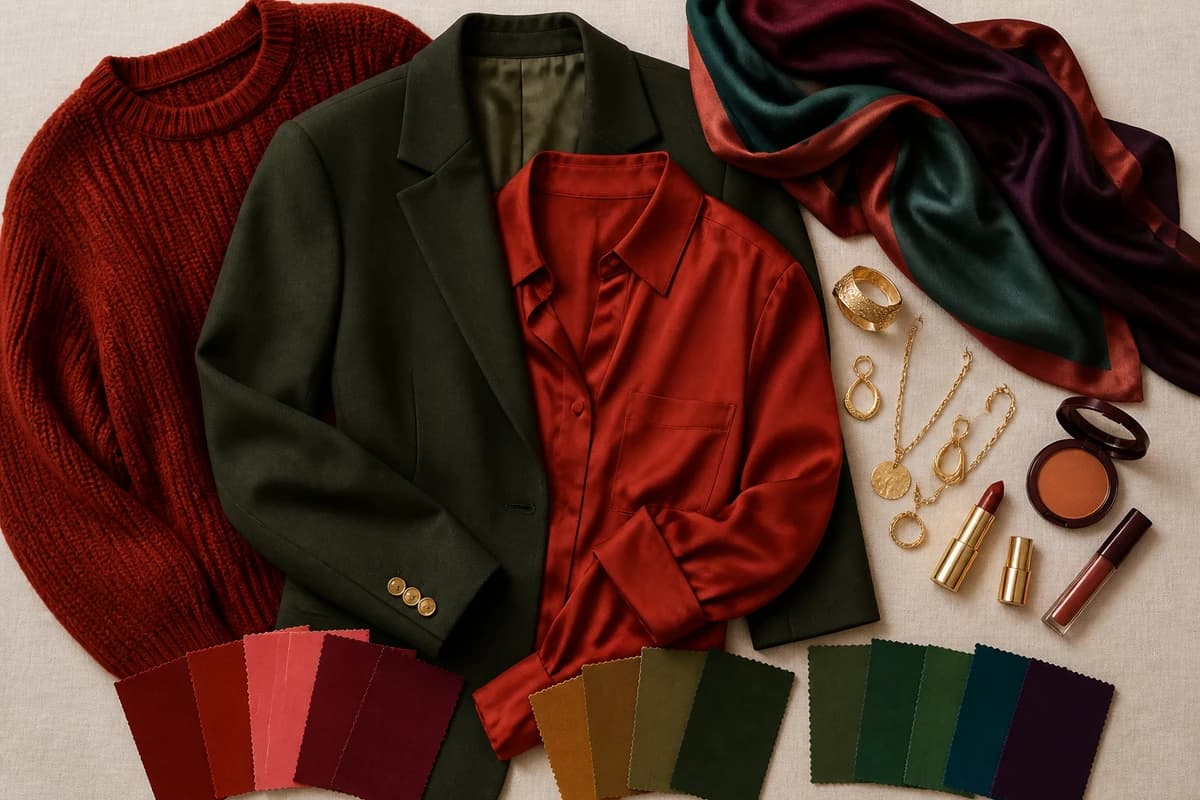
Watch a well-styled Deep Autumn and you'll see this palette in action: a deep rust knit, a mahogany leather jacket, an emerald-leaning forest green that reads warm. The color does the work, and the face glows rather than competes.
Wondering if you share this coloring?
Find your color season →Why the celebrity lists never agree
Search "Deep Autumn celebrities" and you'll find the same faces filed under different seasons from one site to the next. There are real reasons for that, and they all come back to evidence:
- Lighting changes everything. Warm tungsten makes almost anyone read warmer; cool daylight or a blue-lit stage drags the same face toward Winter. A single photo can't tell you which is the "true" reading.
- Hair is usually dyed. A Deep Autumn who's gone cool-ashy or blue-black for a role can easily pass for a Deep Winter on camera, because the cool hair fights their natural warmth.
- Makeup is built for cameras, not undertone. Heavy, cool-toned camera makeup can flip how warm someone looks in seconds.
- Analysts genuinely disagree. With unreliable evidence, two skilled people will draw two reasonable but different conclusions. That isn't sloppiness; it's the limit of typing from photos.
So when one site swears a star is Deep Autumn and another calls her Deep Winter or True Autumn, both can be defensible, they're reading different frames. The split that matters most is Deep Autumn versus its cool twin, Deep Winter: same drama and depth, opposite undertone. If you find that pair confusing on yourself, the Deep Autumn vs Deep Winter guide walks through exactly how to tell them apart.
How to actually use a Deep Autumn celebrity
Treat famous examples as a styling shortcut, not a diagnosis. Two ways to get value from them:
Study the styling, not the person. When a celebrity you suspect is a Deep Autumn looks especially good, look at why: the depth of the color, the warmth in it, the way they let espresso brown or aubergine play the "dark" role instead of black. Those are repeatable choices, whatever your own season turns out to be.
Use them to test your own eye. Find two photos of the same star, one in warm rust or mahogany, one in icy blue or stark black-and-white. Notice which one makes the face glow and which casts a gray shadow. Doing that a few times trains you to spot warmth and depth, which is the same skill you'll use on your own reflection.
What you should not do is decide your season because you think you look like someone famous. Resemblance is a feeling; a season is a measurement of undertone, value and contrast. The two often don't line up.
So how do you actually find your own season?
Here's the honest truth after years of doing this: undertone, value and contrast are hard to judge on yourself, and almost impossible to judge from a celebrity comparison. Bathroom lighting lies, phone screens shift color, dyed hair confuses the read, and we all carry a story in our heads about who we resemble. That's the same problem that makes celebrity lists disagree, only now it's your own face.
What settles it is a careful read of your real coloring: how warm your skin is, how dark a color you can carry, and how much contrast lives between your hair, skin and eyes. A photo-based analysis measures those three things together and places you in one season rather than leaving you guessing against a red-carpet photo. If this Deep Autumn picture sounds like you, that's a reason to confirm it properly, not to assume it. Browse the rest of the color analysis guides to see how the seasons fit together, read the full Deep Autumn color palette for your exact colors, then find your season from a couple of photos and a short quiz.
Frequently asked questions
Which celebrities are Deep Autumns? Celebrity seasons are always estimates, but the faces most often filed under Deep Autumn share the same signature: dark warm hair, deep eyes, and skin with a golden depth that glows in rust, mahogany and dark gold. Names that come up again and again include figures with rich dark-brown or black hair and warm, deep coloring. Treat every list as inspiration rather than proof, only a read of your own face confirms a season.
What does a Deep Autumn celebrity look like? Deep, warm and high in contrast. Think dark chocolate or near-black hair with a warm rather than ashy cast, deep brown or hazel eyes, and skin from fair-golden to deep with a golden or olive-golden undertone. The overall impression is rich and dramatic, but warm, closer to a glass of port than to icy blue-black Winter coloring.
Are Deep Autumn and Dark Autumn the same thing? Yes. Deep Autumn and Dark Autumn are two names for the same season, warm at the core, but pulled darker and higher in contrast than True Autumn. Some systems prefer "Deep Autumn" and some "Dark Autumn", so when you read about a celebrity being one or the other, they mean the same palette.
Can I find my season by matching myself to a Deep Autumn celebrity? Not reliably. Matching to a star is a fun starting point, but celebrity typing is guessed from photos shot under unknown lighting, with makeup and dyed hair, so the same person gets filed under different seasons across sites. Your season comes from your own undertone, value and contrast, not from resembling someone famous.
Why do Deep Autumn celebrity lists never agree? Because the evidence is unreliable. A Deep Autumn photographed in cool light with ashy hair color can read as Deep Winter in a single frame, and stage makeup or a dye job shifts the read further. Without a controlled, makeup-free look in daylight, even analysts disagree, which is exactly why a proper analysis beats any celebrity list.
Frequently asked questions
Which celebrities are Deep Autumns?
Celebrity seasons are always estimates, but the faces most often filed under Deep Autumn share the same signature: dark warm hair, deep eyes, and skin with a golden depth that glows in rust, mahogany and dark gold. Names that come up again and again include figures with rich dark-brown or black hair and warm, deep coloring. Treat every list as inspiration rather than proof, only a read of your own face confirms a season.
What does a Deep Autumn celebrity look like?
Deep, warm and high in contrast. Think dark chocolate or near-black hair with a warm rather than ashy cast, deep brown or hazel eyes, and skin from fair-golden to deep with a golden or olive-golden undertone. The overall impression is rich and dramatic, but warm, closer to a glass of port than to icy blue-black Winter coloring.
Are Deep Autumn and Dark Autumn the same thing?
Yes. Deep Autumn and Dark Autumn are two names for the same season, warm at the core, but pulled darker and higher in contrast than True Autumn. Some systems prefer 'Deep Autumn' and some 'Dark Autumn', so when you read about a celebrity being one or the other, they mean the same palette.
Can I find my season by matching myself to a Deep Autumn celebrity?
Not reliably. Matching to a star is a fun starting point, but celebrity typing is guessed from photos shot under unknown lighting, with makeup and dyed hair, so the same person gets filed under different seasons across sites. Your season comes from your own undertone, value and contrast, not from resembling someone famous.
Why do Deep Autumn celebrity lists never agree?
Because the evidence is unreliable. A Deep Autumn photographed in cool light with ashy hair color can read as Deep Winter in a single frame, and stage makeup or a dye job shifts the read further. Without a controlled, makeup-free look in daylight, even analysts disagree, which is exactly why a proper analysis beats any celebrity list.
Related guides
Soft Autumn Celebrities
A color analyst on so-called Soft Autumn celebrities, why the lists disagree, the traits to look for, the palette, and how to find your own season.
True Autumn Celebrities
A color analyst's hedged take on likely True Autumn celebrities, the warm, rich, muted traits that signal this season, plus how to find your own.
Soft Summer Celebrities
Soft Summer celebrities, from Jennifer Aniston to Dakota Johnson, see who's commonly typed Soft Summer, the shared traits, and the muted palette they share.
Light Spring Celebrities
A color analyst on Light Spring celebrities, who's often typed Light Spring, why the lists disagree, the palette they share, and how to find your own season.
Deep Winter Celebrities
A color analyst on Deep Winter celebrities, who likely fits the cool, deep, high-contrast season, why the lists disagree
Bright Winter Celebrities
A color analyst's hedged take on likely Bright Winter celebrities, the cool, clear, high-contrast traits that signal this season, plus how to find your own.
Prefer in person? Find color analysis near you
Browse local color analysts by city, or get the same season, palette and best-colors breakdown online from one selfie.
See your colors on a photo of you
Upload one selfie and ToneLala reveals your season, your full palette, and your best hair, makeup, jewelry and outfits, styled on you.