In a sentence: build a capsule wardrobe by choosing your colors before your clothes, two or three base neutrals and three to five accents pulled from your own coloring, so every piece mixes with every other. Skip to the capsule palette or find your season.
How to Build a Capsule Wardrobe
By ToneLalaUpdated July 7, 2026

Contents
Most failed capsule wardrobes I see fail in the same place: the color. Someone buys thirty beautifully chosen, well-made pieces, and a third of them never get worn, because the rust jumper doesn't sit with the cool gray trousers, and the optic-white shirt makes the cream blazer look grubby. The clothes were never the problem. The colors simply weren't speaking to each other. A capsule isn't a small wardrobe so much as a cohesive one, and cohesion is almost entirely a color decision you make before anything goes in the basket.
So that's where I always start clients: not with a shopping list, but with a palette. Get the colors right and a capsule almost builds itself, fifteen pieces start producing forty outfits, getting dressed takes ninety seconds, and the things you own actually look like they belong to the same person. Get the colors wrong and no amount of editing will save it. Here's how I build one from the palette up.
Start with your colors, not your clothes
A capsule works because everything mixes, and things only mix when they share an undertone and a depth. That's the whole secret. If half your wardrobe is warm and golden and the other half is cool and blue-based, the two halves quietly refuse to combine, and you end up wearing the same three "safe" outfits on rotation.
So before you buy a single piece, decide on a temperature and commit to it. Are you building a warm capsule, camels, olives, rusts, creams, or a cool one, navies, grays, soft blues, true whites? This isn't about preference; it's about what flatters you. The right lane is the one that matches your own coloring, which is exactly what a color season tells you. Once the temperature is set, you choose three layers of color: your base neutrals, your supporting neutrals, and your accents. Build them in that order and the wardrobe holds together by design.
Pick two or three base neutrals
Your base neutrals are the colors you'll wear most, the trousers, the coat, the trousers-again, the everyday knit. Choose two or three and let them do roughly 60 to 70 percent of the work. A reliable structure is one light, one mid and one dark:
- A soft off-white: ivory or stone rather than stark optic white, which is harsh on most coloring and clashes with warmer pieces.
- A mid-tone neutral: camel and warm taupe for a warm capsule; mid gray for a cool one. This is the color that quietly makes an outfit look expensive.
- A dark anchor: navy or charcoal instead of black for most people. Both are softer near the face and mix more graciously than true black, which can read heavy beside muted colors.
Buy these three in the best quality you can manage, because they carry everything. A camel coat and navy trousers you'll wear two hundred times are worth more than five trend pieces you'll wear twice.
Add one or two supporting neutrals
Supporting neutrals are the bridge between your base and your accents. Think warm taupe, stone, soft gray or a deeper brown, colors quiet enough to read as neutral but with enough warmth or depth to keep an all-neutral outfit from going flat. One or two is plenty. Their job is to let you build a complete, tonal outfit with no "color" at all and still look considered, the camel-stone-ivory combination that looks like money and takes no thought.
Choose three to five accent colors
Now the color. Accents are where personality comes in, and they're also where most capsules go wrong, people pick accents they love in isolation rather than accents that live happily beside their neutrals and each other. Pick three to five, all from the same undertone as your base, and you'll find every top works with every bottom.
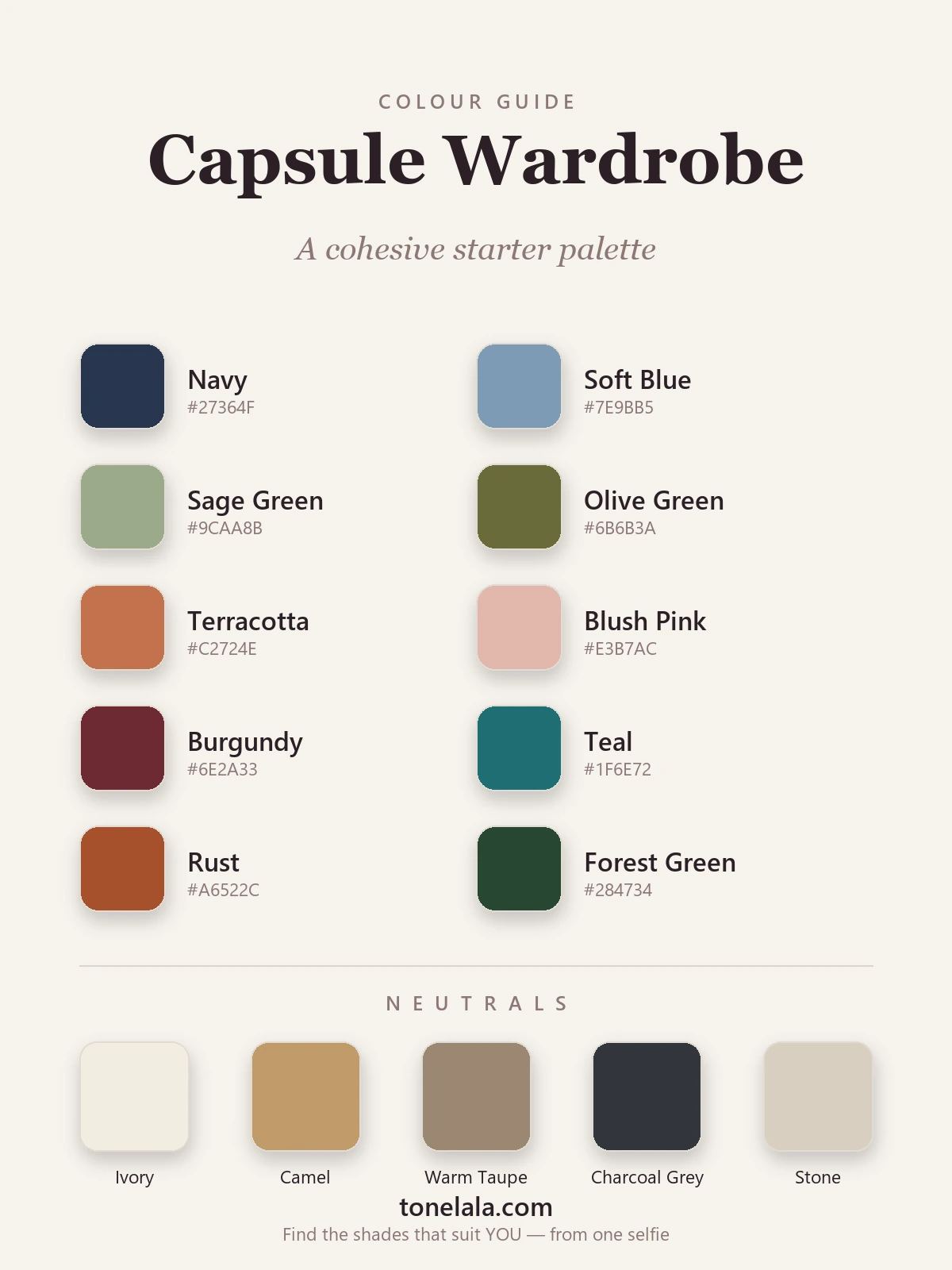
The palette below is a balanced, broadly wearable example, ten accent colors and five neutrals that hold together because they share a muted, mid-depth character. Treat it as a model for the structure, then swap in the exact shades that suit your coloring.
| Color | Hex | Where it earns its place |
|---|---|---|
| Navy | #27364F |
A near-neutral accent. Deep and cool, it anchors lighter pieces and works as a dark base in its own right. |
| Soft Blue | #7E9BB5 |
The easy everyday color, a faded, dusty blue that flatters most people and mixes with every neutral here. |
| Sage Green | #9CAA8B |
Muted and calm, sage reads almost as a neutral and bridges warm and cool pieces beautifully. |
| Olive Green | #6B6B3A |
A warm, grown-up green that sits tonally beside camel and stone, the backbone of a warm capsule. |
| Terracotta | #C2724E |
Soft, earthy warmth. Tonal with camel and ivory, so it deepens a neutral outfit without shouting. |
| Blush Pink | #E3B7AC |
A dusty, warm-leaning pink that softens navy and charcoal and flatters skin like a second neutral. |
| Burgundy | #6E2A33 |
The dressy depth in the palette. Wine-rich and versatile, it lifts any neutral straight into evening. |
| Teal | #1F6E72 |
A cool jewel note for when you want one decisive color. Calm enough to mix, rich enough to stand out. |
| Rust | #A6522C |
Burnt and autumnal, rust makes a tonal outfit look sunlit and is a natural partner to olive and camel. |
| Forest Green | #284734 |
A deep, near-neutral green that behaves like navy's warmer cousin, an alternative dark anchor. |
Neutrals that hold it together: Ivory #F3EDE1 (a soft off-white kinder than stark white), Camel #C19A6B (the mid-tone that makes everything look expensive), Warm Taupe #9A8772 (a tonal bridge between neutral and color), Charcoal Gray #33363B (a dark anchor gentler than black), and Stone #D8CFBF (a pale, sandy neutral for daytime).
Not sure which neutrals suit YOUR coloring?
Find your color season →How many pieces, and which ones
Forget the magic numbers you see online. A capsule of 30 to 40 pieces per season covers most people, but the count matters far less than the ratio: keep it around 70 percent neutrals to 30 percent accents and even a small wardrobe behaves. Stay tonal and twenty-five pieces will throw out dozens of outfits; over-color it and fifty pieces will still feel thin.
Buy by category rather than by impulse. A solid framework:
- Outerwear: one great coat and one blazer or smart jacket, both in base neutrals.
- Knitwear: two or three jumpers, mostly neutral with one or two in accent colors.
- Tops: three or four well-cut shirts and tees; this is where most of your color lives.
- Bottoms: two pairs of trousers, plus a skirt or jeans, all in base neutrals.
- Dresses: one or two, in a neutral or your most wearable accent.
- Shoes and bags: a tight edit in your base neutrals so they go with everything.
The rule that keeps it honest: before any new piece earns a place, it has to work with at least three things you already own. If it doesn't, it's not a capsule piece, it's a one-off, and one-offs are how a capsule quietly turns back into a wardrobe.
Build it for your coloring
This is the part a generic palette can't do for you. The capsule above is balanced, but your best version of it is specific. A warm, deep coloring (a True or Deep Autumn) will want golden camels, olive, rust and terracotta, with burgundy for depth, and stark white swapped for ivory throughout. A cool, light coloring (a Soft Summer, say) is far better in soft grays, navy, dusty blue and muted blush, keeping the warm rusts to a minimum.
Get the temperature and depth right for your face and the whole capsule lifts you; get it wrong and even perfect pieces leave you looking tired. Our color analysis guides walk through each season's palette, and a personal analysis reads your photo to hand you the exact neutrals and accents, your camel, your navy, your blush, so you can build a capsule where nothing clashes and everything flatters.
Putting it together
A capsule wardrobe is really just a color palette with sleeves. Decide your temperature, lock in two or three base neutrals, add a supporting neutral or two, then choose three to five accents from the same family, and only then start buying, by category, quality first on the neutrals that carry everything. Do it in that order and you stop owning clothes that fight each other and start owning a wardrobe that mixes itself. The smaller it gets, the easier dressing becomes, which was always the point.
Frequently asked questions
How do I build a capsule wardrobe step by step?
Start with color, not clothes. Choose two or three base neutrals that suit your coloring (say ivory, camel and navy), add one or two supporting neutrals, then pick three to five accent colors from the same family so everything mixes. Only then buy pieces, and buy by category: outerwear, tops, bottoms, one or two dresses, shoes and bags. Build the neutrals first, add the accents last, and try every new item against three things you already own before it earns a place.
How many pieces are in a capsule wardrobe?
Most workable capsules sit between 30 and 40 pieces per season, including shoes but excluding underwear, gymwear and special-occasion outfits. The exact number matters far less than the ratio: roughly 70 percent neutrals to 30 percent accent colors. Stay tonal and a smaller capsule of 25 pieces will still produce dozens of outfits; go too colorful and even 50 pieces will feel like you have nothing to wear.
What colors should a capsule wardrobe be?
Built around two or three base neutrals (an off-white, a mid-tone like camel or gray, and a dark anchor like navy or charcoal), plus three to five accent colors that all share the same undertone and depth as your coloring. Warm coloring leans into camel, olive, rust and terracotta; cool coloring into navy, charcoal, soft blue and burgundy. The single rule is undertone consistency, keep everything warm or everything cool and the whole wardrobe mixes.
How do I choose a color palette for my capsule wardrobe?
Anchor it to your own coloring rather than a trend. Work out whether your skin, hair and eyes are warm, cool or neutral, and whether you suit soft muted shades or clear bright ones, then pull your neutrals and accents from that lane. A seasonal color analysis does this precisely, it hands you a ready-made palette of the exact shades that flatter you, which is the fastest way to a capsule where nothing clashes.
What are the essential pieces in a capsule wardrobe?
A good coat, a blazer or smart jacket, two or three knits, a few well-cut tops, two pairs of trousers, a skirt or jeans, one or two dresses, and a small edit of shoes and bags, all in your base neutrals. Accent colors live mostly in the tops, knitwear and a statement piece or two. Buy the neutral workhorses in the best quality you can, because they carry the wardrobe; spend less on the trend-led accents.
Related guides

Deep Autumn Outfits: Capsule Wardrobe & Outfit Ideas
A stylist's Deep Autumn outfit guide, capsule building blocks, 10 wardrobe colors and 5 neutrals with hex codes, and casual, work and evening outfit formulas.

Bright Spring Outfits: Capsule Wardrobe & Outfit Ideas
A stylist's Bright Spring wardrobe guide, capsule building blocks, casual, work and evening outfit formulas

True Spring Outfits: Capsule Wardrobe & Outfit Ideas
A stylist's True Spring outfit guide, capsule building blocks, casual, work and evening outfit formulas, and your 10 best wardrobe colors plus 5 neutrals.

Bright Winter Outfits: Capsule Wardrobe & Outfit Ideas
A stylist's Bright Winter outfit guide, build a capsule wardrobe, the best colors and neutrals with hex codes, plus casual, work and evening looks.

True Summer Outfits: Capsule Wardrobe & Outfit Ideas
A stylist's True Summer outfit guide: capsule pieces, casual, work and evening formulas, plus the 10 best wardrobe colors and 5 neutrals with hex.

Soft Autumn Outfits: Capsule Wardrobe & Outfit Ideas
Soft Autumn outfits and capsule wardrobe, the building-block pieces, your 10 best colors and 5 neutrals (hex), and casual, work and evening outfit formulas.
Prefer in person? Find color analysis near you
Browse local color analysts by city, or get the same season, palette and best-colors breakdown online from one selfie.
See your colors on a photo of you
Upload one selfie and ToneLala reveals your season, your full palette, and your best hair, makeup, jewelry and outfits, styled on you.