In a sentence: going gray shifts your coloring cooler and changes its contrast, so the colors that flatter become clearer and slightly cooler, sapphire, teal, emerald, magenta and ruby, with charcoal, soft white and navy as neutrals. Skip to the full palette or find your season.
Color Analysis for Gray Hair
By ToneLalaUpdated July 7, 2026
Contents
A client came in last spring holding a photo of herself from fifteen years earlier, asking why the warm camel coat she'd loved in it now made her look ill. Nothing about her wardrobe had changed, but her hair had gone from a deep warm brown to a soft pewter silver, and the whole equation underneath had quietly rewritten itself. The coat hadn't turned on her. Her coloring had moved, and the coat stayed where it was.
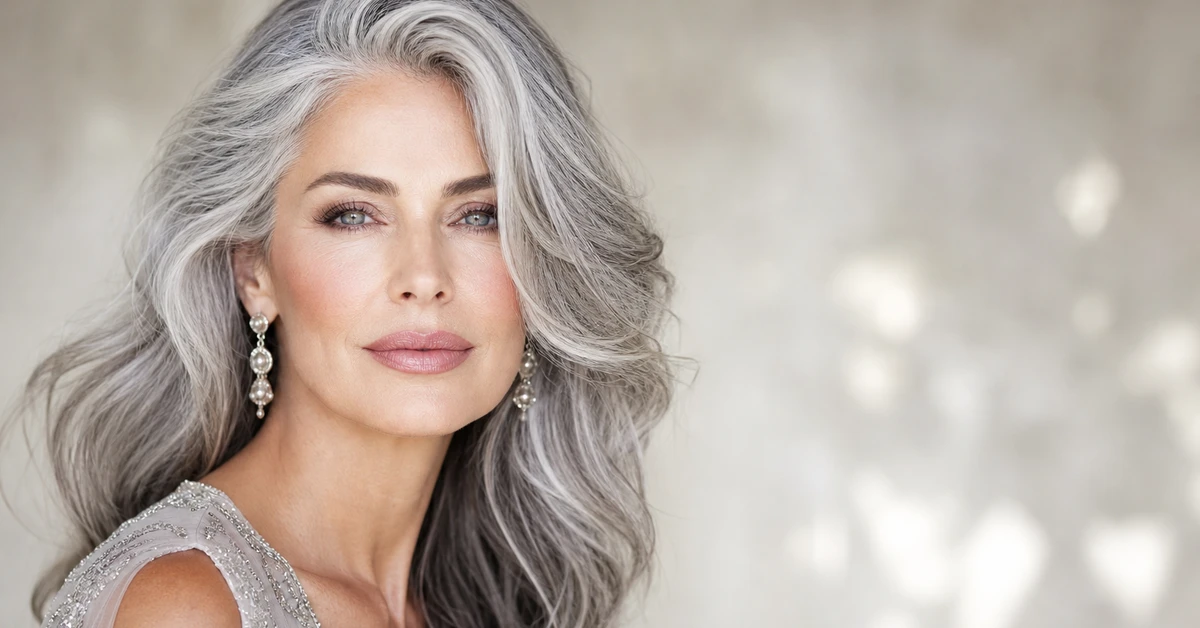
That's the part almost nobody warns you about when you go gray. It isn't only your hair that changes color, it's the balance of your entire face. The warm pigment that used to anchor your coloring lifts out, your contrast level often shifts, and colors that flattered you for decades can suddenly fall flat while shades you'd never have reached for start to sing. Color analysis for gray hair is really about catching up with that shift, so let's look at exactly what moves and what to wear once it has.
What going gray actually changes
Three things shift when hair turns gray, and they're worth separating out because they pull in slightly different directions.
The first is warmth. Pigmented hair, brown, black, auburn, golden, carries warm tones that quietly warmed your whole coloring. Strip that out and what's left is cool: somewhere between soft pewter and bright silver, with no gold in it at all. That single change is why warm earth tones (camel, mustard, olive, rust) so often start to read sallow against gray, and why clear, slightly cool colors begin to look crisp and deliberate instead.
The second is contrast: and this one surprises people. If you had dark hair and fair skin, you used to be high-contrast, and you could wear bold, sharp color pairings with ease. As that hair lightens to silver, the gap between your hair and skin narrows, and your coloring often becomes softer and lighter overall. Suddenly the inky, heavy colors that once balanced your dark hair can overwhelm you, while clearer, slightly lighter versions sit better. (If you've never thought about your contrast level before, my guide to value and contrast in color analysis walks through how to read your own.)
The third is how your features now read. With the distraction of warm hair gone, your eyes and skin undertone become the loudest part of your coloring, which means undertone matters more than ever for deciding your best shades, not less.
Does gray hair make you cooler, warmer, or neither?
Almost always cooler, but with an important caveat. The hair itself goes cool, so your coloring as a whole gets pulled toward the cool half of the palette, this is why so many people drift from a warm season into a cool one as they gray. But your skin's undertone doesn't change when your hair does. If your skin was genuinely warm and golden at thirty, it's still warm at sixty, even framed by silver hair.
So you can end up with a slightly split picture: cool hair, warmer skin. That's completely normal, and it's exactly why gray hair alone can't tell you your season. What it means in practice is that most gray-haired people want clear, cool-leaning colors, but those with warm skin should reach for the warmer, clearer end, teal over icy blue, tomato-red over blue-red, warm emerald over a cold pine, rather than going fully cool. Cool-skinned people can lean all the way into blue-based sapphire, magenta and amethyst.
The most flattering colors for gray hair
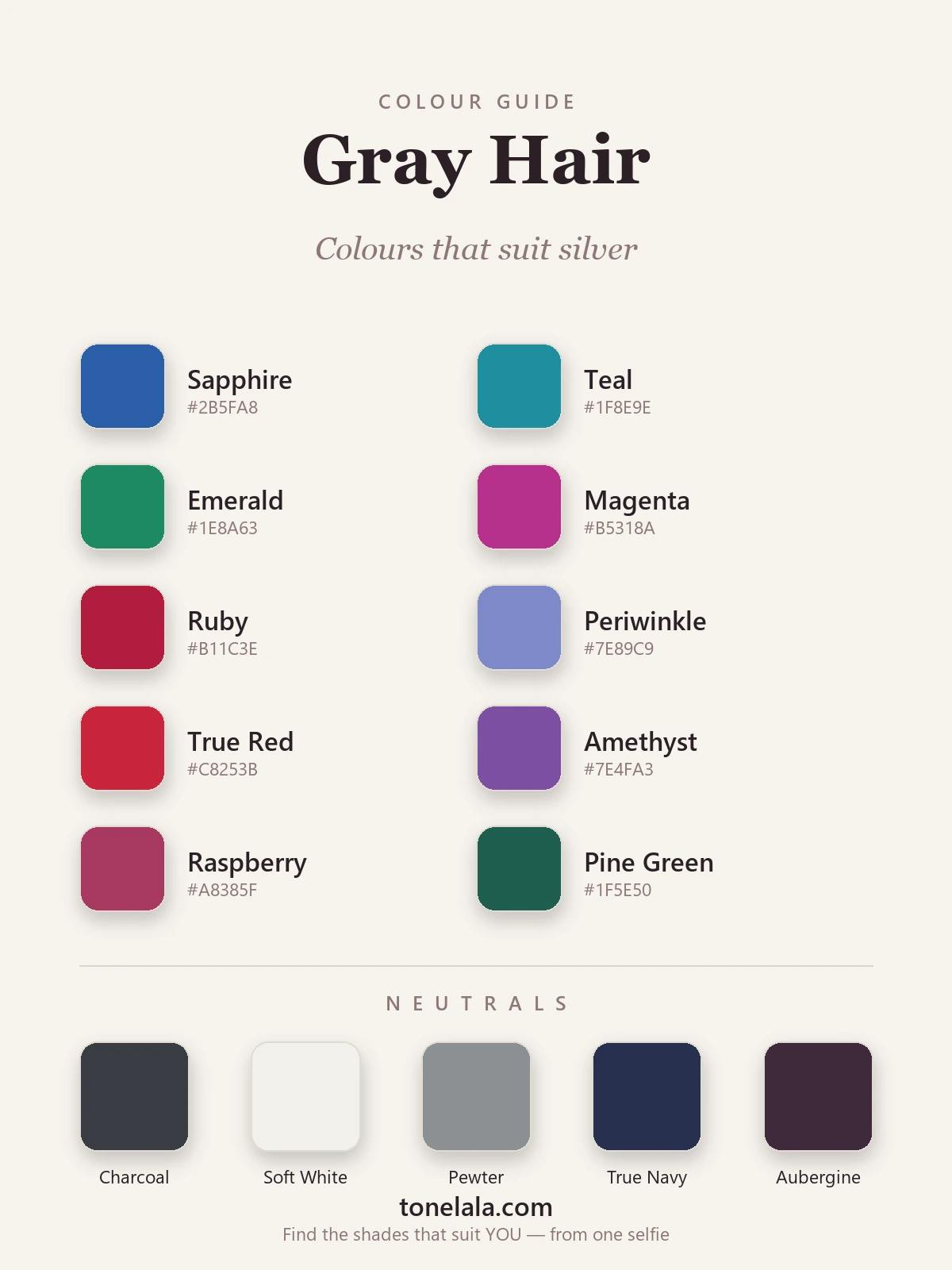
These ten suit the broadest range of silver and gray coloring, clear, saturated and slightly cool, with enough warm-leaning options that there's something here whatever your undertone. Wear them where they count: at the neckline, near the face, where they do the work your hair used to.
| Color | Hex |
|---|---|
Sapphire #2B5FA8 |
A rich, slightly cool blue that makes silver hair look intentional and expensive. My first reach for cool coloring, it brightens light eyes and steadies the whole face. |
Teal #1F8E9E |
A clear blue-green that's about as universally flattering as color gets on gray hair, fresh, modern and just warm enough to suit most undertones. |
Emerald #1E8A63 |
A clear, deep blue-green with real jewel-tone life. Vivid enough to read as proper color, clean enough never to muddy against silver. |
Magenta #B5318A |
A cool pink-purple with punch. Where a soft pink fades into the hair, this gives gray the contrast it craves and lifts the face instantly. |
Ruby #B11C3E |
A deep, slightly blue red that's grown-up and glamorous against silver. The shade that makes people say you look well, not just nicely dressed. |
Periwinkle #7E89C9 |
A soft cool blue-violet, the lighter, gentler note. Lovely on softer, lower-contrast gray coloring and beautiful with cool eyes. |
True Red #C8253B |
A clear, balanced red that flatters a wide range of undertones and looks fantastic on gray. The classic statement, and silver hair earns it. |
Amethyst #7E4FA3 |
A clear cool purple, regal without being heavy, and especially flattering on cooler skin. A more saturated step up from periwinkle. |
Raspberry #A8385F |
A cool, blue-leaning pink-red with a little warmth in it. The bridge shade for skin that reads slightly warm under cool hair. |
Pine Green #1F5E50 |
A deep, cool green that works as a rich near-neutral. Sophisticated against silver and easy to build a whole outfit around. |
Best neutrals: Charcoal #3A3D42 instead of flat black; Soft White #F2F0EA in place of stark optic white; Pewter #8C9094 for a clear, modern mid-gray that flatters silver hair; True Navy #27314F as your reliable dark base; and Aubergine #3E2A3C when you want a rich dark neutral with a hint of color in it.
Want the exact shades that suit your silver?
Find your color season →Colors to ease away from the face
- Warm, muddy earth tones, camel, mustard, olive, rust, beige. These were probably friends when your hair was warm; against silver they tend to turn sallow and make gray read dull rather than chic. Keep them below the waist or lift them with a clear color up top.
- Anything too close to your hair. Dove gray, oatmeal and washed-out greige sit so near to silver that all the contrast collapses and the face fades. A clear pewter or a proper color does the opposite.
- Heavy, inky darks worn alone, especially if your contrast has softened. Stark head-to-toe black can overwhelm lighter gray coloring now. Charcoal, navy and aubergine give you depth without the drain.
Makeup and metals for gray hair
Makeup is where you put back the color the hair took away, so keep it clear and clean and let it lift the face. A true red or berry lip is genuinely transformative on gray hair, the single fastest way to look pulled-together and less washed out, while a cool rose or soft plum blush warms the skin without going muddy. On eyes, clean taupe, soft charcoal and plum read crisp; go gently with hard black liner and orange-warm bronzes, both of which fight the cool of silver. A soft charcoal or deep plum liner is kinder than jet black.
Metals deserve a fresh look the moment you go gray, because habit lies. Silver, white gold and platinum echo the cool crispness of silver hair and flatter cool undertones; gold still works beautifully if your skin runs genuinely warm, warming the face where the hair has cooled it. If you've worn the same metal for thirty years, test both against your face in daylight now, the answer sometimes flips. My guide to gold vs silver has three quick tests if you want them.
Gray hair and your color season
In the seasonal system, gray hair most often points toward a cool family. Crisper, higher-contrast coloring with clear bright eyes leans True Winter: the clear jewel tones and true brights above. Softer, lower-contrast coloring (which is where a lot of people land as they gray) leans True Summer or Soft Summer, the same colors gentled and slightly muted. If your skin is genuinely warm and golden, you might sit in a Soft or Deep Autumn instead, wearing the warmer, clearer end of this palette. Hair color narrows the field; it never closes the case.
Which is the whole point, and worth saying plainly: undertone decides your season, not the silver. Two women can both have gorgeous gray hair and suit nearly opposite ends of the palette, one glowing in icy True Winter brights, the other in the warmer, softer shades of an Autumn. They look related in a photograph and behave completely differently in a mirror. If you'd like to see how undertone, depth and contrast combine into a season, the color analysis guides walk through each one, and the companion piece on the best colors for gray hair goes deeper on building a wardrobe around them.
Putting it together
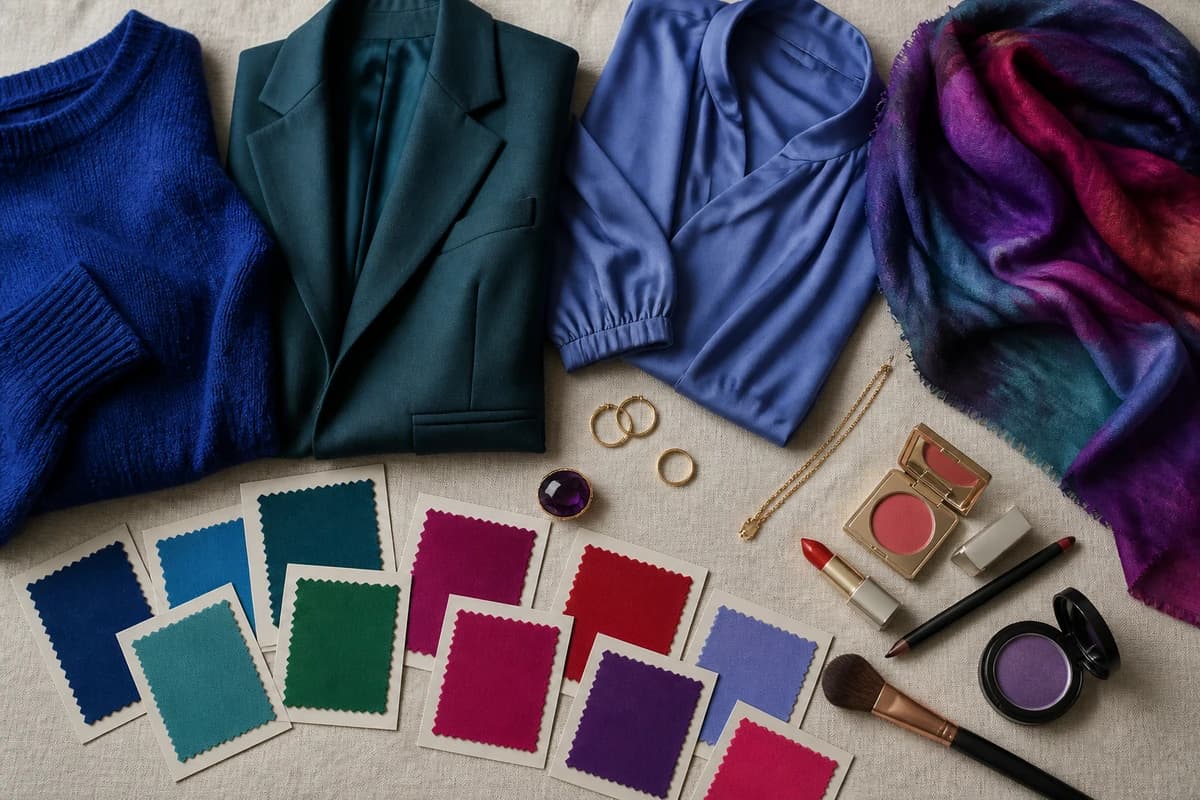
Going gray isn't the cue to fade into beige, it's the cue to update the equation. Your coloring has moved cooler and very likely softer, so retire the warm earth tones near your face, keep your shades clear and saturated rather than dusty or muddy, and pick by undertone (cool sapphire, magenta and amethyst, or warmer teal, true red and emerald). Choose three or four colors from the list above plus charcoal, navy and a soft white, add the right metal, and your silver hair stops reading like something that happened to you and starts reading like the best decision you made. When you want the precise shades, the exact sapphire, the exact red, that light your face, a personal color analysis hands them to you with hex codes.
Frequently asked questions
How does gray hair change your color analysis?
Going gray strips the warm pigment out of your hair, so it reads cool and clean rather than golden or red-brown. That does two things to your color analysis. It usually pulls your palette cooler, clear, slightly blue-based colors start to flatter where warm earth tones used to, and it can change your contrast level, because silver hair against the same skin often reads softer and lighter than dark hair did. The result is that many people drift toward a cooler season as they go gray, but your undertone, not the hair alone, decides exactly where you land.
What is the best color season for gray hair?
There's no single season that owns gray hair, but most silver and gray coloring leans cool, which points toward True Summer, Soft Summer or True Winter. Higher-contrast, crisper coloring with bright eyes tends toward True Winter and its clear jewel tones; softer, lower-contrast coloring leans True Summer or Soft Summer, where the same colors are gentled down. If your skin still reads genuinely warm and golden, you may sit in a Soft or Deep Autumn instead. Hair color narrows it down but never settles it on its own.
What colors look best with silver or gray hair?
Clear, true, slightly cool colors with real saturation flatter silver hair most, sapphire, teal, emerald, magenta, ruby, periwinkle, true red, amethyst, raspberry and pine green. Gray hair is crisp and cool, so it loves color with enough clarity and depth to meet that crispness, while muddy, beige or dusty shades flatten it. Which of these suits you most depends on undertone: cooler skin glows in sapphire, magenta and amethyst, while slightly warmer skin can carry teal, true red and emerald.
Should I wear gold or silver jewelry with gray hair?
Both can work, and gray hair is not automatically a silver-only situation. Silver, white gold and platinum tend to echo the cool crispness of silver hair and suit cool undertones beautifully. Gold still flatters if your skin has a genuinely warm, golden cast, it warms the face where the hair has cooled it. The deciding factor is your skin's undertone rather than your hair, so if you've always worn one metal out of habit, going gray is a good moment to test the other against your face in daylight.
Does gray hair make you look washed out, and how do I fix it?
Gray hair only looks washing-out when it's paired with colors that share its muted, low-warmth quality, beige, oatmeal, dove gray and dusty pastels worn near the face. The fix is contrast and clarity rather than more neutrals. One clear, saturated color at the neckline, a sapphire, a true red, a magenta, gives the face the lift the hair no longer provides, and a brighter lip does the same in seconds. Treat silver hair as a feature to dress up to, not a problem to tone down, and the washed-out look disappears.
Related guides
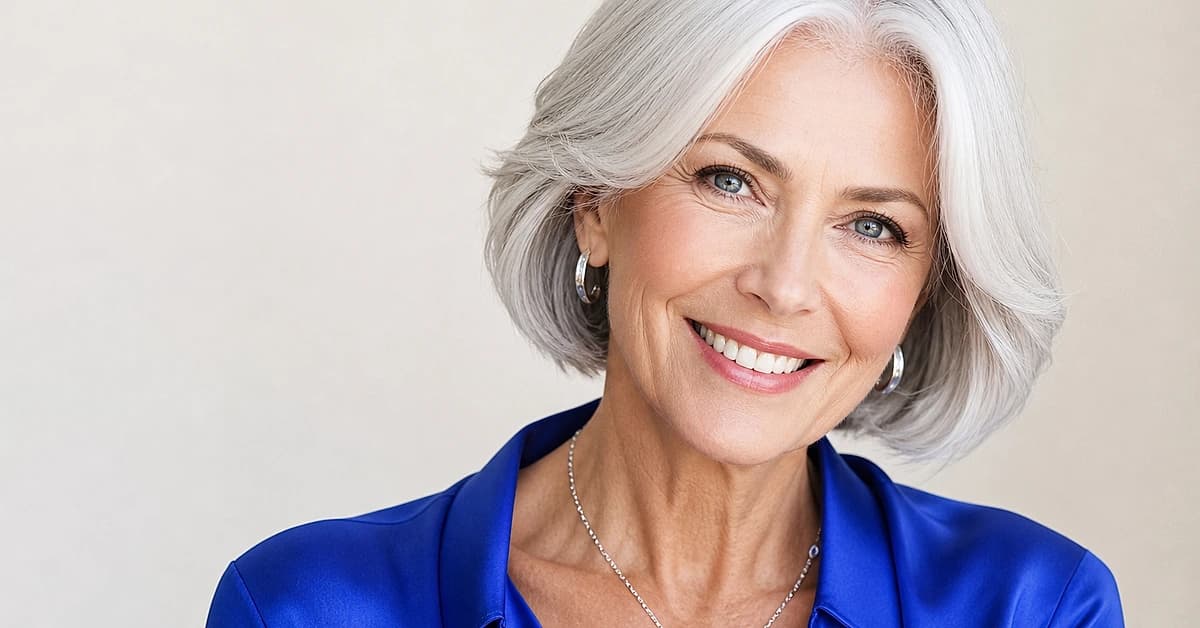
What to Wear With Gray Hair: The Best Colors by Skin Tone
The colors that flatter gray and silver hair, by fair, medium, olive and deep skin tone, with hex codes, the shades that age you, and the metals and makeup to match.
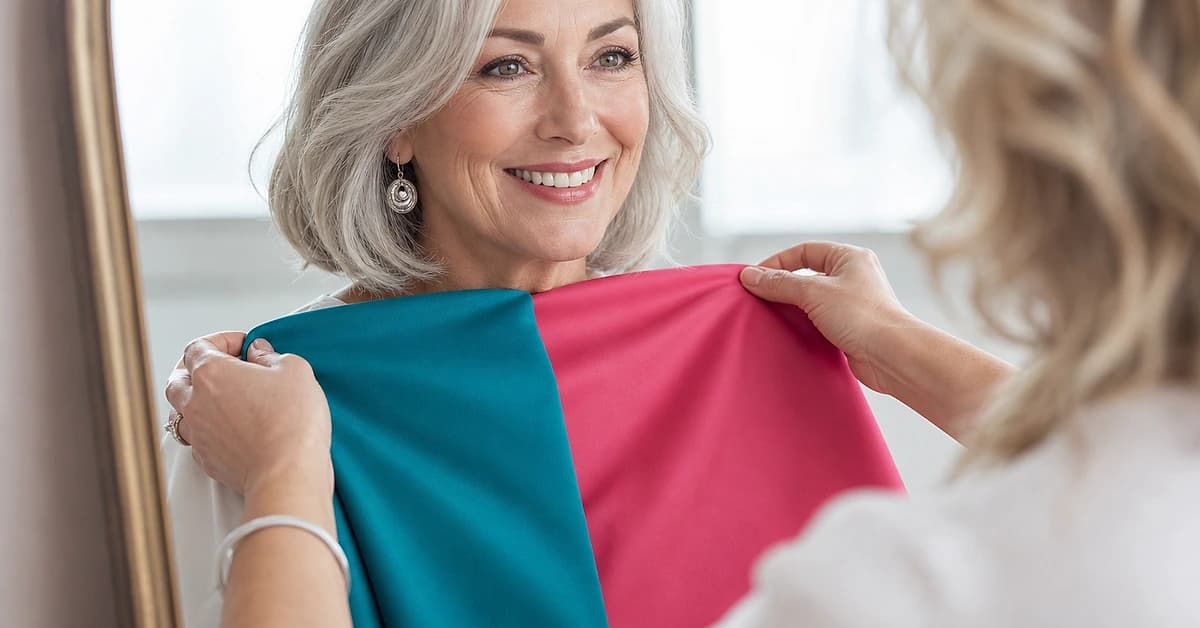
Color Analysis Over 60: How Silver Hair Changes Your Palette
Your undertone never changes, but gray hair, softer skin and lower contrast shift your best colors after 60. A color analyst explains what moves, what stays and what to wear now.
Best Colors for Gray Hair: Your Best Shades (with Hex Codes)
A color analyst's guide to the best colors for gray hair, 10 flattering shades and 5 neutrals with hex codes, what to avoid, and how to find your season.
Best Colors to Wear With Gray Hair and Olive Skin
Silver hair changes what olive skin can wear. A color analyst's guide to the best colors for gray hair and olive skin, teal, plum, berry, soft white, plus what to avoid.

Value and Contrast in Color Analysis
A color analyst explains value and contrast in color analysis, what they mean, how to assess your own, and why they decide which colors flatter you.
Auburn Hair Color: Who It Suits & the Best Colors to Wear With It
A color analyst's guide to auburn hair, who it suits, the flattering shade range, and the 10 best outfit colors plus 5 neutrals to wear with it
Prefer in person? Find color analysis near you
Browse local color analysts by city, or get the same season, palette and best-colors breakdown online from one selfie.
See your colors on a photo of you
Upload one selfie and ToneLala reveals your season, your full palette, and your best hair, makeup, jewelry and outfits, styled on you.