In a sentence: your undertone never changes, but after 60 your depth, contrast and clarity do, gray hair cools and lightens the frame, skin softens, so your best colors move towards clearer, cooler shades worn close to the face, often a softer or cooler neighbour of your original season. Skip to the four changes, the palette, or get re-analyzed from a photo.
Color Analysis Over 60: How Silver Hair Changes Your Palette
By ToneLalaUpdated September 5, 2026
Contents
"I had my colors done in 1992 and I've dressed by them ever since." I hear this often, and I admire it, and then I gently point out that the person in front of me has different hair, different skin and different eyes from the woman who was draped in 1992. The system didn't fail her. She changed, the way everyone does, and nobody told her the palette was allowed to change too.
This guide explains exactly what shifts after 60, what stays fixed, how to tell which way your palette has moved, and what to wear now. It is written for silver and gray hair because that's the biggest driver, but the same logic applies if you color your hair, with a twist I'll cover at the end.
What changes after 60, and what doesn't
Color analysis reads four things: undertone, depth, contrast and clarity. Only the first one is fixed.
| Younger you | You now | What it means for color | |
|---|---|---|---|
| Undertone | Warm / cool / neutral | Unchanged | You stay in your family: warm stays warm, cool stays cool |
| Depth (hair + skin) | Darker hair, more pigment in skin | Lighter: silver hair, softer skin | Deepest colors can now overwhelm; medium depth flatters |
| Contrast | Set by hair vs skin | Usually up on medium and deep skin, down on fair skin | High contrast wants clearer color; low contrast wants softer, still-clear color |
| Clarity | Set by eyes and skin | Eyes and skin soften slightly | Muted colors read "tired"; clear colors read "well" |
The pattern that comes out of this is consistent: the family stays, the sub-season slides. A True Autumn whose hair turns silver usually wears a Soft Autumn palette better, same warmth, gentler depth, and if the gray is very cool, may even look best in Soft Summer. A Bright Winter stays cool and clear but often drops to True Winter depth. A True Spring tends to read as Light Spring. Deep Winter is the exception: high-contrast cool coloring often looks more Deep Winter with silver hair, not less.
The four things silver hair does
- It cools the frame. Silver has no gold in it. Camel, mustard, khaki and olive drab, colors that harmonized with warm hair, now read yellow and dull.
- It raises contrast on medium and deep skin (light hair, darker skin) and lowers it on fair skin (light hair, light skin). High-contrast coloring can now wear clear jewel tones it couldn't before; low-contrast coloring wants clear-but-gentle color, not black-and-white.
- It removes warmth from around the face. Dark hair used to cast a warm shadow; silver bounces light. Color at the collar and on the lips has to put it back.
- It makes yellow the enemy. Yellowed ivory, beige, orange lipstick, a warm-toned foundation, anything with yellow in it reads as "dingy" next to silver. Blue-toned versions read as polished.
The palette after 60
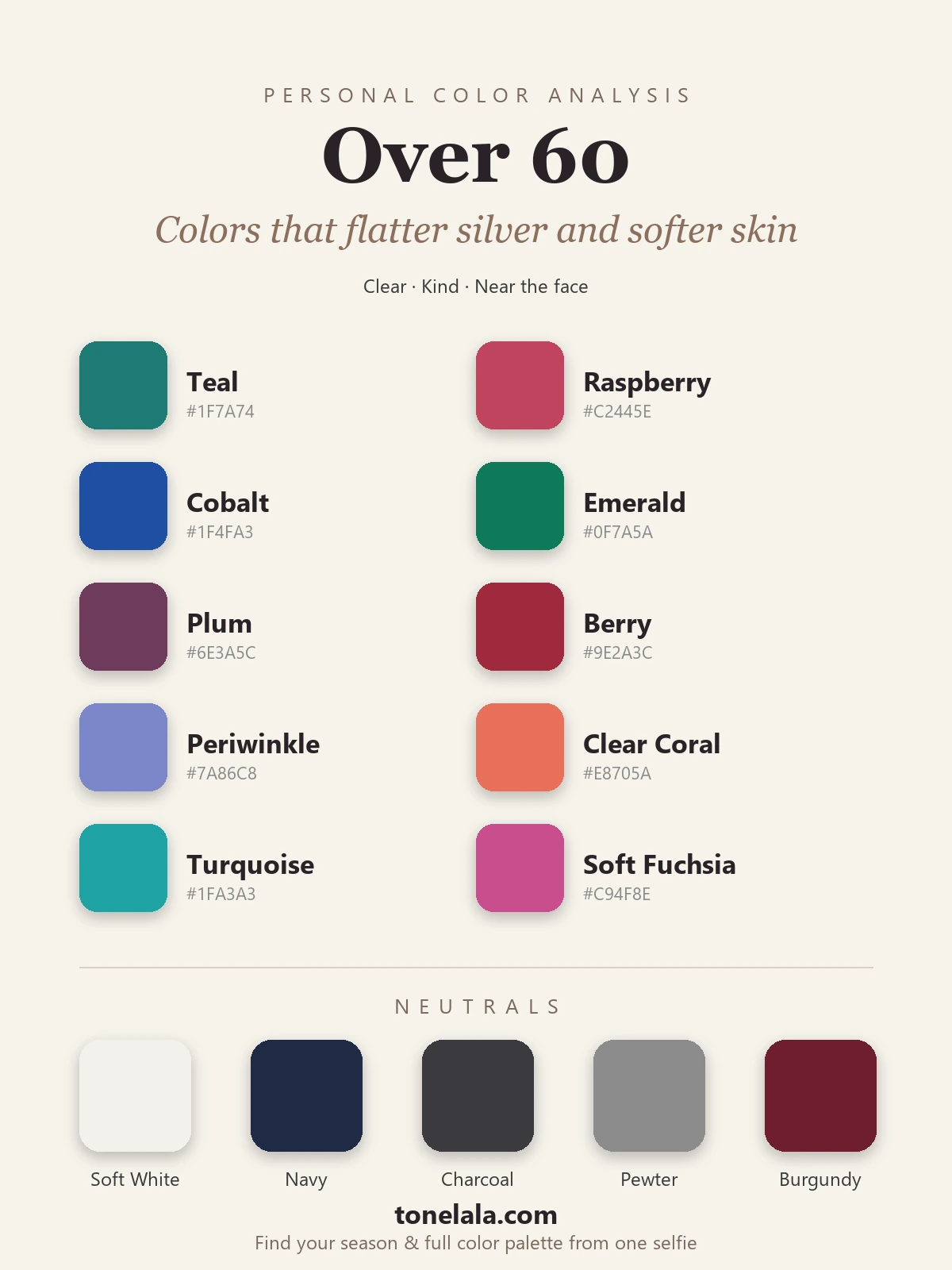
A universal starting palette: clear, mid-depth, cool-leaning color that flatters silver hair on almost everyone. Then adjust for your family using the notes below.
| Color | Hex | Why it works |
|---|---|---|
| Teal | #1F7A74 |
Clear and mid-depth, the safest jewel tone for silver hair on any skin. |
| Raspberry | #C2445E |
Puts color back into a softer face without going neon. |
| Cobalt | #1F4FA3 |
Clear blue next to silver hair is the most flattering pairing there is. |
| Emerald | #0F7A5A |
Vivid but elegant; wonderful on higher-contrast coloring. |
| Plum | #6E3A5C |
A soft-deep color for knitwear and coats; kind to every skin tone. |
| Berry | #9E2A3C |
The red that works now, slightly cool, no orange. |
| Periwinkle | #7A86C8 |
Blue-lavender that makes silver look chosen, especially on fair skin. |
| Clear Coral | #E8705A |
For warm undertones: the warm color that still flatters silver. |
| Turquoise | #1FA3A3 |
Clear and lifting; the summer color for silver hair. |
| Soft Fuchsia | #C94F8E |
Bright, cool pink with the edge taken off, bold without being hard. |
Neutrals: Soft White #F3F1EA (not ivory), Navy #1E2A44, Charcoal #3B3B40, Pewter #8C8C8C and Burgundy #6E1F2E. Navy and charcoal replace black; burgundy behaves like a neutral and flatters everyone.
Warm families (Springs and Autumns): keep the palette but swap berry for clear coral, plum for muted terracotta #B5674A, and periwinkle for soft turquoise; keep gold brushed, or mix it with silver.
Cool families (Summers and Winters): the palette as written; Winters can add true red #C8102E and crisp white.
Metals: silver, pearl and white gold echo the hair. Brushed or antique gold still suits warm undertones, it's bright yellow gold that fights silver.
Was your last color analysis before your hair changed?
Find your color season →How to tell which way your palette moved
Three quick drapes in daylight, no makeup:
- Your old best color versus its softer neighbour. If you were a True Autumn, hold pumpkin against a muted terracotta. If the softer one now looks better, your depth has dropped, slide to the Soft sub-season.
- Your old best color versus its cooler neighbour. Rust against berry, mustard against teal. If the cooler one wins, silver has cooled your frame more than you thought, you may sit in Soft Summer or Winter territory now.
- Black versus navy at the collar. If black throws shadows and navy doesn't, your contrast and depth have softened. If black still looks striking, you're a high-contrast type and can keep it.
If the answers disagree, and they often do, a photo-based analysis reads all four dials from a current picture of you, silver and all. That is genuinely the most useful thing you can do for your wardrobe after 60: get analyzed as you are now, not as you were.
The colors that add years
- Beige, camel, taupe, sand and khaki near the face. They vanish between silver hair and softer skin, the number-one "washed out" culprit.
- Mustard, orange and yellow-greens. They pull yellow into the hair.
- Dusty pastels. Powder pink, pale lilac, mint: too weak, and they read tired.
- Yellowed ivory and cream at the collar. Soft white instead.
- Solid black at the face on fair or softened skin. Navy, charcoal, burgundy instead.
- Muddy mid-browns. Chocolate-dark or nothing.
Makeup after 60
Skin softens and loses pigment, silver hair removes warmth, and the answer to both is a little clear color, well placed, not more product. Foundation: lighter in texture and often a shade lighter than before; neutral or slightly cool rather than golden, and never yellow against silver hair; see how to find your foundation shade. Blush: cream rather than powder, in clear rose, raspberry or brick-rose, placed a little higher on the cheek. Lips: berry, raspberry, rose and blue-based red; beige nudes make the mouth disappear and orange reds turn sallow. Eyes: taupe, slate, plum; a soft charcoal or navy liner smudged rather than a hard black line. Brows: taupe or gray-brown, softly filled, they frame the whole face now that the hair is lighter. More in best blush for your skin tone and best lipstick for your skin tone.
If you color your hair
The same shifts happen underneath, just hidden. If you keep your hair dark, the frame stays warm and your original palette holds longer, but the contrast between very dark hair and softened skin can start to look harsh, and moving one or two shades lighter and softer usually flatters more. If you go blonde to blend the gray, ask for a neutral or cool blonde rather than a golden one: warm blonde over graying roots and softer skin pulls the whole face yellow, which is the exact effect silver hair is trying to avoid. The best colors for gray hair and color analysis for gray hair guides cover the transition options.
Putting it together
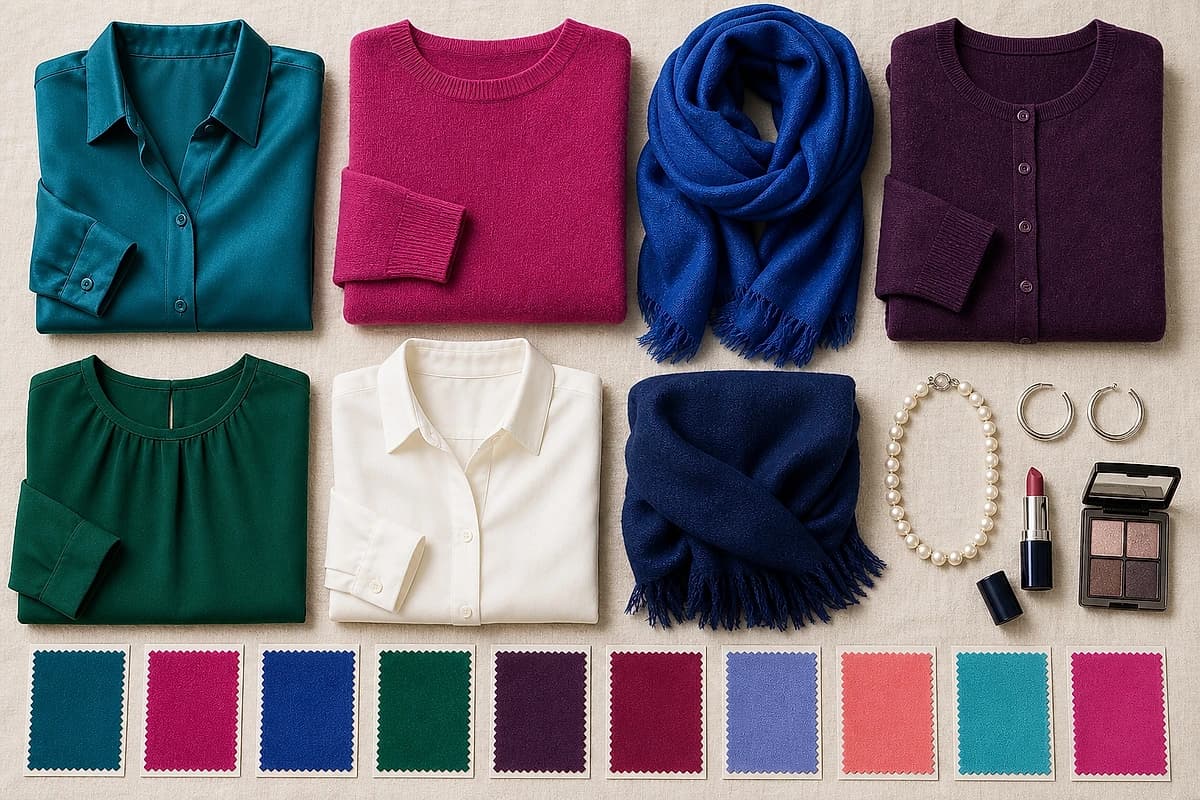
Keep your family, slide the sub-season, and move the color to your face. In practice: one teal or cobalt top, one soft white shirt, a navy or charcoal layer, a raspberry or berry lipstick, and silver or pearl at the ears. Retire beige, camel and mustard from the top half of your wardrobe. Then get your colors re-read from a photo of who you are now, the palette that comes back is almost always kinder, clearer and more you than the one from 1992.
Frequently asked questions
Does your color season change as you age?
Your undertone, warm, cool or neutral, never changes, so you don't jump from a warm season to a cool one. But depth, contrast and clarity all shift with gray hair and softer skin, so your best sub-season often moves: a True Autumn may wear a Soft Autumn or even Soft Summer palette better, and a Bright Spring may sit closer to Light Spring. The family stays; the best version of it moves.
Should women over 60 wear muted or clear colors?
Clear, in most cases. Silver hair is a clean, cool frame and skin loses some pigment with age, so muted, dusty colors near the face read as tired. Clear teal, raspberry, cobalt and berry put color back into the face; dusty rose, taupe and beige take it away. Keep the clarity, soften the depth if you need to.
What colors make women over 60 look younger?
Clear color worn near the face: teal, raspberry, cobalt, emerald, periwinkle and clear coral, with soft white instead of ivory and navy or charcoal instead of black. Beige, camel, khaki, mustard and dusty pastels are the shades that add years, because they disappear against gray hair and softer skin.
Is it worth getting a color analysis after 60?
It is arguably the best time. Most people were analyzed, or guessed their season, with the hair and skin they had at 30 or 40. Gray hair and lighter skin change the result enough that a fresh analysis usually finds a palette that flatters more than the old one.
Can older women wear bright colors?
Yes, bright but not neon. Raspberry, cobalt, emerald, turquoise and clear coral are bright colors that flatter silver hair and mature skin, particularly worn as a top, scarf or lipstick against a calm neutral. What doesn't work is fluorescent brights on one hand and washed-out pastels on the other.
What should I wear instead of black after 60?
Navy, charcoal, burgundy and aubergine. They give the same depth and polish as black without the gray shadows black casts on lighter, softer skin. If you love black, wear it below the face and add a clear color at the collar.
Related guides
Color Analysis for Gray Hair
A color analyst on color analysis for gray hair, how going silver shifts your palette and contrast, plus the best colors, makeup and metals (with hex codes).
What to Wear With Gray Hair: The Best Colors by Skin Tone
The colors that flatter gray and silver hair, by fair, medium, olive and deep skin tone, with hex codes, the shades that age you, and the metals and makeup to match.
Best Colors for Gray Hair: Your Best Shades (with Hex Codes)
A color analyst's guide to the best colors for gray hair, 10 flattering shades and 5 neutrals with hex codes, what to avoid, and how to find your season.
Best Colors to Wear With Gray Hair and Olive Skin
Silver hair changes what olive skin can wear. A color analyst's guide to the best colors for gray hair and olive skin, teal, plum, berry, soft white, plus what to avoid.
Best Hair Colors for Dark Skin: Shades That Glow (Warm, Cool and Neutral)
A color analyst's guide to the most flattering hair colors for dark and deep skin, espresso, mahogany, auburn, caramel, honey balayage, burgundy and blonde, by warm, cool and neutral undertone.
Which Skin Tones Suit Ash Brown Hair? A Color Analyst's Guide
Ash brown flatters cool and neutral skin and washes out warm skin. A color analyst explains exactly who suits it, which ash brown to choose, and the warm-skin workaround.
Prefer in person? Find color analysis near you
Browse local color analysts by city, or get the same season, palette and best-colors breakdown online from one selfie.
See your colors on a photo of you
Upload one selfie and ToneLala reveals your season, your full palette, and your best hair, makeup, jewelry and outfits, styled on you.