In a sentence: Wear navy like a deep cool neutral and give it warmth or one clear accent, camel and white for everyday, coral or mustard for a lift, emerald or burgundy for evening. Skip to the pairing palette or find your most flattering colors.
How to Wear Navy: Outfit Ideas & Color Pairings
By ToneLalaUpdated July 9, 2026

Contents
Navy is the most-worn and least-styled color in most wardrobes. We pull it on because it's safe, pair it with black or another navy, and then quietly wonder why a perfectly nice outfit looks tired by mid-morning. The color isn't the problem. The lack of contrast is.
Here's the shift that changes everything: navy is not a background. It's a deep, cool canvas, and it can carry a warm coral or a soft blush every bit as happily as it carries a crisp white shirt. After years of styling clients in it, my one rule is that navy wants a partner with some life in it. Give it that, and it stops being the color you settle for and becomes the one you reach for first.
What navy brings to an outfit
Navy is a very dark, slightly muted, cool blue, somewhere around #1F2A44. That makes it a near-neutral: deep and low enough in saturation that, like charcoal or chocolate brown, it can sit under almost any accent color without competing. It anchors an outfit the way black does, but with none of black's harshness against most skin tones, which is exactly why navy reads grown-up, polished and a touch more considered than black on the same hanger.
The mood it sets is calm authority. Navy looks credible in a meeting, easy on a weekend, and quietly elegant at night, which is rare for a single color. It's at its best as a base you build on rather than the whole story, a navy suit, navy denim or a navy dress that you then lift with one warm or bright partner. The moment you treat navy as the finished outfit, it goes invisible. The moment you treat it as the starting point, it does almost anything you ask.
The best colors to pair with navy
Here are the ten I keep coming back to, a mix of soft, warm and jewel tones so there's a navy pairing for every mood and occasion.
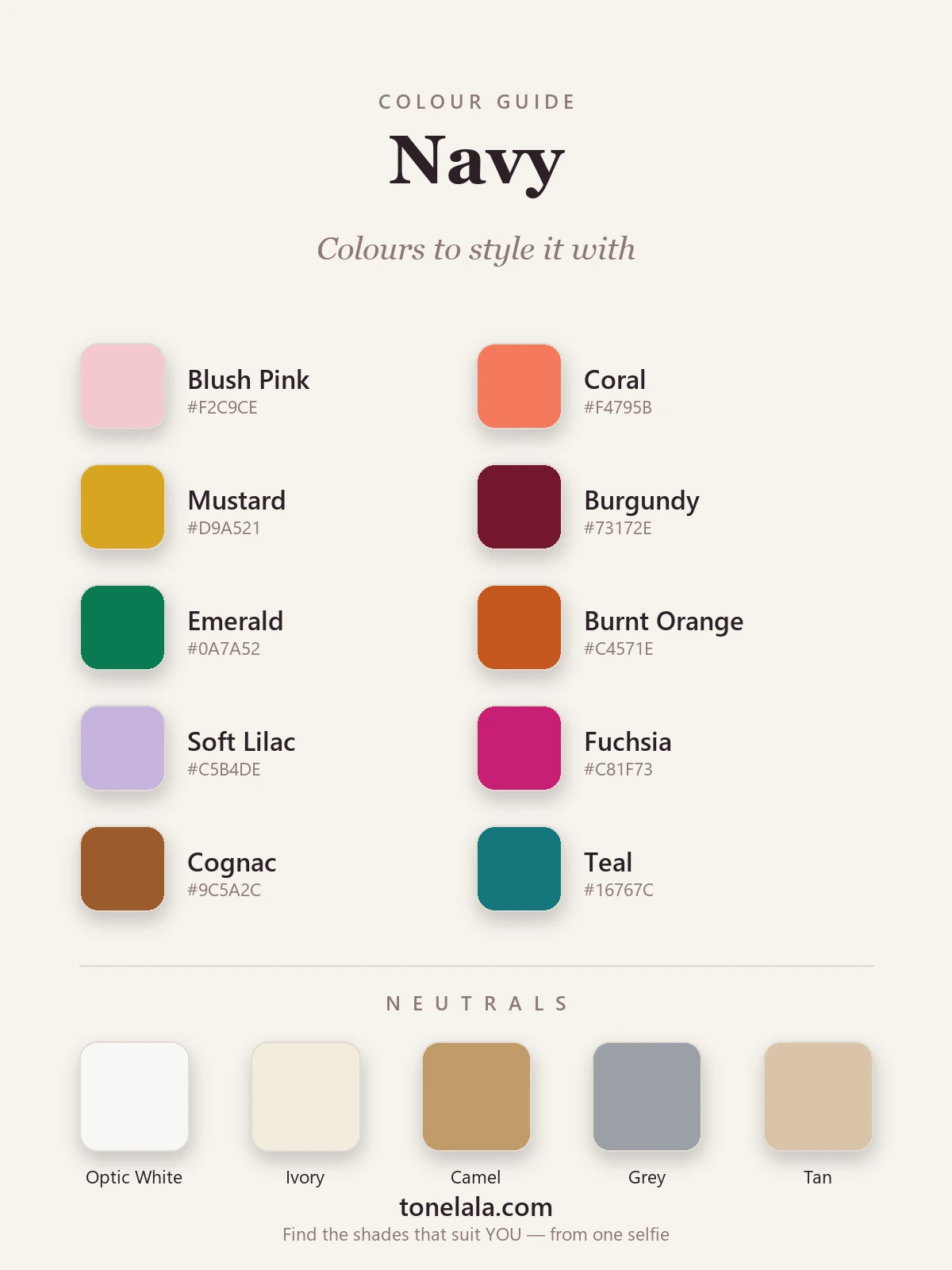
| Color | Hex |
|---|---|
Blush Pink #F2C9CE |
The easiest, most universally flattering partner, soft warmth that takes navy's edge off and reads quietly luxe. |
Coral #F4795B |
Navy's wheel complement in its happiest form; the warm-cool clash makes both colors pop without trying. |
Mustard #D9A521 |
A golden yellow that feels rich and grown-up against navy, autumnal, a little retro, very chic. |
Burgundy #73172E |
Deep wine red beside deep blue is moody and dressy; two rich darks that hold their own without muddying. |
Emerald #0A7A52 |
Jewel-on-jewel. Navy and emerald is a regal, expensive-looking combination that always reads considered. |
Burnt Orange #C4571E |
The bolder cousin of coral, straight from navy's complement, so it carries an outfit single-handedly. |
Soft Lilac #C5B4DE |
A cool, pale purple that's gentle and pretty next to navy, ideal when you want soft contrast not drama. |
Fuchsia #C81F73 |
A clear, cool pink that's electric against deep navy, the most fun way to dress navy up. |
Cognac #9C5A2C |
Warm leather-brown; the reason navy and tan accessories look so polished. Endlessly wearable. |
Teal #16767C |
A blue-green cousin that's close enough to feel harmonious, different enough to add interest. Subtle and rich. |
Neutrals to wear with navy: Optic White #F7F7F4 for crisp, nautical contrast; Ivory #F3ECDD for a softer, warmer take; Camel #C19A6B, my favorite, instantly expensive; Gray #9CA0A6 for a quiet tonal-cool look; and Tan #D8C4A8 for relaxed warmth.
Is YOUR best shade of navy warm or cool?
Find your color season →Navy outfit formulas
A pairing on paper is one thing; a whole outfit is another. Here are the formulas I build on repeat, written so you can copy them straight off the page.
- Everyday: navy + camel + white. A navy blazer or jumper, camel trousers or a camel coat, a white tee or shirt underneath. Quiet, expensive, works for the office and the weekend in equal measure, the most reliable navy outfit there is. Add cognac loafers and you're done.
- Work: navy + gray + a warm accent. Navy suiting or a navy dress with a gray knit keeps things tonal and serious, then one warm note near the face, a coral scarf, a mustard blouse, gold earrings, stops it tipping into severe. This is how navy looks authoritative without looking cold.
- Casual: navy denim + coral (or blush) + tan. Navy jeans, a coral or blush top, tan sandals or a tan crossbody. The warm-cool contrast does all the heavy lifting, so the outfit looks considered even though it took two minutes.
- Evening: navy + emerald or burgundy + gold. Swap the accent for a jewel tone and navy reads properly dressed-up: a navy suit with an emerald shirt, or a navy dress with a burgundy lip, bag and gold jewelry. Rich, grown-up and never garish.
Colors and styling to avoid with navy
- Black, used by accident. Unless it's a clear head-to-toe choice, navy and black side by side just look like you got dressed in low light, close enough to clash, far enough to read as a mistake. Reach for charcoal or another navy as your "dark" instead.
- Other deep cool darks. Charcoal, slate, forest green and gray-blue sit too near navy in depth and temperature, so the outfit goes flat and heavy with no contrast to lift it. If you want depth, add a light or warm color to break it up.
- A slightly different navy. A navy top with navy trousers that don't quite match is the most common navy crime there is. Either commit to a true tonal navy in matching pieces, or break it deliberately, don't leave it almost-matching.
Wearing navy for your coloring
Navy genuinely suits almost everyone, but which navy, and which partner colors, is where your personal coloring comes in. There isn't one navy; there's a whole range from inky blue-black to a softer slate-navy, and the best one for you depends on your undertone, depth and contrast.
If you're cool and high-contrast (a Winter), you can wear the deepest, most blue-based navy with crisp white and clear, cool brights, fuchsia, emerald, icy blue. If you're warm (an Autumn or Spring), a slightly softer or warmer navy is kinder near your face, and it loves camel, coral, mustard and cognac far more than stark white. Soft, muted coloring (a Summer or Soft Autumn) tends to look best in navy worn with equally soft partners, blush, lilac, dusty teal, rather than anything electric. And if a very dark navy ever feels a touch severe on you, that's your cue to keep it below the waist or break it with a warm, light color up top.
Working out your season is the shortcut to all of it. The color analysis guides walk through how each one reads, and a personal analysis reads your undertone, depth and contrast to tell you the exact navy, and the exact partner colors, that flatter you most.
Putting it together
Navy is at its best when you stop treating it as a safe default and start treating it as the deep, cool canvas it is. Give it warmth or one clear accent, camel and white for everyday, gray and a warm note for work, coral or blush for the weekend, emerald or burgundy for evening, and it goes from invisible to intentional. Build a small navy capsule around two neutrals and two or three of the colors above and you'll have a wardrobe that mixes effortlessly. The only navy mistake worth worrying about is pairing it with another dark cool tone and calling it a day. Everything else, navy can carry.
Frequently asked questions
How do you wear navy without it looking boring?
Give it one thing to play against. Navy goes flat when you pair it with another dark cool tone, black, charcoal, deep gray, so the whole outfit reads as one heavy block. Add light (white, ivory, camel) or warmth (coral, mustard, cognac, blush) and navy instantly looks intentional rather than safe. My quickest fix on a dull navy outfit is a warm accessory near the face: a cognac bag, a coral lip, gold earrings.
What colors go with navy?
Navy behaves like a deep cool neutral, so most things work, but the standouts are blush pink, coral, mustard, burgundy, emerald, burnt orange, soft lilac, fuchsia, cognac and teal. For neutrals it loves white, ivory, camel, gray and tan. Warm accents (coral, mustard, cognac) feel fresh against navy's coolness; jewel tones (emerald, burgundy, fuchsia) feel rich and dressed-up.
Can you wear navy and black together?
You can, but only as a deliberate choice, and it's hard to pull off. Side by side, navy and black are close enough to clash and far enough to read as a mistake rather than a decision. If you want to combine them, keep them in clearly different pieces (a black leather jacket over a navy dress, say) and add a third lighter color to make it look intended. When in doubt, swap the black for charcoal or navy itself.
What shoes and accessories go with navy?
Cognac, tan and camel leather are navy's best friends, warm brown against cool navy looks expensive every time, which is why navy-and-tan is such a classic. For something dressier, nude or blush heels lengthen the leg, white trainers keep it crisp and modern, and metallics work either way (gold for warmth, silver for a cooler finish). I'd avoid black shoes with navy unless the rest of the outfit is already anchored in black.
What shade of navy suits my skin tone?
Navy suits almost everyone, but the right navy depends on your coloring. Cool, deep coloring (Winter) can wear the inkiest blue-based navy with crisp white and clear brights like fuchsia and emerald. Warm coloring (Autumn, Spring) is flattered by a slightly softer or warmer navy worn with camel, coral, mustard and cognac rather than stark white. If navy ever looks a little severe near your face, keep it below the waist or break it with a warm, light color up top, or get a color analysis to find your exact shade.
Related guides

How to Wear Beige: Outfit Ideas & Color Pairings
A stylist's guide to wearing beige, 10 color pairings with hex codes, the best neutrals, outfit formulas by occasion and what to avoid.

How to Wear Brown: Outfit Ideas & Color Pairings
How to wear brown without looking dull: 10 color pairings with hex codes, 5 neutrals, outfit formulas by occasion, and the right shade for your coloring.

How to Wear Orange: Outfit Ideas & Color Pairings
A stylist's guide on how to wear orange, 10 pairing colors with hex codes, the best neutrals, outfit formulas, and the right shade for your coloring.

How to Wear Red: Outfit Ideas & Color Pairings
How to wear red without it wearing you, a stylist's outfit formulas, the 10 best colors to pair with red (plus neutrals)

How to Wear Lavender: Outfit Ideas & Color Pairings
A stylist's guide to wearing lavender, 10 color pairings and 5 neutrals with hex codes, outfit formulas by occasion, and the right shade for your coloring.

How to Wear Coral: Outfit Ideas & Color Pairings
A stylist's guide to wearing coral, 10 pairing colors with hex codes, the best neutrals, outfit formulas, and how to find your most flattering coral.
Prefer in person? Find color analysis near you
Browse local color analysts by city, or get the same season, palette and best-colors breakdown online from one selfie.
See your colors on a photo of you
Upload one selfie and ToneLala reveals your season, your full palette, and your best hair, makeup, jewelry and outfits, styled on you.