In a sentence: Autumn is the warm, earthy, medium-to-deep season family, golden coloring flattered by golden, spiced color, from soft and muted to rich and deep. Skip to the full palette with hex codes, the three sub-types compared, or find your own season from a selfie.
Autumn Color Palette: The Complete Guide (with Hex Codes)
By ToneLalaUpdated October 8, 2026
Contents
- 01 Autumn at a glance
- 02 What makes an Autumn
- 03 Autumn eyes, hair and skin
- 04 The three Autumn sub-types
- 05 The Autumn palette
- 06 Colors to avoid (and why)
- 07 Are you an Autumn? Three tests at home
- 08 How to tell which Autumn you are
- 09 Autumn vs the other seasons
- 10 Autumn celebrity examples
- 11 Autumn outfit formulas
- 12 An Autumn capsule wardrobe
- 13 Prints, fabrics and denim
- 14 Autumn makeup and hair at a glance
- 15 Jewelry, glasses, shoes and bags
- 16 Where to start
In seasonal color analysis, Autumn is one of the two warm families, and the one with earth in it. Spring is warm and clear; Autumn is warm and muted to rich, with colors that look like the season it is named after: rust, moss, pumpkin, dried-leaf gold and pine. A quick way to see the difference is to hold cream next to stark white under your face in daylight. On an Autumn, white tends to look hard and cream looks natural, because the skin has gold in it.
This guide covers the whole Autumn family: an at-a-glance profile, what every Autumn shares, the eyes, hair and skin that usually go with it, the three sub-types, the full palette in categories with hex codes, home tests for working out whether you are an Autumn and which one, how Autumn differs from the other seasons, and makeup, hair, accessories, prints and a capsule wardrobe. If you already know your sub-type, go straight to its full guide: Soft Autumn, True Autumn or Deep Autumn.
Autumn at a glance
| Autumn family | |
|---|---|
| Undertone | Warm, golden, never blue-based |
| Depth (value) | Medium to deep |
| Chroma | Muted to rich, always earthy |
| Contrast | Low (Soft) to high (Deep) |
| Typical hair | Golden brown, chestnut, auburn, copper, warm dark brown, dark honey |
| Typical eyes | Warm brown, hazel, olive green, amber, warm dark brown |
| Typical skin | Golden, peach, warm beige, olive, bronze, warm deep |
| Best "dark" | Chocolate brown, espresso, forest, not black |
| Best "white" | Warm cream, ivory, not optic white |
| Metals | Warm gold, copper, bronze |
| Sub-types | Soft Autumn · True Autumn · Deep Autumn |
| Signature colors | Rust, pumpkin, terracotta, mustard, golden olive, forest, warm teal |
What makes an Autumn
Every Autumn sub-type shares the same three settings:
- Undertone: warm. Golden rather than blue-based. This is the one trait every Autumn has: the skin has a gold or warm-peach cast, and gold jewelry flatters it more than silver.
- Value: medium to deep. Autumn coloring runs from medium to genuinely dark. It is never as pale and light as a Spring or a Light Summer.
- Chroma: muted to rich, but always earthy. Even the brightest Autumn color has a little brown or spice in it. Nothing reads neon or icy-clear.
Put together, that is warm, golden, earthy coloring flattered by warm, golden, earthy color. The most useful test of a single color: could it exist in nature in autumn? Pumpkin, moss, rust, chestnut, dried-leaf gold and pine all could. Icy mint, blue-pink and gunmetal could not, and none of them are Autumn colors.
One trap is reading "muted" as pale or washed out. Autumn is muted the way a good curry is: deep, warm and complex, not faded. Even the softest Autumn carries warmth and body, and the family runs all the way down to genuinely dark, so an Autumn is as likely to suit a deep forest green as a golden camel. What holds it together is not lightness or softness but gold.
Autumn eyes, hair and skin
These are the usual patterns. Plenty of Autumns break one of them, which is why analysts judge the three together.
Skin
Golden, peachy, warm beige, olive or bronze, at any depth from light-medium to deep. Many Autumns have freckles or a skin tone that tans to gold rather than pink. Olive skin often falls here too, though it can also sit in other seasons; the olive skin guide covers that.
Hair
Golden brown, chestnut, auburn, copper, warm dark brown and dark honey blonde. Natural red hair is common in True Autumn. Ash blonde and blue-black hair are less typical, and Autumns who dye their hair ashy often find it makes their skin look sallow.
Eyes
Warm brown, hazel, amber, olive and topaz green are the most common. Blue eyes are less usual but not ruled out: some Autumns have teal, turquoise or blue-green eyes, often with a gold or brown ring around the pupil. Guides differ on how common this is, especially for Soft Autumn.
The three Autumn sub-types
| Soft Autumn | True Autumn | Deep Autumn | |
|---|---|---|---|
| Undertone | Warm-neutral | Purely warm | Warm-neutral |
| Depth | Medium | Medium-deep | Deep |
| Chroma | Muted | Rich | Rich and deep |
| Contrast | Low | Medium | Medium-high |
| Signature colors | Camel, soft coral, sage, soft olive | Pumpkin, rust, golden olive, mustard | Deep rust, aubergine, deep teal, forest |
| Best dark | Cocoa, soft olive | Chocolate brown | Espresso |
| Mistaken for | Soft Summer | Spring | Deep Winter |
| Full guide | Soft Autumn | True Autumn | Deep Autumn |
Soft Autumn is the warm, muted, low-contrast corner, the most neutral of the three, where the warmth is gentle and slightly grayed. Think camel, soft coral, sage and soft olive. It is the sub-type most often mistyped as cool, because the muting can read like a Soft Summer until you hold warmth beside it.
True Autumn is the warm, rich, medium-deep center of the family, the most purely warm of all twelve seasons, and the one some systems call Warm Autumn. The colors are fuller and more saturated than Soft Autumn's: pumpkin, rust, golden olive, mustard, forest green. If full, golden colors brighten you rather than overwhelm you, this is usually your sub-type.
Deep Autumn is the warm and deep corner, where Autumn borders Winter. The coloring has real depth, so the palette darkens (bittersweet chocolate, deep teal, dark spice, aubergine warmed with brown) while staying golden rather than cool. It is the only Autumn that can wear a near-black, such as a deep espresso or forest, without being overwhelmed.
Not every system uses three. Some list four Autumns, adding a Cool Autumn or splitting Warm Autumn from True Autumn; the three-way split above is the most common.
The Autumn palette
The chart shows ten signature colors and five neutrals spanning the family; the tables expand it to more than thirty shades and note which sub-type wears each best.
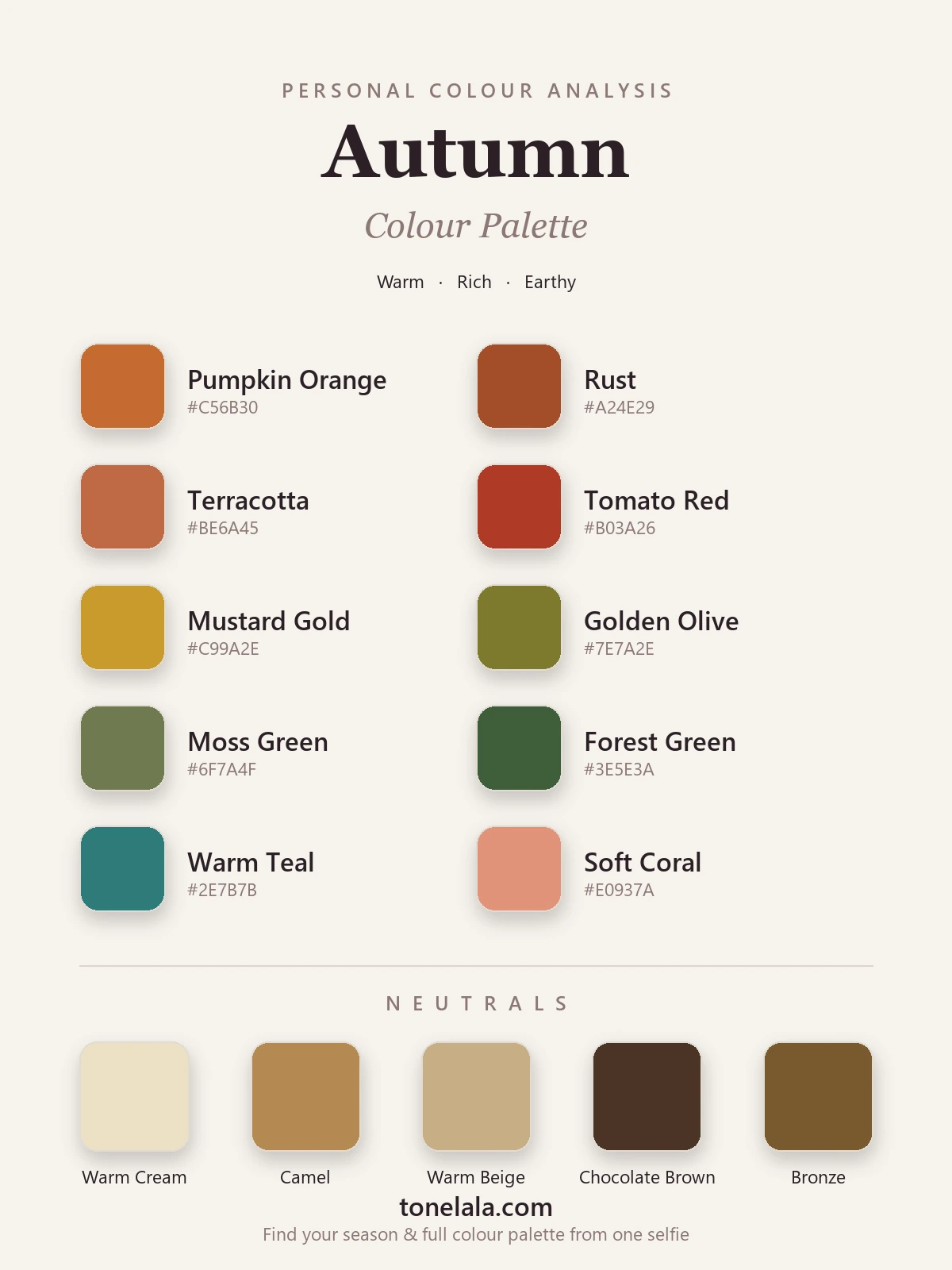
Signature Autumn colors
| Color | Hex | Best sub-type |
|---|---|---|
| Pumpkin Orange | #C56B30 |
True |
| Rust | #A24E29 |
True, Deep |
| Terracotta | #BE6A45 |
All three |
| Tomato Red | #B03A26 |
True, Deep |
| Mustard Gold | #C99A2E |
True |
| Golden Olive | #7E7A2E |
True, Deep |
| Moss Green | #6F7A4F |
Soft, True |
| Forest Green | #3E5E3A |
Deep, True |
| Warm Teal | #2E7B7B |
All three |
| Soft Coral | #E0937A |
Soft |
Lights: Autumn's "pastels" are warm and creamy, never icy: Peach #EBB89A, Butter #EBD39A, Sand #D9C3A0, Sage #9DA88A, Apricot #E8A57A, Light Camel #D2B48C.
Mediums: the core of the wardrobe: Copper #A5552D, Saffron #C98F1E, Olive #6B6B3A, Warm Coral #CF6B4A, Cognac #8B4A2B, Peacock #1F6B7A.
Darks: Autumn goes deep without going cool: Chocolate #4A3526, Espresso #3A2A1E, Aubergine #4A2A3D, Deep Teal #1F5455, Mahogany #5A2E22, Deep Warm Navy #222A38.
Neutrals: warm and golden, never stark: Warm Cream #EDE0C4, Camel #B68A52, Warm Beige #C7AE85, Chocolate Brown #4A3526 (the family's best "dark", softer than black), Bronze #7A5A2E, plus Tan #B98B5E and Warm Stone #B5A98E.
Metals: warm gold, copper and bronze echo the gold in Autumn skin. Bright silver and platinum tend to read cold and flat. Tortoiseshell, amber, wood and leather are Autumn's natural accessories.
Not sure which Autumn you are?
Find your color season →Colors to avoid (and why)
- Cool and icy tones: icy blue, fuchsia, cool gray, blue-pink. They fight the golden undertone and gray the skin.
- Pure black and stark white: too cool and hard-edged near the face. Chocolate and cream do the same jobs more gently.
- Clear cool pastels: baby pink, mint, lavender. Too cool and too thin for warm, earthy coloring.
- Neon brights: lime, electric blue, hot pink. Autumn color has earth in it; neon has none.
- Cool neutrals: charcoal, dove gray, taupe-gray, cool beige. Swap for bronze, camel, chocolate.
Can Autumns wear black?
This is the most common question about the season, and guides do not fully agree. Most say no black near the face and suggest dark brown, espresso, forest green or a warm navy instead. Some allow it for Deep Autumns, whose coloring borders Winter, and several allow it away from the face: black trousers, boots or a bag. The practical answer: if you own and love black, keep it below the waist, or wear a cream, rust or olive layer at the neckline.
Navy, silver and pink
The other colors with mixed advice:
- Navy: a warm, slightly greened navy works for most Autumns; a bright, blue-violet navy reads cool.
- Silver: some guides rule it out entirely; others allow brushed or oxidized silver for Soft Autumns. Polished silver next to the face is the version most likely to look cold.
- Pink: cool and blue-pinks rarely work, but warm pinks such as salmon, coral-pink, dusty rose and terracotta-pink suit most Autumns.
Are you an Autumn? Three tests at home
Do these by a window in daylight, without makeup, and ideally without a tan, which can make cool skin look warm for a few months.
- Gold or silver. Hold a gold and a silver piece (or fabric) under your chin. If gold makes your skin look smoother and silver makes it look gray or tired, you lean warm.
- Cream or white. Compare an ivory or cream top with an optic white one. Autumns usually look better in cream; white can make them look sallow.
- Muted or bright. Compare an earthy color (rust or olive) with a clear bright one (a bright coral or turquoise). If the earthy one looks like it belongs with your face, you lean Autumn; if the bright one wins and the earthy one looks heavy, you may be a Spring.
The vein test (green veins for warm, blue for cool) is the least reliable of the common tests, because vein color depends on skin thickness and lighting as much as undertone. Lighting is the bigger problem in general: warm indoor bulbs make most people look warmer than they are, which is also why phone apps reading photos taken at night often get warm and cool wrong.
How to tell which Autumn you are
Once you are confident you are warm, the question is how warm and how deep:
- Start with chroma. Hold a full, saturated pumpkin or rust to your face. If it brightens you, you are toward True Autumn. If it slightly overwhelms you and a dustier, softer version looks more like you, you are toward Soft Autumn.
- Then check depth. Try a deep espresso brown or a dark forest green at the jaw. If the deepest tones look natural on you rather than heavy, you are toward Deep Autumn. If they overwhelm a medium-toned face, you are a True or Soft.
- Look at the contrast in your own coloring. Soft Autumns tend to be low-contrast (hair, skin and eyes sit close in value); Deep Autumns usually have noticeably darker hair or eyes against the skin.
- Check you are not a Spring. Both are warm. If clear, bright, sunlit colors (coral, golden yellow, turquoise) flatter you more than earthy ones, you are probably a Spring, not an Autumn.
Undertone, value and contrast are hard to judge in a bathroom mirror, where lighting and habit get in the way. A photo-based analysis reads all three for you.
Autumn vs the other seasons
Autumn vs Spring
The two warm seasons. Spring is clear, light and bright; Autumn is muted to rich and medium to deep. True Autumn and True Spring are the pair most often confused; True Spring vs True Autumn compares them side by side.
Autumn vs Summer
Summer is cool and soft; Autumn is warm. The overlap is at the soft end: Soft Autumn and Soft Summer are both muted and low-contrast and differ mainly in temperature. Hold a camel and a dove gray under your chin; the one that looks smoother decides it. Soft Summer vs Soft Autumn goes into detail.
Autumn vs Winter
Winter is cool and clear; Autumn is warm and earthy. They meet at the deep end, where Deep Autumn and Deep Winter both suit dark, rich colors. Deep Autumn wants espresso and forest; Deep Winter wants black and icy white. See Deep Autumn vs Deep Winter.
Autumn celebrity examples
Celebrity seasons are guesses from photos, and lists disagree, often by sub-type rather than family. These names appear as Autumns on more than one list:
- Julia Roberts and Julianne Moore: listed as Autumns by several guides, and as True Autumns by PaletteHunt.
- Beyoncé: Autumn on most lists; True or Warm Autumn in the guides that give a sub-type.
- Jessica Alba: Soft Autumn on PaletteHunt, Warm Autumn on Roberta Style Lee's guide.
- Drew Barrymore and Gisele Bündchen: Soft Autumn on Frankie4's list.
- Eva Mendes and Halle Berry: Deep Autumn on PaletteHunt and Frankie4 respectively.
Use them for the overall impression, not as proof of your own season. There are fuller lists for Soft Autumn, True Autumn and Deep Autumn.
Autumn outfit formulas
- Camel coat + chocolate trousers + rust knit. A formula for the whole family.
- Golden olive trousers + warm cream shirt + cognac loafers. Work.
- Forest green dress + warm gold jewelry. Evening, no black required.
- Warm-washed denim + mustard knit + tan boots. Weekend.
- Terracotta blouse + warm teal scarf + camel. A color-forward option.
- Soft coral top + sage trousers (Soft Autumn) / pumpkin + golden olive (True) / aubergine + deep teal (Deep).
More by sub-type in the Soft Autumn, True Autumn and Deep Autumn outfit guides.
An Autumn capsule wardrobe
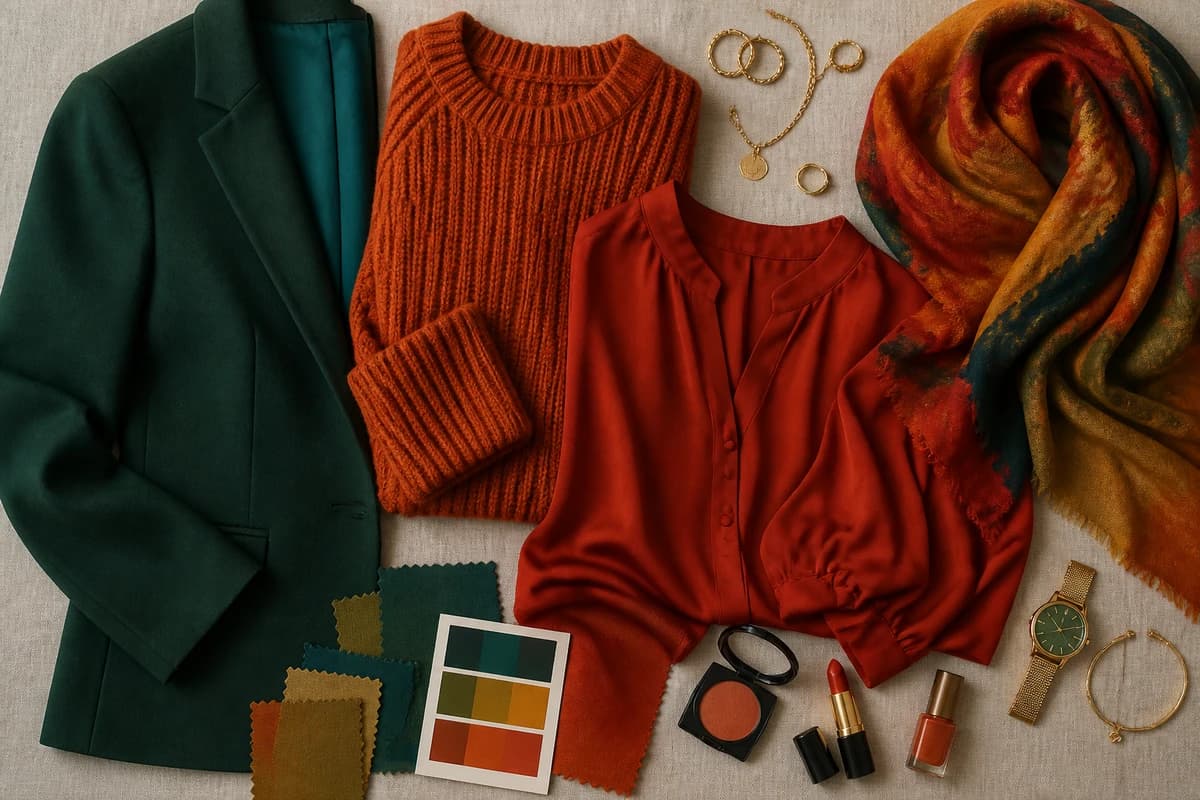
Twelve pieces that all mix: a camel coat, chocolate trousers, warm-washed indigo jeans, a warm cream shirt, a rust knit, a mustard or golden-olive top, a terracotta blouse, a forest green dress, a warm teal scarf, a tan leather jacket, cognac boots and a chocolate bag. Every piece shares the same warm, earthy base, and when you want contrast you use chocolate or forest rather than black.
Prints, fabrics and denim
Autumn suits prints: paisley, leopard and tortoiseshell, plaid in rust and olive, dark florals on cream or forest grounds, ikat and other prints in spice tones. Textured, matte, natural fabrics flatter it (suede, tweed, corduroy, linen, cashmere, leather, raw silk), while cool-looking high-shine fabrics fight it. Denim belongs here too: a warm-washed, slightly faded blue sits with these colors better than a crisp blue-black one.
Autumn makeup and hair at a glance
Across the family, Autumn makeup is warm and earthy: brick, terracotta, warm brown-red and soft coral lips; peachy-bronze or warm apricot blush; copper, moss, bronze and warm-brown eyes, with a warm brown or bronze liner instead of black. Soft Autumns keep it muted, Deep Autumns can take it richer, and cool pinks, blue-reds and stark black liner fight all three. Hair is warm too: golden brown, copper, auburn, warm chestnut and rich honey share the skin's gold, while ashy and jet-black tones pull the warmth out and can read sallow. The copper and auburn guides cover Autumn's signature hair colors, lipstick by season has the lip shades for each sub-type, and the Soft, True and Deep Autumn makeup guides do the full face.
Nails
The same colors work on nails: terracotta, brick, rust, olive, chocolate, copper and warm nude. A warm red with brown in it is the classic. Cool pastels and blue-based reds look out of place next to warm skin.
Jewelry, glasses, shoes and bags
Warm gold, copper, bronze and brass; stones in amber, tiger's eye, carnelian, garnet, jade and turquoise; tortoiseshell, wood, leather and horn. Glasses in tortoiseshell, amber, olive, bronze or warm brown.
For shoes and bags, cognac, tan, chocolate and olive leather are the Autumn versions of black and do the same job. Suede in camel or rust suits the season's matte texture, and a burgundy or oxblood shoe is the dressier option. Deep Autumns can carry dark espresso leather that reads almost black.
Where to start
Look at what you already own before buying anything. Pull out everything camel, brown, olive, rust and cream; for most Autumns that is already the start of a working wardrobe. Then add the one piece that will be closest to your face most often, usually a knit or a scarf, in the signature color that suits your sub-type: soft coral or sage for Soft, rust or pumpkin for True, deep teal or aubergine for Deep. If you are not sure which sub-type you are, start with terracotta and warm teal, the two colors in the table above that suit all three, and pin down your exact Autumn with the Soft, True or Deep Autumn guide.
Frequently asked questions
What is the Autumn color palette?
Autumn is a warm, earthy, medium-to-deep palette that runs from muted to rich: pumpkin, rust, terracotta, mustard gold, golden olive, forest green and warm teal, with warm neutrals such as cream, camel and chocolate brown. Icy pastels, cool gray-blues and stark black and white are the colors it leaves out.
What are the Autumn colors?
The signature Autumn colors are pumpkin, rust, terracotta, tomato red, mustard gold, golden olive, moss, forest green, warm teal and soft coral, supported by cream, camel, warm beige, chocolate and bronze. They are the colors of the season itself: leaves, bark, spice, moss and harvest gold.
Is Autumn warm or cool?
Warm. Autumn is one of the two warm season families, with Spring. The undertone is golden rather than blue-based, which is why earthy, sun-warmed colors flatter it and icy or cool colors tend to look off against the skin.
Am I an Autumn?
You are likely an Autumn if warm gold jewelry flatters you more than silver, cream looks better on you than stark white, and rich earth tones brighten your face while cool pastels drain it. Autumn skin usually has a golden or warm-peach cast. Check in daylight and without a tan if you can. A photo-based color analysis confirms it and tells you which of the three Autumn sub-types you are.
What are the three Autumn sub-types?
Soft Autumn (warm and muted), True Autumn (the most purely warm and the richest) and Deep Autumn (warm and the darkest, bordering Winter). All three are warm and earthy; they differ in how soft, rich or deep the coloring is. Some systems add a fourth, such as a Cool Autumn, or call True Autumn Warm Autumn.
What colors should an Autumn avoid?
Cool and icy tones (icy blue, fuchsia, cool gray), stark white, pure black near the face, and clear cool pastels like baby pink or mint. They clash with Autumn's warm, golden coloring and either gray out the skin or look harsh against it.
What are the best Autumn neutrals?
Camel and chocolate brown are the workhorses, with warm cream as the white and bronze or olive as extra darks. Warm beige, tan, cognac, a warm navy and a warm-washed denim all work. Black, cool gray and optic white are the ones to leave out or keep away from the face.
What is the difference between Autumn and Spring?
Both are warm, but Spring is clear and light (coral, golden yellow, turquoise) while Autumn is muted to rich and medium to deep (rust, olive, mustard). If clear, bright warm colors flatter you more than earthy ones, you are probably a Spring; if earthy beats bright, an Autumn.
Can Autumns wear black?
Most color analysis guides say not near the face, and suggest chocolate brown, espresso, forest green or a warm navy instead. Some allow black for Deep Autumns, who sit next to Winter, or in shoes, trousers and bags away from the face. If you love black, wear it below the waist or with a warm color at the neckline.
Should Autumns wear gold or silver?
Gold, copper, bronze and brass are the usual advice, because they echo the gold in Autumn skin. Guides disagree on silver: some rule it out, others allow a soft, brushed or oxidized silver for Soft Autumns. Bright, polished silver and platinum are the metals most likely to look cold.
Can an Autumn have blue eyes?
Yes, though it is less common. Most Autumns have brown, hazel, amber or olive-green eyes, but some have teal, turquoise or blue-green eyes, often with a gold or brown ring around the pupil. Season is decided by the skin, hair and eyes together, so blue eyes on their own do not rule Autumn out.
Related guides

Soft Autumn Color Palette: The Complete Guide (with Hex Codes)
A color analyst's complete Soft Autumn guide, your exact palette with hex codes, best neutrals and metals, colors to avoid
Deep Autumn Color Palette: The Complete Guide (with Hex Codes)
The complete Deep Autumn (Dark Autumn) color palette, 30+ colors with hex codes, neutrals and metals, an at-a-glance profile, Deep Autumn vs Deep Winter, makeup, hair and a capsule wardrobe.
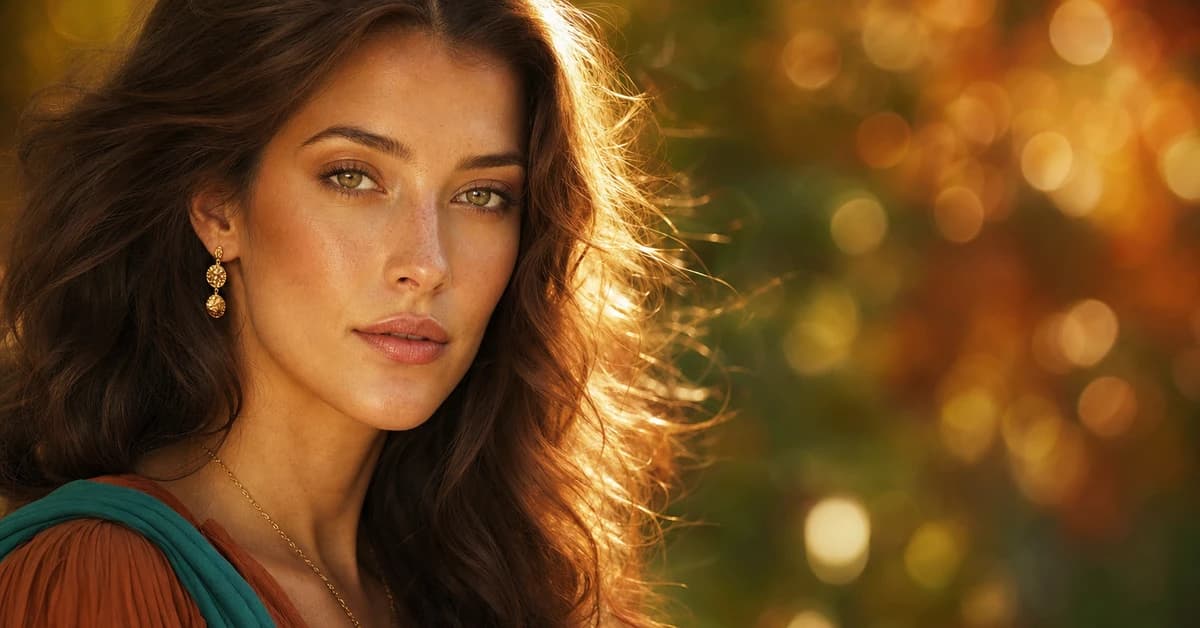
True Autumn Color Palette: The Complete Guide (with Hex Codes)
A color analyst's complete True Autumn guide, your palette with hex codes, best neutrals and metals, colors to avoid
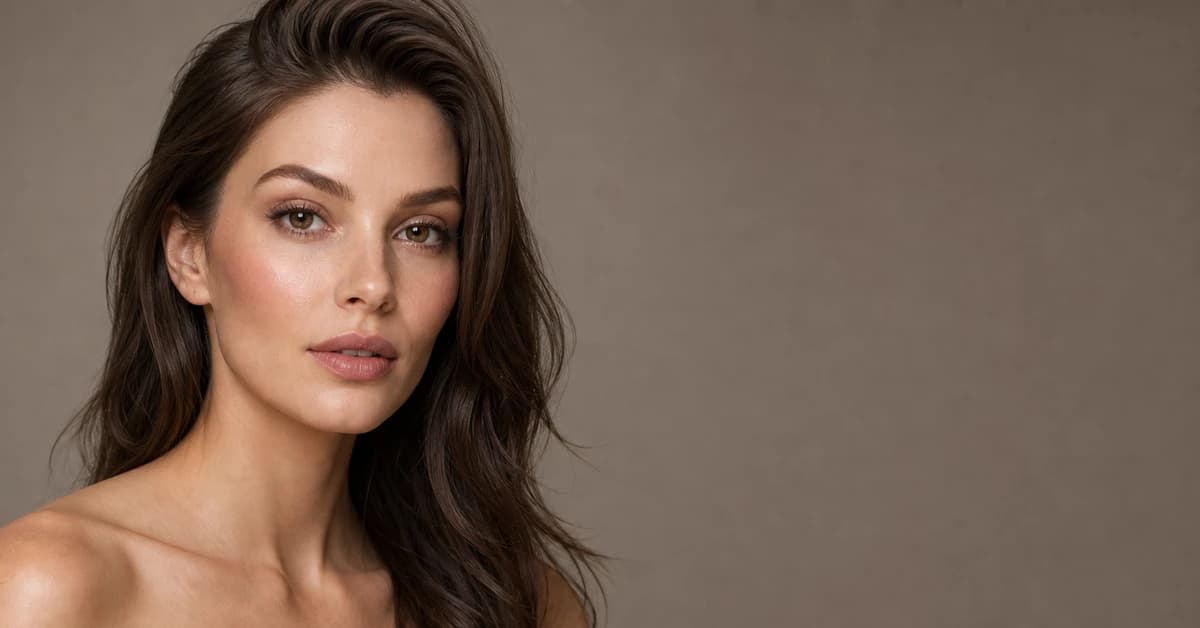
Soft Autumn Celebrities
A color analyst on so-called Soft Autumn celebrities, why the lists disagree, the traits to look for, the palette, and how to find your own season.
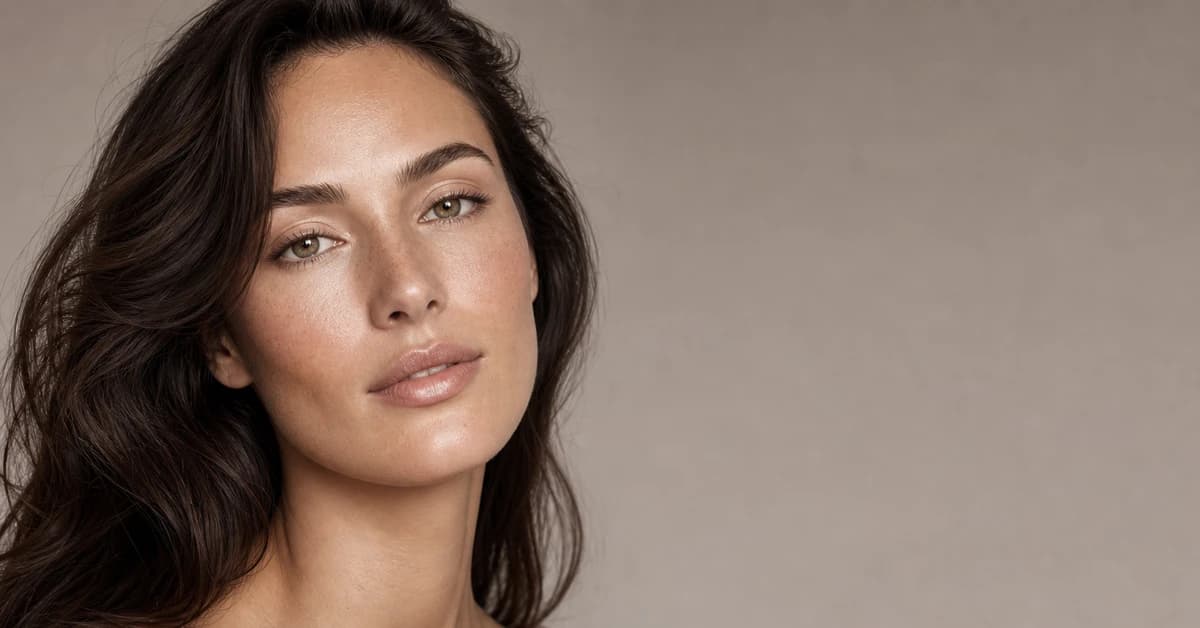
True Autumn Celebrities
A color analyst's hedged take on likely True Autumn celebrities, the warm, rich, muted traits that signal this season, plus how to find your own.
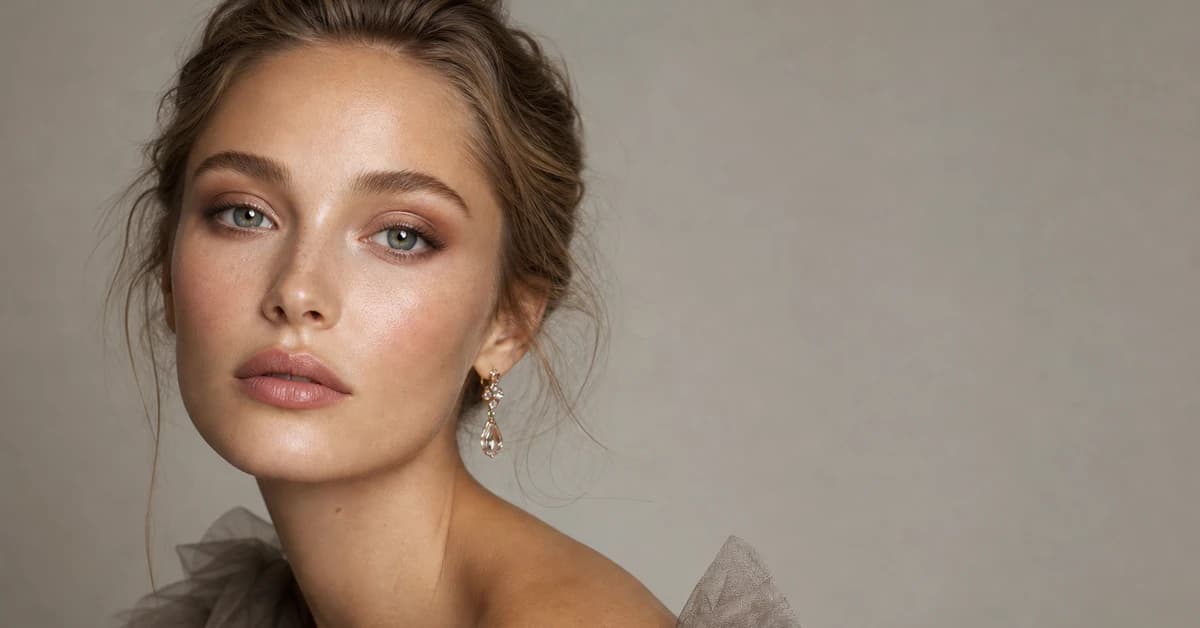
Warm Autumn Color Palette (a.k.a. True Autumn)
A color analyst explains the warm autumn palette, your best colors and hex codes, why warm autumn and true autumn are the same season
Prefer in person? Find color analysis near you
Browse local color analysts by city, or get the same season, palette and best-colors breakdown online from one selfie.
See your colors on a photo of you
Upload one selfie and ToneLala reveals your season, your full palette, and your best hair, makeup, jewelry and outfits, styled on you.