In a sentence: olive skin is a complexion with a soft green or gray-green cast over its base tone, sitting over a warm, neutral or cool undertone. It is flattered by slightly muted jewel colors like teal, olive, peacock, rust and plum, and most often maps to True Autumn, Deep Autumn or Deep Winter. Skip to the full palette or find your season.
Olive Skin Tone: The Complete Guide
By ToneLalaUpdated October 6, 2026
Contents
- 01 What olive skin actually is
- 02 Light, medium and deep olive skin
- 03 Where olive skin is common
- 04 How to tell if you have olive skin
- 05 Olive skin vs warm skin
- 06 Is olive skin warm, cool or neutral?
- 07 The seasons olive skin maps to
- 08 The most flattering colors for olive skin
- 09 Colors that work against olive skin
- 10 Foundation and makeup for olive skin
- 11 Hair color for olive skin
- 12 Celebrities often described as having olive skin
- 13 Where to start if you think you are olive
Olive skin is a skin tone with a green, gray-green or golden-green quality over its base color. Wikipedia's entry places it roughly at Types III, IV and V on the Fitzpatrick scale, the dermatology scale that sorts skin by how it reacts to the sun, and describes it as lighter brown tones with greenish, yellowish or golden undertones.
It is also the skin tone people most often fail to name. It gets called "Mediterranean", "tans easily" or simply "neutral", and then dressed in beige, black and cool pastels that work against it. A common clue is foundation: shades that look right in the bottle turn orange, pink or gray on the face by lunchtime, because most ranges are built on pink or yellow bases and olive is neither.
What olive skin actually is
Olive skin is defined by a green or gray-green cast over the base complexion. It is easy to confuse with two things it is not. It is not simply "skin that tans", since plenty of warm skin tans without any green in it. And it is not a level of depth: you can be fair olive, pale with an ashy-green quality, or deep olive, rich and tanned, or anywhere between.
No dermatology source we found explains the green on its own. Skin color comes mainly from melanin and hemoglobin, with a much smaller contribution from carotenoids in the diet, and olive is how some combinations of these read to the eye: warmth with the brightness turned down. You see it most clearly in the shadows of the face, under the eyes, along the jaw and at the sides of the nose, rather than on the cheeks. Hold a sheet of bright white paper to your face in daylight and the muted, faintly green or gray character stands out against the white.
Light, medium and deep olive skin
Because olive is a cast, it appears at every depth, and depth changes how it looks.
Fair or light olive
Often described as pale with a yellow or "sallow" tinge. The green is subtle and shows mainly in shadow, and pale pastels make it obvious. Fair olive skin can still burn before it tans. The fair olive skin guide covers colors for this depth.
Medium olive
The complexion most people picture when they hear "olive": a light to mid tan with a golden-green cast that deepens easily in the sun. Foundations labeled plain "warm" or "golden" often turn orange on it.
Deep olive
Tan to deep skin with a green or gray-green quality. The cast is harder to see on the surface and shows up instead when a foundation or concealer looks ashy or gray. The deep olive skin guide goes into this depth.
Where olive skin is common
Olive skin appears across many ancestries. Wikipedia lists the Mediterranean, West Asia and the Middle East, South Asia, parts of East Asia, North Africa and the Americas, and notes it in some Northern Europeans too. None of the sources we checked gives a reliable figure for how common olive skin is. Healthline describes it as less common than warm, cool or neutral skin, though that may say more about how rarely it is named than about how rarely it occurs.
The common thread is always the green-gray quality, never a particular depth or background.
How to tell if you have olive skin
The cast is hard to see when you look straight for it, so it is easier to spot by how your skin behaves. If several of these apply, you are very likely olive:
- The white-paper test. In soft daylight, hold a sheet of pure white paper beside your bare face. Pink-toned skin looks rosy against it and golden skin looks clearly yellow. Olive skin looks muted, slightly green or gray, as if someone turned the saturation down.
- Baby blue makes you look ill. Cold, chalky pastels such as baby blue, lilac and icy pink drain olive skin quickly and give it a gray, tired look.
- Beige and khaki disappear on you. Colors close to your own tone merge with the skin, and the face goes flat. If "nude" tops make you look washed out, that points to olive.
- Foundations go orange or gray. Pink-based shades turn gray or ashy, and many yellow-based shades turn orange or brassy.
- You tan more than you burn. Most olive skin deepens in the sun rather than staying pink, though fair olive skin can still burn.
- Both metals seem fine. Beautylish and RMS Beauty both list wearing gold and silver equally well as a sign of olive skin.
None of these alone proves it. The most telling pair is the white-paper test and the baby-blue test: muted green against white, and visibly drained beside a cold pastel.
What about the vein test? Checking whether the veins on your wrist look green or blue appears on almost every page about undertone. It is one of the weaker checks, and color-analysis.app calls it unreliable for olive skin in particular, because vein color also depends on how deep the veins sit and the skin over them. Use it as a tiebreaker at most.
Olive skin vs warm skin
This is the confusion that sends olive skin toward the wrong foundation and the wrong clothes.
| Warm (golden) skin | Olive skin | |
|---|---|---|
| Next to white paper | Clearly yellow, golden or peachy | Muted, slightly green or gray |
| Yellow-based foundation | Usually matches | Often turns orange or brassy |
| Beige and camel at the face | Usually flattering | Can merge with the skin |
| Clear warm brights (marigold, bright coral) | Usually flattering | Can look harsh; slightly muted versions work better |
| Undertone | Warm | Warm, neutral or cool under the cast |
Olive skin can have a warm undertone under the cast, which is exactly why the two get mixed up. If you have always been told you are warm but golden foundations never match, olive is the likely explanation. Olive also differs from neutral skin without a cast: neutral skin looks balanced, neither pink nor yellow, against white paper, with no green or gray quality.
Is olive skin warm, cool or neutral?
The ranking guides do not agree, and the disagreement is useful to know about.
- RMS Beauty describes olive as a neutral skin tone.
- Healthline describes olive skin as having neutral and warm undertones along with green.
- IPSY quotes makeup artist Bethany Brenneman saying that about 90% of the olive skin she sees has a cool undertone.
- Beautylish and color-analysis.app say olive can sit over warm, neutral or cool, and color-analysis.app calls olive an appearance rather than a temperature.
The way through is to treat olive as a cast and the undertone as a separate question. Undertone is the warm, cool or neutral direction underneath; olive is the green-gray quality over the top, and the two coexist. Some olive complexions lean clearly warm and glow in rust and mustard. Others run cooler and rosier and look better in teal, plum and a raspberry-leaning pink. That is why two people who both honestly call themselves "olive" can suit noticeably different palettes. The olive skin undertones guide walks through five tests for olive specifically, and how to find your undertone covers the general method.
The seasons olive skin maps to
Olive carries both a depth and a cast, so it does not belong to one season. Undertone and contrast decide which.
- True Autumn: the usual home for warm olive skin. Golden, earthy and muted: rust, mustard, olive and warm teal. If gold is clearly your metal, this is the likeliest fit.
- Deep Autumn: deeper, richer olive with more contrast. The warmth stays, in darker and more saturated versions.
- Deep Winter: where cooler, rosier olive skin tends to sit. Teal, plum, aubergine and a clear raspberry pink suit it, the neutrals turn crisper, and contrast runs higher.
- Soft Autumn: softer, lower-contrast olive, where every color is a notch less clear. Muted olive with a cooler lean can also land in Soft Summer.
The colors below flatter across all of these. What changes from season to season is the temperature and clarity of each shade: how warm, how deep, how clean. A generic chart cannot read that for you. Our color analysis guides cover each of the twelve seasons, and a personal analysis tells you which one your olive skin belongs to.
Not sure which season your olive skin lands in?
Find your color season →The most flattering colors for olive skin
These colors are warm, saturated and slightly softened, never icy or chalky. Olive skin already contains green, so the greens and blue-greens repeat the cast and make it look deliberate, while the warm reds and plums sit opposite it on the color wheel and make the skin look clearer.
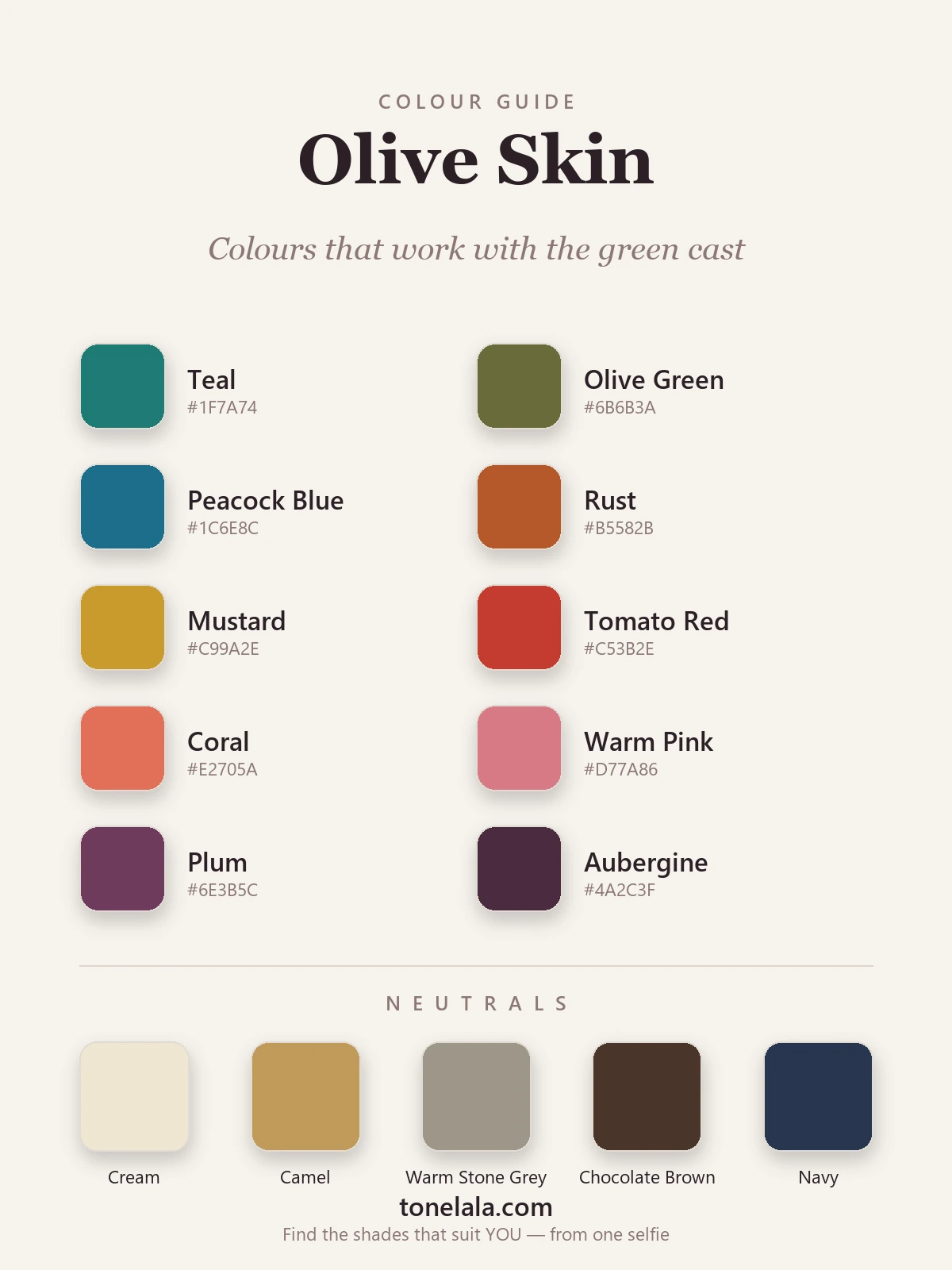
| Color | Hex | Why it works |
|---|---|---|
| Teal | #1F7A74 |
The safest single color for olive skin. Its blue-green echoes the cast and clears the complexion. |
| Olive Green | #6B6B3A |
The tonal match. Wearing your cast as a color looks intentional. Choose a rich olive, not flat khaki. |
| Peacock Blue | #1C6E8C |
A bolder relative of teal. The touch of green in the blue keeps it on olive's side. |
| Rust | #B5582B |
Warm and earthy. It brings heat into the skin and makes olive look sun-warmed rather than tired. |
| Mustard | #C99A2E |
A deep golden yellow. Some guides list mustard as one to avoid, so test it in daylight; it suits medium and deep warm olive better than fair or cool olive. |
| Tomato Red | #C53B2E |
A warm, slightly orange red, opposite green on the wheel. The liveliest red for golden olive complexions. |
| Coral | #E2705A |
A softer warm note for daywear, warm enough to lift the face. |
| Warm Pink | #D77A86 |
A dusty rose with warmth in it, much kinder to olive than cold bubblegum pink, which grays it out. |
| Plum | #6E3B5C |
A muted berry purple that gives cooler-leaning olive skin depth without going harsh. |
| Aubergine | #4A2C3F |
A deep purple-brown that works as an alternative to black at the face. |
Best neutrals: Cream #EFE6D2 (a warm off-white, kinder than stark white), Camel #C19A5B (a tonal base that suits most olive skin), Warm Stone Gray #9E978A (a soft greige that does not drain the way cool gray can), Chocolate Brown #4A352A (a dark that is warmer at the face than black) and Navy #27364F (the usual stand-in for black).
The olive skin color palette breaks this down by depth with outfit formulas, the best colors for olive skin guide goes further on season links, and there is a separate page on the best colors for olive skin and brown eyes if that is your combination.
Colors that work against olive skin
- Cold pastels: baby blue, lilac, icy pink, mint and pale lemon. They push the cast forward and make the skin look tired.
- Beige, khaki and sand at the face. Below the waist they are fine; as a top or scarf they merge with the skin.
- Neon brights. Every ranking guide we checked puts neon on the avoid list.
- Stark optic white on fair and medium olive. Cream and ivory are easier. Deep olive skin usually carries crisp white well.
- Pure black on lighter olive. It can cast gray shadows. Navy, aubergine and chocolate do the same job more kindly; deep or high-contrast olive often wears black well.
Foundation and makeup for olive skin
Foundation is where olive skin is let down most often, and the advice disagrees in the details. Healthline says a warm, yellow foundation is usually a mistake for olive skin; RMS Beauty suggests a neutral foundation with a green undertone, moving to gold or amber bases for deeper olive; Beautylish notes that true olive shades look more green-gray and muted in the bottle than standard ones.
In practice:
- Look for shades labeled olive or neutral-olive first. Several brands now name them that way.
- Test on the jaw, not the hand, and check it in daylight after a few hours, since the color shifts as it settles.
- Read the failure. If a shade turns orange or brassy, go more neutral or more olive. If it looks gray or ashy, go a little warmer or deeper.
For color, borrow from the wardrobe palette. Blush in brick, terracotta or muted rose-brown; lips in tomato, brick, cranberry or a warm rose-brown nude, with berry and raspberry for cooler olive; eyes in bronze, copper, moss, teal and plum. The foundation shade guide covers matching in detail.
Hair color for olive skin
Hair-color guides for olive skin tend to recommend warm or neutral browns such as chestnut, caramel, honey brown, espresso and mahogany, and to warn against ashy blonde and cool platinum, which can make olive skin look sallow. Cooler olive skin can carry a neutral or slightly cool brown. The hair color for your skin tone chart has the full breakdown.
Celebrities often described as having olive skin
These are examples of the look, not proof of a type: celebrity skin is seen through studio lighting, makeup and editing, and lists disagree.
- Eva Mendes and Jennifer Lopez are named by Beautylish in its guide to olive undertones.
- Salma Hayek is named by EX1 Cosmetics and by other olive skin roundups.
- EX1 also groups examples by depth, from paler olive (Audrey Tautou) through medium (Meghan Markle, Freida Pinto) to deeper olive (Zoe Saldaña).
- Wikipedia's article illustrates olive skin with photos of actor Aidan Turner and footballer Mohamed Salah.
Where to start if you think you are olive
- Run the two tests that matter most: white paper against your bare face in daylight, then a baby blue or lilac top next to a teal one. Muted against white and drained in the pastel is the olive signature.
- Settle the undertone separately. Try gold and silver at the jaw, and cream against stark white. That tells you whether to lean toward rust and mustard or toward teal, plum and berry.
- Change one thing near your face. Swap a beige or black top for teal, and keep everything else the same. The difference shows best in a mirror by a window.
- Fix the foundation last, once you know the undertone, using an olive-labeled shade tested on the jaw.
If the tests leave you between two answers, a photo-based color analysis reads undertone, depth and contrast together and places your olive skin in a season with its exact palette.
Frequently asked questions
What is olive skin tone?
Olive skin is a complexion with a soft green, gray-green or golden-green cast over its base color. The cast defines it, not the depth, so olive skin runs from fair to deep. Wikipedia places it roughly at Types III to V on the Fitzpatrick scale. The green is easiest to see in the shadows of the face, under the eyes and along the jaw.
How do I know if I have olive skin?
Hold a sheet of pure white paper beside your bare face in daylight. Olive skin looks muted and slightly green or gray next to it, rather than clearly pink or clearly golden. Other signs: baby blue and lilac make you look tired, beige and khaki tops seem to disappear on you, foundations turn orange or gray on your face, and you tan more easily than you burn. Two or three of these together point to olive.
What undertone does olive skin have?
Sources disagree. RMS Beauty calls olive a neutral skin tone, Healthline describes neutral and warm undertones with green, and a makeup artist quoted by IPSY says about 90% of the olive skin she sees is cool. Beautylish and others say it can be any of the three. The useful view is that olive is a cast over a warm, neutral or cool undertone, so test the undertone separately; it decides which version of each color suits you.
What color season is olive skin?
Warm olive skin most often lands in True Autumn or Deep Autumn, and cooler, rosier olive in Deep Winter. Softer, lower-contrast olive can sit in Soft Autumn or Soft Summer. Olive alone does not decide the season; undertone, depth and contrast do, which is what a personal color analysis reads.
What colors look best on olive skin?
Slightly muted, jewel-leaning colors: teal, olive green, peacock blue, rust, mustard, tomato red, coral, warm pink, plum and aubergine. The greens and blue-greens repeat the cast so it looks intentional, and the warm reds and plums sit opposite it and make the skin look clearer. Cream, camel, warm stone gray, chocolate and navy are the neutrals.
Can you have pale or fair olive skin?
Yes. Olive describes the cast, not the depth, so fair olive skin exists and is often mistaken for pale skin with a yellow or sallow tinge. It shows the same signs: muted next to white paper, drained by icy pastels, and hard to match with pink or yellow foundations. Fair olive skin may burn before it tans.
Is olive skin the same as warm skin?
No. Warm skin looks clearly golden or peachy next to white paper and usually suits clear warm colors and yellow-based foundation. Olive skin looks muted and slightly green or gray beside white, and yellow-based foundations often turn it orange or brassy. Olive skin can have a warm undertone underneath the cast, which is why the two get confused.
Should olive skin wear gold or silver?
Many olive complexions can wear both, which Beautylish and RMS Beauty list as a sign of olive skin. Gold usually suits olive skin with a warm undertone, and silver or white gold suits cooler, rosier olive. Hold each against your jaw in daylight; the one that makes the skin look clearer, not grayer or more yellow, is your better metal.
Related guides
Neutral Skin Tone: Undertones & Best Colors
A color analyst explains what a neutral skin tone is, how to tell if you have one, and the versatile colors and seasons that suit it (with hex codes).
Light Brown Skin Tone: Best Colors
A color analyst's guide to light brown skin tone, how to spot it, read your warm, cool or neutral undertone
Golden (Warm) Skin Tone: Best Colors
A color analyst's guide to a golden, warm skin tone, how to confirm it, the warm seasons that suit it, and 10 flattering colors with hex codes.
Warm-Toned Skin: How to Tell & Best Colors
How to tell if you have warm-toned skin, the vein, jewelry and white-paper tests, plus the colors, metals and neutrals that flatter warm skin
Olive Skin Undertones: Warm, Cool and Neutral Olive Explained
Olive skin is a green-gray cast that can sit over a warm, neutral or cool undertone. Five daylight tests to tell which olive you are, with the colors, makeup, hair and seasons for each.
Warm vs Cool Undertones
A color analyst's guide to warm vs cool undertones: simple at-home tests, the neutral middle ground, and example colors with hex codes for each.
Prefer in person? Find color analysis near you
Browse local color analysts by city, or get the same season, palette and best-colors breakdown online from one selfie.
See your colors on a photo of you
Upload one selfie and ToneLala reveals your season, your full palette, and your best hair, makeup, jewelry and outfits, styled on you.