Quick answer: Winter is the cool, deep, high-contrast color family, clear, saturated jewel tones, icy pastels, and the crisp black-and-white most seasons can't pull off. Skip to the full palette with hex codes, the three sub-types compared, or find your own season from a selfie.
Winter Color Palette: The Complete Guide (with Hex Codes)
By ToneLalaUpdated September 21, 2026

Contents
- 01 Winter at a glance
- 02 What makes a Winter
- 03 The three Winter sub-types
- 04 The Winter palette
- 05 Colors to avoid (and why)
- 06 How to tell which Winter you are
- 07 Winter outfit formulas
- 08 A Winter capsule wardrobe
- 09 Prints, fabrics and denim
- 10 Winter makeup & hair at a glance
- 11 Jewelry and glasses
- 12 Winter celebrities, with a caveat
- 13 Where to start with a Winter result
Winter is the easiest color family to spot from across a room and the hardest for people to place in themselves. The coloring has a built-in drama: eyes that hold their own against dark hair, skin that reads clean and cool rather than golden, a face that looks as if someone nudged the contrast up. Most Winters have also been told for years to "soften," and own a drawer of dusty rose and warm taupe that quietly drains them. A true red or a sapphire held to the face does the opposite, and the difference is visible in seconds.
This is the complete overview for the entire Winter family: an at-a-glance profile, what every Winter shares, the three sub-types compared, the full palette in categories with hex codes, a practical way to work out which Winter you are, plus makeup, hair, jewelry, prints and a capsule wardrobe. If you already know your sub-type, jump straight to its guide, Deep Winter, True Winter or Bright Winter.
Winter at a glance
| Winter family | |
|---|---|
| Undertone | Cool, blue-based, never golden |
| Depth (value) | Deep, or carried by high contrast |
| Chroma | Clear and saturated, never muted |
| Contrast | High, dark hair or eyes against clear skin |
| Typical hair | Black, blue-black, espresso, cool dark brown, occasionally ash or platinum |
| Typical eyes | Dark brown, black-brown, clear cool blue, icy gray, cool green |
| Typical skin | Porcelain, cool beige, cool olive, cool tan, deep with a blue or ebony cast |
| Best "dark" | Black, the one family that wears it at the face |
| Best "white" | True optic white |
| Metals | Silver, white gold, platinum |
| Sub-types | Deep Winter · True Winter · Bright Winter |
| Signature colors | True red, fuchsia, sapphire, emerald, royal purple, icy pastels |
What makes a Winter
Every season in color analysis sits on three dials, and the Winter family lands the same way on all three:
- Undertone: cool. This is non-negotiable for a Winter. Blue-based reds, icy pinks and crisp whites flatter you; golden and earthy tones pull you off-balance.
- Value: deep, or carried by high contrast. Winter coloring is built to handle darkness near the face, whether that's deep hair, deep eyes, or a striking light-skin-against-dark-hair contrast.
- Chroma: clear and saturated. Winter wants color with intensity. Grayed-down, dusty, muted tones read as "tired" against it.
Add those up and you get the family signature: cool, clear, high contrast. Winter is the only family where solid black and true white genuinely work near the face, softer seasons get swallowed by them, but a Winter rises to meet them. If a color makes your features look hazier than the garment, it's too muted or too warm to be a true Winter shade.
The most common mistake in self-typing is a cool-but-soft person deciding they are a Winter. Coolness alone doesn't make a Winter, the cool Summers are cool too. What separates them is chroma and contrast: a Summer is flattered by softness, a Winter is flattered by clarity. If clear jewel tones feel a shade too strong on you and dustier versions sit more comfortably, you're likely a Summer, not a Winter.
The three Winter sub-types
| Deep Winter | True Winter | Bright Winter | |
|---|---|---|---|
| Undertone | Cool-neutral | Purely cool | Cool-neutral |
| Depth | Deepest | Deep | Medium-deep |
| Chroma | Clear | Clear and icy | Most vivid of all 12 seasons |
| Contrast | High | High | Highest |
| Signature colors | Pine, deep emerald, sapphire, true red | Blue-red, icy pastels, stark black-and-white | Hot pink, electric blue, bright emerald |
| Mistaken for | Deep Autumn | Soft Summer (if soft-featured) | Bright Spring |
| Full guide | Deep Winter | True Winter | Bright Winter |
Deep Winter is the darkest and richest of the three. It leans a touch more neutral than the others, which is exactly what lets it own the deepest jewel tones, pine, deep emerald, sapphire, alongside the brights. If you read as dramatic and your best colors are deep and saturated rather than electric, start here.
True Winter is the purest, iciest cool of the family, cool with no warm edge at all. It's the most classically "icy" Winter: blue-reds, stark icy pastels, sharp black-and-white. If pure coolness suits you better than either depth or electricity, you're likely True.
Bright Winter is the brightest, most electric Winter, in fact the highest-chroma season of all twelve. It carries a faint cool-neutral edge that lets it go fully vivid: hot pink, electric blue, bright emerald. If the very clearest, most charged colors light up your face, lean Bright.
Picture the three on a line. True Winter is the cool anchor in the middle. Deep Winter is that same coolness pulled darker and richer; Bright Winter is the same coolness lit from within, turned electric. They overlap generously, a color like true red or a clean sapphire suits all three, which is exactly why people get stuck between them, and why the palette below works as a family.
The Winter palette
Clear, cool and saturated, spanning all three sub-types. The chart shows ten signature colors and five neutrals; the tables expand it to more than thirty shades with the sub-type that wears each best.
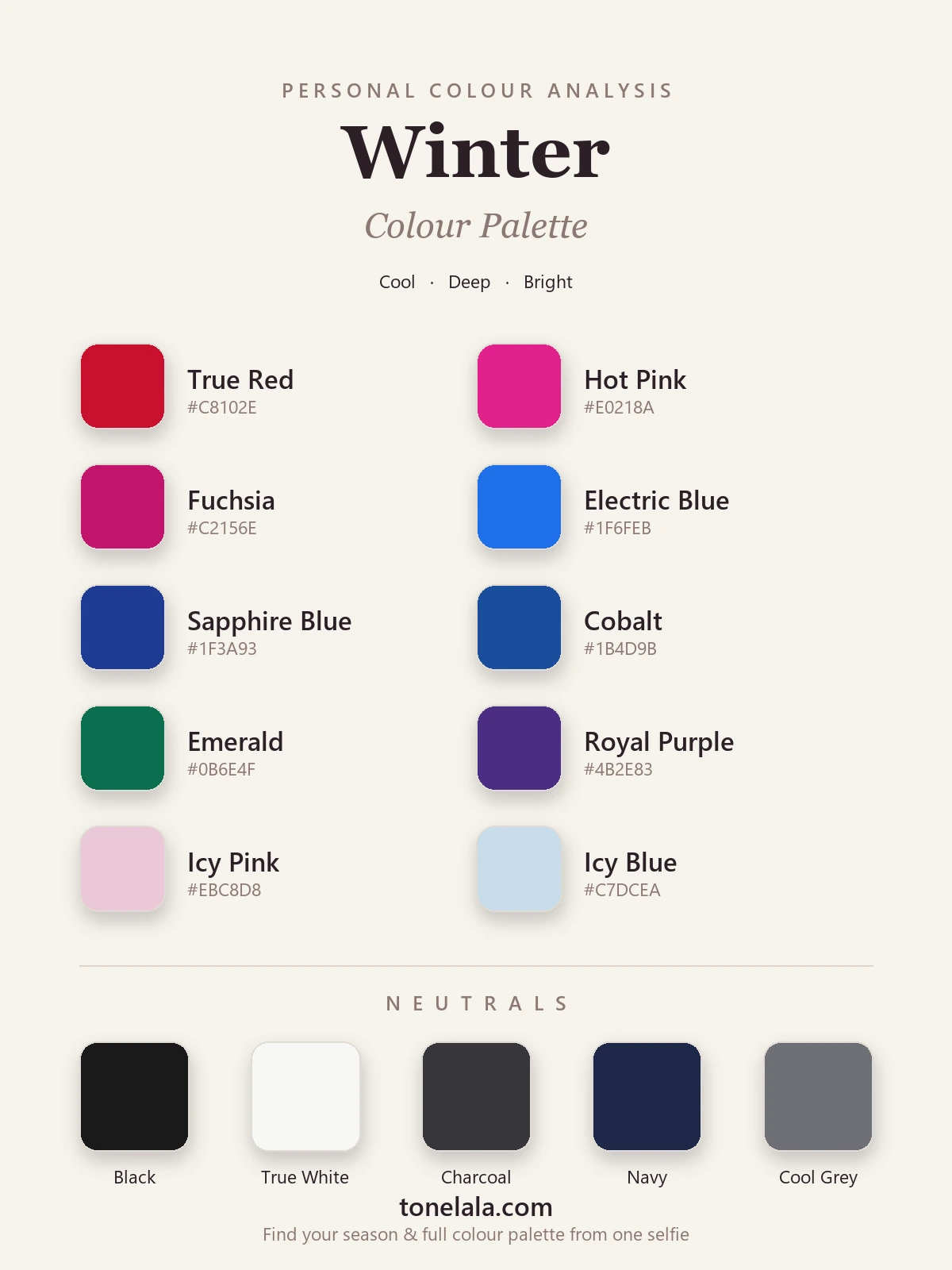
Signature Winter colors
| Color | Hex | Best sub-type |
|---|---|---|
| True Red | #C8102E |
All three |
| Hot Pink | #E0218A |
Bright, True |
| Fuchsia | #C2156E |
All three |
| Electric Blue | #1F6FEB |
Bright |
| Sapphire Blue | #1F3A93 |
Deep, True |
| Cobalt | #1B4D9B |
All three |
| Emerald | #0B6E4F |
Deep, Bright |
| Royal Purple | #4B2E83 |
Deep, True |
| Icy Pink | #EBC8D8 |
True, Bright |
| Icy Blue | #C7DCEA |
True |
Icy lights: Winter's pastels are frosted, not dusty: Icy Lavender #D6CBEA, Icy Mint #C8EADF, Icy Lemon #F3F0C4, Icy Gray #D9DCE3, Icy Violet #C9BCE8, Icy Aqua #BFE6EA.
Brights: the electric end: Magenta #B0287A, Cherry Red #B9122E, Bright Turquoise #1AB0BF, Violet #7A3FC9, Bright Emerald #0E9E6A, Lemon Yellow #F2E23A (Bright Winter only).
Darks: Winter goes as deep as color goes: Pine #14533C, Deep Emerald #0B4F3A, Wine #5C1A33, Damson #3E1F4E, Midnight Blue #141E3C, Black-Cherry #3A0F1E.
Neutrals: and here's the Winter superpower: Black #1A1A1A and True White #F7F7F4 genuinely flatter you, the one family that can wear them solid near the face. Round them out with Charcoal #36363B, Navy #1E2749, Cool Gray #6E7076, plus Icy Gray #D9DCE3 and a crisp blue-black denim.
Metals: silver, white gold and platinum, cool and bright, to match your clarity. Yellow gold pulls warm and muddy against a Winter; gunmetal and chrome work.
Not sure which Winter you are?
Find your color season →Colors to avoid (and why)
- Muted, dusty tones: dusty rose, sage, mauve, anything grayed-down. They read "tired" on high-chroma coloring.
- Warm earthy tones: rust, mustard, olive, camel, terracotta, warm gold. These belong to Autumn; on you they turn muddy.
- Washed-out warm pastels: baby pink, peach, butter yellow. Your icy pastels work because they're cool and crisp; warm, weak ones fall flat.
- Warm neutrals: camel, beige, cream, warm brown, tan. Swap for black, white, charcoal, navy, cool gray.
- Golden metals: yellow gold and brass read warm against cool skin.
How to tell which Winter you are
Once you're confident you're cool and high-contrast, the question is which Winter, and it comes down to depth versus brightness.
Start with how your best colors behave. If the deepest, richest versions of cool colors suit you best, and the most electric brights start to feel like they're wearing you, you're likely a Deep Winter. If the brightest, most electric colors light your face up and depth feels a little heavy, lean Bright Winter. And if neither extreme fits, if it's pure, icy coolness that flatters rather than depth or electricity, you're probably a True Winter, the cool center of the family.
A useful gut check: picture a stark icy pastel, a deep sapphire and a hot electric pink against your face. Most Winters look good in all three, but one will clearly outshine the rest, and that's your sub-type talking. Check the border too: if you're deep but warm colors (rust, mahogany) flatter you more, you're a Deep Autumn; if you're bright but warm, a Bright Spring. The reliable way to settle it is a draping session or a photo-based analysis that reads your undertone, value and contrast for you.
Winter outfit formulas
- Black trousers + true white shirt + one jewel tone. The formula for the whole family.
- Navy + icy pink + silver. Cool, crisp, polished.
- Charcoal + emerald + platinum jewelry. Work, with drama.
- True red coat over black. Winter's signature statement.
- Blue-black denim + fuchsia top + white sneakers. Weekend.
- Deep Winter: pine + sapphire + black / True Winter: icy blue + navy + white / Bright Winter: hot pink + electric blue + white.
A Winter capsule wardrobe
Twelve pieces that all mix: a black blazer, black trousers, blue-black jeans, a true white shirt, a true red top, a fuchsia or hot pink blouse, a sapphire or cobalt knit, an emerald dress, an icy pink or icy blue silk top, a navy coat, black boots and a black or silver bag. Two neutrals plus a few jewel tones you love is a whole capsule, because everything in the family shares the same cool, clear DNA.
Prints, fabrics and denim
Winter is the family for graphic prints: black-and-white stripes, houndstooth, bold geometrics, high-contrast florals on black grounds, a single vivid color on white. Fabrics with sheen and structure suit the coloring, satin, silk, patent leather, crisp cotton, structured wool, where fuzzy, matte, "cozy" textures soften the drama. Denim should be a crisp blue-black or a clean cool indigo; warm faded washes read Autumn.
Winter makeup & hair at a glance
Across the whole family, Winter makeup goes bolder and cooler than any other season, and it should. Lips love clear, saturated color: true red, berry, fuchsia and plum, never muddied. Blush wants a cool rose or berry, and Winter is one of the few families that can wear a true black liner and a crisp wing without it overpowering the face. On hair, Winter is cool and deep, espresso, blue-black, cool dark brown, or a genuinely cool dark-with-icy contrast. The most common hair mistake is a Winter adding "warm dimension", caramel, copper or golden balayage, to soften the look. It does not soften; it dulls. Ask for cool tone, not warm. The ash brown guide covers Winter's cool brunette options, hair colors for dark skin the deepest complexions, and lipstick by season has the exact red.
Jewelry and glasses
Silver, white gold, platinum, gunmetal, chrome; stones in diamond, sapphire, emerald, ruby, amethyst, black onyx and crisp white pearl. Yellow gold reads warm and dull. Glasses in black, crisp navy, clear crystal, silver or a bold jewel tone, not tortoiseshell.
Winter celebrities, with a caveat
The names cited most often across color-analysis sites as Winters are Anne Hathaway, Megan Fox, Naomi Campbell, Lucy Liu, Camila Mendes and Zooey Deschanel. Treat the list as a way to picture the coloring rather than as a diagnosis: celebrity typing is done from photographs shot under different lighting with makeup and dyed hair, and the same face is filed under two or three seasons from one site to the next. A Winter lit warmly with a golden balayage can pass for an Autumn on camera.
Where to start with a Winter result
Start with contrast, because it is the thing Winters are usually missing. Put a deep neutral next to one clear, saturated color and let that carry the outfit: black with true red, navy with icy pink, charcoal with emerald. Two neutrals and a few jewel tones make a working capsule, since everything in the family shares the same cool, clear character. The first swaps to make are near the face: a true white shirt instead of cream, a cool berry lipstick instead of a warm nude, and a cool-toned hair color at the next appointment. Knowing the exact sub-type narrows the palette to the precise shades, but the principle holds at every level: on a Winter, clarity reads as polished rather than loud.
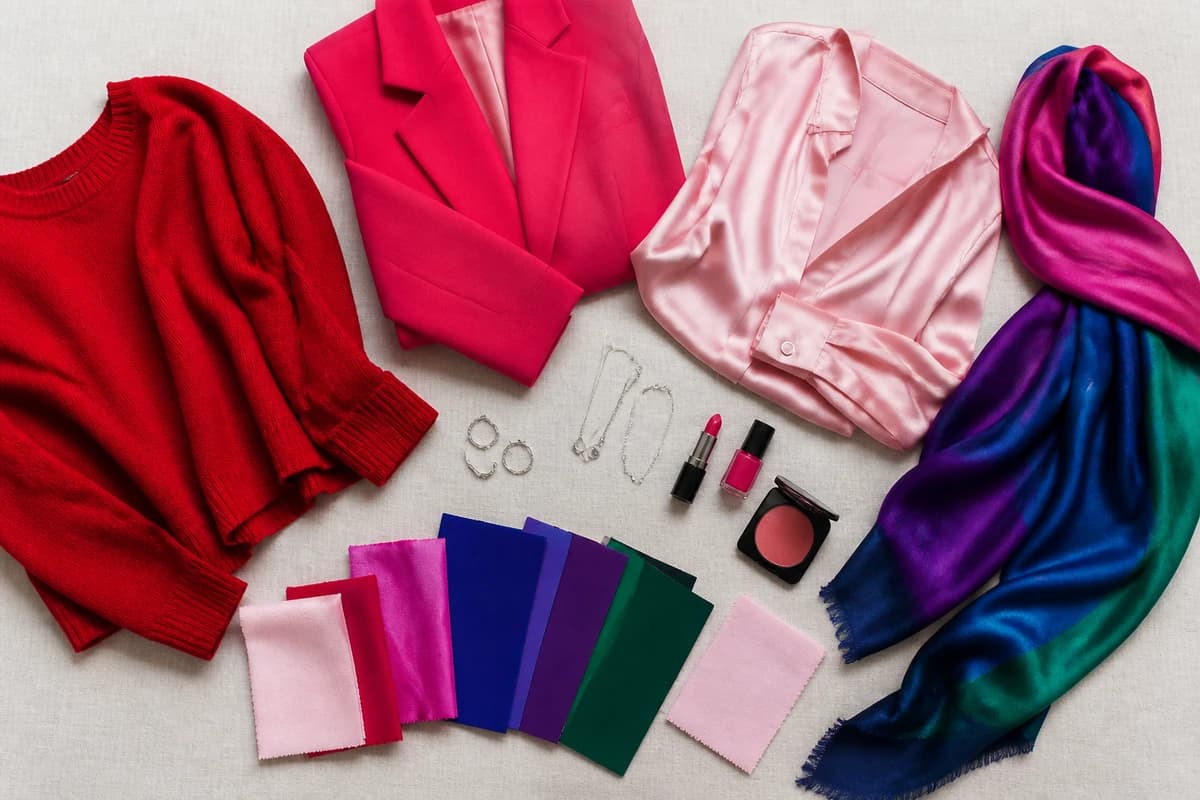
Frequently asked questions
What is the Winter color palette?
Winter is the cool, deep, high-contrast family in seasonal color analysis. The palette is built from clear, saturated colors, true red, hot pink, sapphire, emerald, electric blue and royal purple, plus icy pastels and the crisp neutrals most seasons can't wear, black and true white. Nothing muted, dusty or earthy.
What are the Winter colors?
The signature Winter colors are true red, hot pink, fuchsia, electric blue, sapphire, cobalt, emerald, royal purple, icy pink and icy blue, with black, true white, charcoal, navy and cool gray as neutrals. Every one is clear and cool, jewel tones, ice and stark contrast.
How do I know if I'm a Winter?
Winters share three traits: a cool undertone, a deep or high-contrast look, and skin that comes alive next to clear, vivid color rather than soft, dusty tones. If black and true white flatter you, jewel tones suit you, and muted beiges wash you out, you're almost certainly somewhere in the Winter family.
What are the three types of Winter?
Deep Winter (the darkest and richest, owning the deepest jewel tones), True Winter (the purest, iciest cool), and Bright Winter (the brightest and most electric of all twelve seasons). All three are cool and high-contrast; they differ mainly in how dark versus how bright they go.
Can a Winter wear black?
Yes, Winter is one of the few families black genuinely flatters. Cool, deep, high-contrast coloring can carry solid black near the face where softer seasons can't. Pair it with true white or an icy bright for the contrast Winter is built around.
What colors should a Winter avoid?
Muted, dusty and earthy warm tones, rust, mustard, olive, camel, beige, warm gold and muddy browns, all go flat. Washed-out warm pastels do too. Winter coloring wants clarity and contrast, so anything grayed-down or golden fights it.
What are the best Winter neutrals?
Black and true white are Winter's signature neutrals, then charcoal, navy and cool gray. Icy gray, silver and a crisp blue-black denim work too. Camel, beige, warm brown and cream are the ones to leave out.
What is the difference between Winter and Summer?
Both are cool, but Winter is clear, deep and high-contrast, jewel tones, black and white, while Summer is soft, light-to-medium and low-contrast, dusty rose, slate blue, pewter. If clear, vivid color flatters you more than soft color, you're a Winter; if softness flatters you, you're a Summer.
Is there a Soft Winter?
No. The three Winter sub-types are Bright, True and Deep, and all three are clear rather than soft. A person who is cool but flattered by muted, softened colors is a Soft Summer, and someone cool and deep but softer than a Deep Winter is usually a Soft Summer with depth. Softness belongs to the Summer and Autumn families, never to Winter.
Related guides

Deep Winter Color Palette: The Complete Guide (with Hex Codes)
A color analyst's complete Deep Winter (Dark Winter) guide, your exact palette with hex codes, best neutrals and metals, colors to avoid

Deep Winter Celebrities
A color analyst on Deep Winter celebrities, who likely fits the cool, deep, high-contrast season, why the lists disagree

Deep Autumn Color Palette: The Complete Guide (with Hex Codes)
The complete Deep Autumn (Dark Autumn) color palette, 30+ colors with hex codes, neutrals and metals, an at-a-glance profile, Deep Autumn vs Deep Winter, makeup, hair and a capsule wardrobe.

True Winter Color Palette: The Complete Guide (with Hex Codes)
A color analyst's complete True Winter guide, your exact palette with hex codes, best neutrals and metals, colors to avoid

Bright Winter Color Palette: The Complete Guide (with Hex Codes)
A color analyst's complete Bright Winter guide, your exact palette with hex codes, best neutrals and metals, colors to avoid

Clear Winter Color Palette (a.k.a. Bright Winter)
A color analyst explains the Clear Winter palette, why it's the same season as Bright Winter, your exact colors with hex codes, best neutrals and metals.
Prefer in person? Find color analysis near you
Browse local color analysts by city, or get the same season, palette and best-colors breakdown online from one selfie.
See your colors on a photo of you
Upload one selfie and ToneLala reveals your season, your full palette, and your best hair, makeup, jewelry and outfits, styled on you.