In a sentence: True Autumn is the warm, rich, medium-deep season, the warmest of the three Autumns. Your palette is built from golden, earthy colors (pumpkin, rust, golden olive, mustard, forest green) with warm cream, camel and chocolate neutrals. No black, no icy brights. Skip to the full palette with hex codes or find your own season.
True Autumn Color Palette: The Complete Guide (with Hex Codes)
By ToneLalaUpdated September 26, 2026
Contents
- 01 What "True Autumn" actually means
- 02 True Autumn eyes, skin and hair
- 03 The palette
- 04 Colors to avoid (and why)
- 05 How to know you're actually a True Autumn
- 06 True Autumn outfit combinations
- 07 Prints and fabrics
- 08 True Autumn makeup
- 09 True Autumn hair colors
- 10 Jewelry, glasses, shoes and bags
- 11 True Autumn celebrities, and why the lists never agree
- 12 Where to start with a True Autumn result
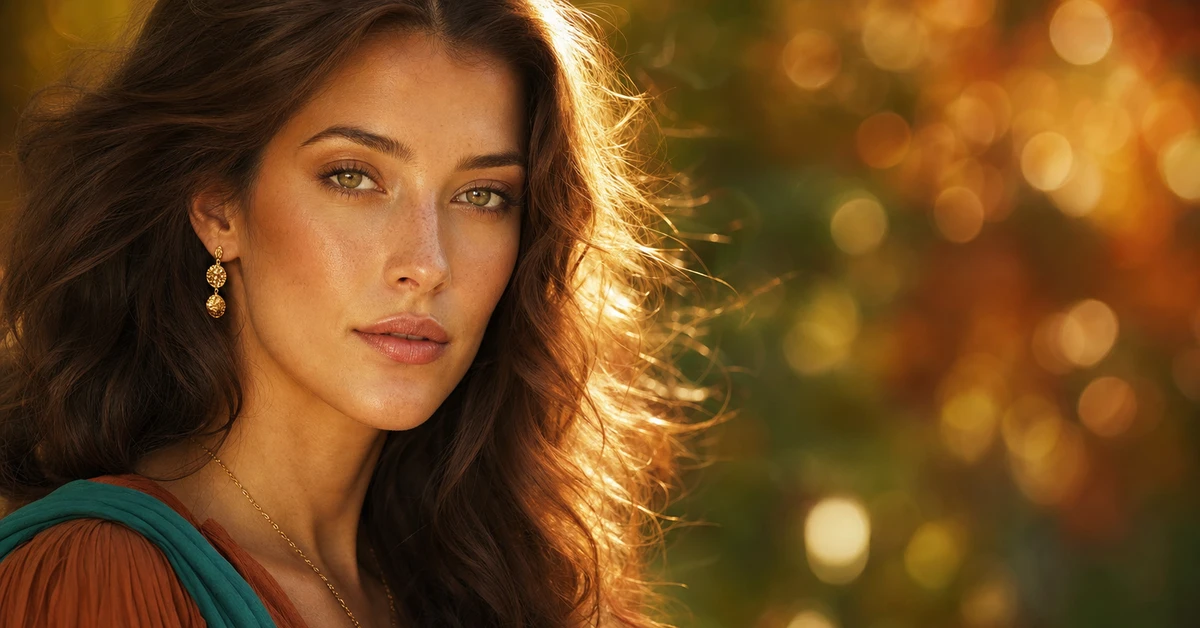
True Autumn coloring looks its best in the colors of a turning forest: rust, pumpkin, mustard, olive and deep green, all with gold in them. When a True Autumn switches from cool grays and dusty pinks to a rust knit or a golden olive scarf, the difference is usually easy to see: the skin looks warmer and more even, and the shadows under the eyes fade. Many people in this season have spent years in cool colors because black and gray are the default in most shops.
This guide covers what the season means, what True Autumn eyes, skin and hair usually look like, the palette with hex codes, the colors to leave on the rail, how to tell True Autumn from Soft Autumn, Deep Autumn and True Spring, and then outfits, prints, makeup, nails, hair color, jewelry and the celebrities people cite.
What "True Autumn" actually means
True Autumn (also called Warm Autumn) is one of the twelve seasons in personal color analysis, and it sits on three scales:
- Undertone: warm. Not warm-ish, not neutral-warm: True Autumn is the most decisively warm of the Autumns, all gold and no blue.
- Value: medium to medium-deep. Richer and a little darker than the light warm seasons, but not as dark as a Deep Autumn.
- Chroma: rich but slightly muted. Saturated and full-bodied, with enough earth in it that the colors read like spices, not neon.
Add that up and you get medium contrast: warm, golden, fairly deep coloring that is flattered by warm, golden, fairly deep color. A True Autumn color analysis lands on exactly this combination, and the true autumn color palette is built to mirror it.
A common mistake is reading "muted" as "soft and pale." True Autumn is muted the way ground cinnamon is: deep and complex, never washed out. Where a Spring is clear and bright, True Autumn is roasted and golden.
True Autumn eyes, skin and hair
No single feature makes someone a True Autumn. The season is about how the features sit together: all of them warm, none of them icy, and the overall depth somewhere in the middle.
Eyes
True Autumn eyes are most often hazel, olive green, warm green, golden brown, amber or warm brown. Brown eyes are common. Some True Autumns have a deep teal-blue or a green-blue eye with a gold ring around the pupil. Whatever the color, it tends to have gold, copper or olive flecks rather than gray or icy ones.
Skin
The undertone is clearly warm: golden, peachy, honey or bronze. The skin can range from fair to deep, and freckles are common on lighter True Autumns. Next to true black or cool gray, the skin can look yellow or sallow; next to camel or rust it looks even and warm. It usually looks better with yellow gold than with silver.
Hair
Natural hair runs from golden blonde and strawberry blonde through copper, auburn and chestnut to a rich golden brown. Many True Autumns have golden or red highlights that show in sunlight. Darker True Autumns can have a warm near-black, but it will look brown or red at the edges in daylight, not blue-black.
Contrast
The overall contrast is usually medium: not the stark dark-and-light of a Winter and not the blended softness of a Soft Autumn. A True Autumn with copper hair and fair skin has more contrast than one with golden brown hair and a medium golden tan, and both are still True Autumns.
The palette
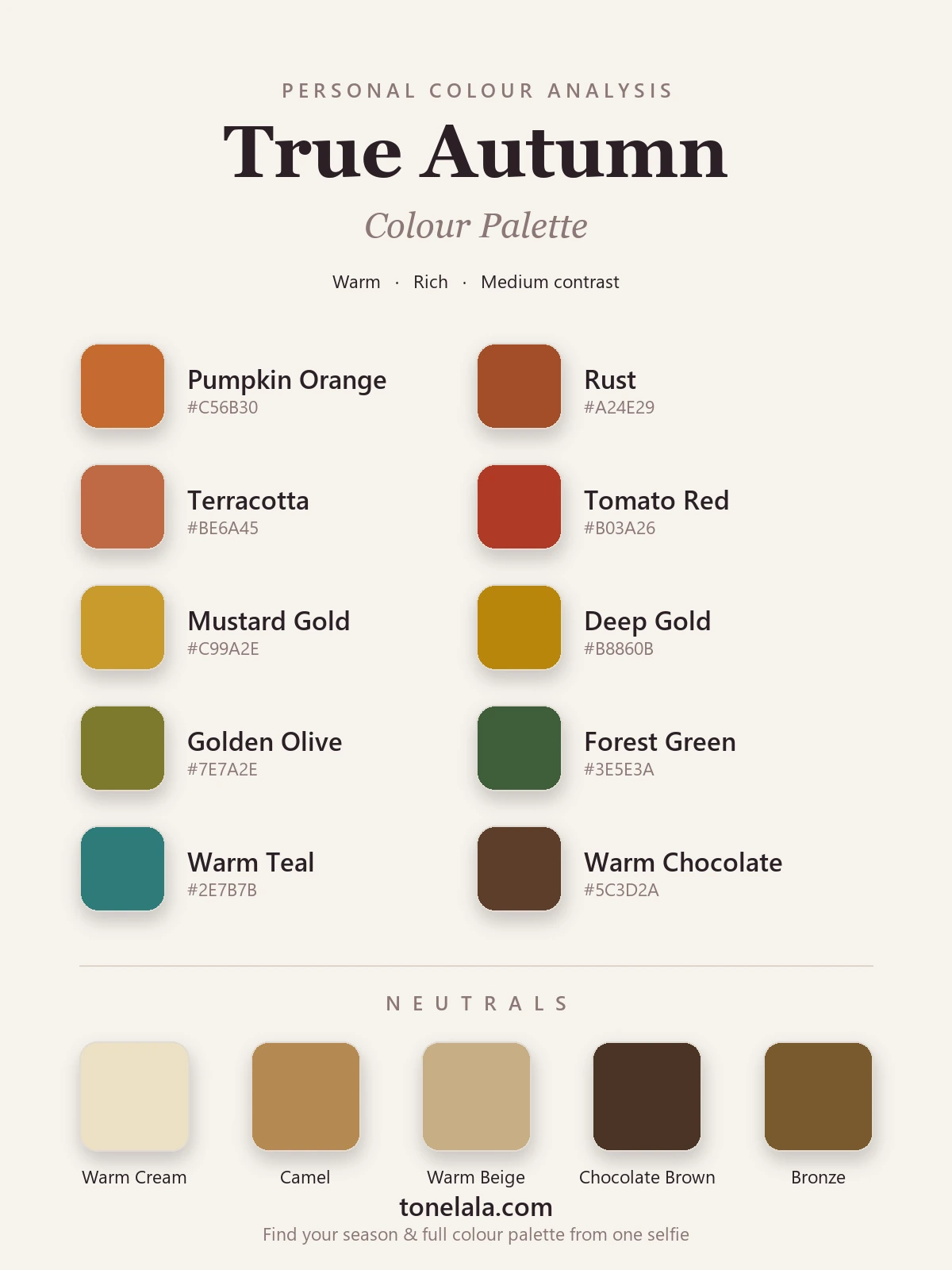
Golden, earthy, rich. Every color looks like it has sunlight and a little spice folded in.
Your best colors
| Color | Hex |
|---|---|
| Pumpkin Orange | #C56B30 |
| Rust | #A24E29 |
| Terracotta | #BE6A45 |
| Tomato Red | #B03A26 |
| Mustard Gold | #C99A2E |
| Deep Gold | #B8860B |
| Golden Olive | #7E7A2E |
| Forest Green | #3E5E3A |
| Warm Teal | #2E7B7B |
| Warm Chocolate | #5C3D2A |
Your neutrals: warm and golden, never stark: Warm Cream #EDE0C4, Camel #B68A52, Warm Beige #C7AE85, Chocolate Brown #4A3526 (your best "dark", far kinder than black), and Bronze #7A5A2E. Warm khaki, olive and a faded, warm-washed denim also work as everyday neutrals.
Your metals: warm gold, copper and bronze. They echo the gold in your skin. Brass and hammered or antiqued finishes suit this season too. Silver and platinum tend to look cold and flat against it.
Not sure True Autumn is actually your season?
Find your color season →Colors to avoid (and why)
- Cool and icy tones: icy blue, fuchsia, cool gray, blue-based pink, lavender and magenta. They fight a golden undertone and can make the skin look sallow.
- Black and stark white: too cool and too high-contrast. They overpower medium-deep warmth. Chocolate brown and warm cream do the same jobs.
- Clear pastels: baby pink, mint, powder blue. Too cool and too light; next to them rich coloring can look heavy and tired.
- Neon and electric brights: cobalt, hot pink, lime. They are too clear for a slightly muted season, so the color stands out and the face does not.
The mirror test: if a color makes your skin look gray, or your face look pulled down and dull, it is too cool or too light for you.
| Instead of | Try |
|---|---|
| Black | Chocolate brown, espresso, dark forest green |
| Optic white | Warm cream, ivory |
| Cool gray | Camel, warm taupe, khaki |
| Fuchsia | Tomato red, terracotta |
| Icy blue | Warm teal, turquoise with a green lean |
| Lavender | Golden olive, moss |
Can a True Autumn wear black?
Most analysts say not near the face. Black is cooler and harsher than anything in the palette and tends to make golden skin look yellow. It works better away from the face, as trousers, boots or a bag, or softened with a warm color at the neckline. For a dark neutral close to the face, chocolate brown, espresso, deep olive or forest green give the same depth without the harshness.
How to know you're actually a True Autumn
Start with a daylight check by a window, with no makeup and your hair pulled back. Hold a yellow gold piece and a silver piece under your chin in turn, then a camel fabric and a cool gray one. If gold and camel make your skin look even and silver and gray make it look sallow, you are warm. For more ways to check, see how to find your undertone.
If you are warm, the next step is to rule out the seasons that border True Autumn:
- True Autumn vs Soft Autumn: both warm, but chroma decides it. True Autumn is richer and more saturated; Soft Autumn is softer, grayed down and a little lighter. Hold a full pumpkin against your face: if it makes your skin look clearer rather than wearing you, you are more likely True. The Soft Autumn vs True Autumn guide goes into the test drapes.
- True Autumn vs Deep Autumn: both warm and rich, but Deep Autumn is darker and a touch cooler. True Autumn is a little lighter and warmer; if the very deepest, near-espresso tones start to overwhelm you, you are the True one. See True Autumn vs Deep Autumn.
- True Autumn vs True Spring: both purely warm, but True Autumn is deeper and more muted, while True Spring is lighter and clearer. If clear, bright warm colors feel a little sharp on you, you sit on the Autumn side. See True Spring vs True Autumn.
- True Autumn vs Deep Winter: darker True Autumns are sometimes typed as Winters, especially with dyed dark hair. Winters look clear and sharp in black and white; True Autumns look better in chocolate and cream. See Deep Winter vs True Autumn.
| Soft Autumn | True Autumn | Deep Autumn | |
|---|---|---|---|
| Undertone | Warm leaning neutral | Warmest | Warm leaning neutral |
| Value | Light-medium to medium | Medium to medium-deep | Deep |
| Chroma | Most muted | Rich, slightly muted | Rich |
| Example shades | Sage, soft camel, dusty coral | Rust, pumpkin, golden olive | Espresso, deep teal, aubergine |
If rich golden colors start to overwhelm you and softer, dustier versions feel more like you, you may be a Soft Autumn rather than a True Autumn; the two sit next to each other on the chroma scale. Undertone and depth are hard to judge in your own mirror, so the reliable way to settle it is a photo-based analysis that reads your warmth, value and contrast for you.
True Autumn outfit combinations
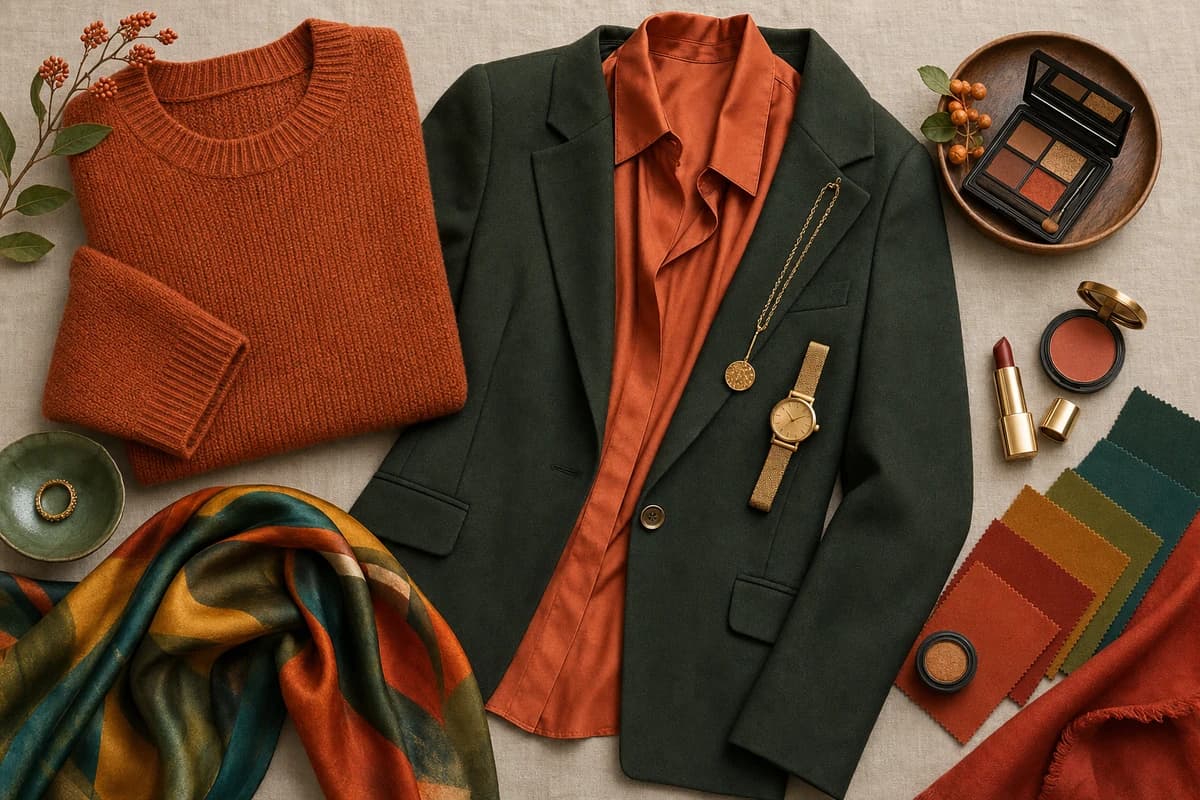
These pairings use the palette above:
- Camel and rust: a camel coat over a rust knit, with warm-washed jeans.
- Chocolate and mustard: chocolate trousers with a mustard sweater or blouse. The chocolate plays the role black would in another season.
- Golden olive and cream: an olive jacket or shirt with cream trousers, for a lighter outfit that stays warm.
- Forest green and tomato red: a forest green dress or knit with a tomato red bag or scarf.
- Warm teal and terracotta: a teal top with terracotta or brick trousers. Teal is one of the few blue-greens that suit True Autumn, because it leans green and warm.
- Tonal browns: bronze, camel and warm beige worn together, finished with gold jewelry.
For work, camel, chocolate, olive and warm navy-teal trousers or suits carry a whole week, with rust, mustard and tomato red as the accent colors. More combinations are in the True Autumn outfits guide.
Prints and fabrics
True Autumn prints look best when they are warm and medium in contrast: paisley, tortoiseshell, leopard in golden browns, plaids and tartans in rust, olive and mustard, and nature prints such as leaves or florals in autumn colors. Black-and-white stripes and icy geometric prints tend to look hard against warm coloring. Textured fabrics, such as tweed, corduroy, suede, cable knits and brushed wool, suit this season better than cool, high-shine satin.
True Autumn makeup
True Autumn makeup is warm and earthy, never cool.
- Lips: brick, terracotta, warm brown-red, cinnamon and a rich tomato red, anything with gold or rust in it.
- Cheeks: peachy-bronze or warm apricot blush, placed low on the cheek so it looks sun-warmed rather than pink. A warm bronzer suits this season.
- Eyes: copper, bronze, moss, olive, warm taupe and deep warm brown. A warm brown or bronze liner usually looks softer than black.
- Foundation: warm or golden undertone. A cool-toned foundation is the quickest way to make a True Autumn look gray.
Cool pinks, blue-reds and frosted finishes work against this coloring. The True Autumn makeup guide has more detail on shades.
Nails
Rust, terracotta, brick red, burnt orange, olive, mustard, chocolate and warm nude all suit True Autumn hands. Cool pinks, lilac and icy blue look out of place next to golden skin.
True Autumn hair colors
True Autumn hair is warm and rich: golden brown, warm chestnut, copper, rich auburn and warm honey all suit it because they share the gold in the skin. Coolness and ash work against this season. Jet black and ashy or platinum tones pull the warmth out of the face and can make it look sallow, while very pale cool blonde erases natural depth. For dimension, ask for warm, golden or copper-toned highlights rather than cool ones. As True Autumn hair grays, warm golden lowlights can keep the palette working while the gray grows in.
Jewelry, glasses, shoes and bags
- Jewelry: yellow gold, copper, bronze and brass, especially in hammered or antiqued finishes. Amber, tiger's eye, carnelian, jade and turquoise all sit in the warm range. See gold vs silver if you are unsure which metal suits you.
- Glasses: tortoiseshell, warm brown, olive, honey or gold frames rather than black or silver.
- Shoes and bags: cognac, tan, chocolate, olive and burgundy-brown leather. Black shoes are fine away from the face, but brown usually looks more at home with the rest of the palette.
True Autumn celebrities, and why the lists never agree
Search "True Autumn celebrities" and you will find the same faces sorted differently from one site to the next. Julianne Moore is the most-cited example; she appears on True Autumn lists from Palette Hunt, Dream Wardrobe, color-analysis.app, Four Seasons Studio and Spicemarket. Shailene Woodley is on four of those lists. Jennifer Lopez and Isla Fisher each appear on three, and Beyoncé and Ana de Armas show up on some lists and not on others.
The reason is the method. Celebrity typing is done from photos shot under different lighting, with makeup and dyed hair, all of which shift how warm or deep someone looks on camera. A True Autumn lit coolly with ashy hair color can pass for a Winter in a single frame. Spicemarket itself notes that its list is a guide only.
So treat celebrity examples as inspiration, not a diagnosis. True Autumn is defined by your own warm undertone, medium-deep value and rich-but-muted chroma, not by whether you resemble a particular star. The True Autumn celebrities page has a longer list.
Where to start with a True Autumn result
Start with the pieces nearest your face: tops, scarves, coats and glasses. Swap black near the face for chocolate brown or forest green, optic white for warm cream, and silver jewelry for gold. Those changes show the difference quickly and cost the least.
Then build a small capsule from two warm neutrals you like, say camel and chocolate brown, plus two or three of your richer colors, such as rust, golden olive and forest green. Nearly everything in that set mixes, because all of it shares the same warm, golden base. When you shop, check a piece against the palette in daylight near the shop door, not under warm store lighting, which makes almost everything look warmer than it is.
If you are unsure whether you are True, Soft or Deep Autumn, or whether you are an Autumn at all, a photo-based analysis reads your undertone, value and contrast from one clear selfie and points you to one season.
Frequently asked questions
What is the True Autumn color palette?
True Autumn is a warm, rich, medium-deep palette with a slightly muted edge: pumpkin, rust, terracotta, mustard gold, golden olive, forest green and warm teal, plus warm neutrals such as camel, cream and chocolate brown. It leaves out black, icy pastels and anything cool or dusty gray.
Is True Autumn warm or cool?
Warm. True Autumn is the warmest of the three Autumns and, with True Spring, one of the two most purely warm seasons in the 12-season system. The undertone is golden, which is why rich earth tones flatter it and cool, icy or blue-based colors look off against the skin.
How do I tell True Autumn from Soft Autumn?
Both are warm, but chroma settles it. True Autumn is richer and more saturated (deep rust, pumpkin, golden olive); Soft Autumn is softer, more grayed and a little lighter. If full, golden autumn colors make your face look clearer rather than overwhelmed, you are more likely a True Autumn.
What colors should a True Autumn avoid?
Cool and icy tones (icy blue, fuchsia, cool gray), pure black and stark white, clear pastels such as baby pink or mint, and neon brights. They clash with warm, golden, medium-deep coloring and either drain the face or look harsh against it.
What makeup and hair suit a True Autumn?
For makeup, warm earthy shades: brick, terracotta and warm brown-red lips, peachy-bronze blush, and copper, moss or warm-brown eyeshadow, with brown liner rather than black. For hair, golden brown, chestnut, copper, auburn and warm honey tones suit most True Autumns; ash tones and jet black work against the warmth.
Is True Autumn the same as Warm Autumn?
Yes, in practice. True Autumn is the name used in 12-season systems, and Warm Autumn is the name tonal systems use for the same warm-dominant Autumn. Many guides use the two names interchangeably.
Can a True Autumn wear black?
Not near the face, as a rule. Black is cooler and harsher than anything in the True Autumn palette and can make golden skin look sallow. Chocolate brown, espresso, deep olive and dark forest green do the same job. Black trousers, boots or a bag worn away from the face are fine, especially with warm colors on top.
Can True Autumns have brown eyes?
Yes. Warm brown, golden brown and amber eyes are common in True Autumns, alongside hazel, olive green and warm green. Eye color alone does not decide a season; what matters is that the eyes, skin and hair all read warm and medium-deep together.
Will my season change if I tan, age or dye my hair?
Your undertone does not change, so your season usually stays the same. A tan can make you look deeper for a while, and graying hair can soften your coloring, which may make the softer Autumn colors feel easier to wear. Dyeing your hair ash or black does not make you cool; it usually just makes the warm palette look slightly off until the color grows out.
Related guides
Soft Autumn vs True Summer: How to Tell the Difference
A color analyst on Soft Autumn vs True Summer, the two dials that separate them, the colors that tell them apart, and how to decide which you are.
Soft Autumn vs True Autumn: How to Tell the Difference
Soft Autumn vs True Autumn, explained by a color analyst, how they differ on undertone, value and chroma, the colors that separate them
True Autumn Makeup: Best Shades for Lips, Eyes & Cheeks
A makeup artist's True Autumn makeup guide, the best lip, eye and blush shades with hex codes, foundation undertone tips, and what to avoid.

Soft Autumn Color Palette: The Complete Guide (with Hex Codes)
A color analyst's complete Soft Autumn guide, your exact palette with hex codes, best neutrals and metals, colors to avoid
True Autumn Celebrities
A color analyst's hedged take on likely True Autumn celebrities, the warm, rich, muted traits that signal this season, plus how to find your own.
Warm Autumn Color Palette (a.k.a. True Autumn)
A color analyst explains the warm autumn palette, your best colors and hex codes, why warm autumn and true autumn are the same season
Prefer in person? Find color analysis near you
Browse local color analysts by city, or get the same season, palette and best-colors breakdown online from one selfie.
See your colors on a photo of you
Upload one selfie and ToneLala reveals your season, your full palette, and your best hair, makeup, jewelry and outfits, styled on you.