In a sentence: A color analysis quiz scores three things about your face, undertone (warm or cool), value (light or deep) and contrast (bright or muted), and points you to a seasonal family; it gets you close, but the exact season is the part a quiz can't quite settle on its own. See what a quiz is really sorting or find your season.
Color Analysis Quiz: Find Your Season
By ToneLalaUpdated July 2, 2026
Contents
Most people arrive at a color analysis quiz the same way: they've held a navy jumper next to a camel coat in a changing-room mirror, felt that one of them was "off," and wanted a name for the rule. A quiz promises that name in two minutes. Tap through ten questions, get told you're a Soft Autumn, and suddenly the whole shop makes sense, at least until the next quiz says you're a True Summer.
I've watched clients take three or four of these in a row and get three or four answers, and it's worth saying plainly why that happens. It isn't that color analysis is guesswork. It's that a quiz is asking you to be the measuring instrument, and the human eye is a famously unreliable one when it's pointed at its own face under bathroom light. So let me walk you through exactly what a quiz does, what it can genuinely tell you, where it runs out of road, and how to take ours.
How a color analysis quiz actually works
Strip away the personality-test packaging and every seasonal quiz is doing the same thing: scoring you on three dials.
- Undertone: the color running underneath your skin. Warm leans golden or peachy; cool leans pink or rosy; neutral sits between.
- Value: how light or deep your overall coloring is, hair and eyes and skin taken together.
- Contrast: how far your features sit apart. Dark hair on pale skin is high contrast; soft mid-tones blending together are low.
Each question is a proxy for one of those dials. "Do you suit gold or silver jewelry?" is really asking about undertone. "How would you describe your natural hair?" is feeding the value score. "In a black-and-white photo, do your features stand out sharply?" is measuring contrast. The quiz tallies your answers, finds the family where they agree, and hands you a season.
That's a legitimate method. Undertone, value and contrast genuinely are the three axes professional analysts use. The quiz isn't inventing anything, it's just outsourcing the hardest part, the seeing, to you.
What a quiz can genuinely tell you
Used honestly, a quiz is a good first sort. Here's what it does well:
- Finds your family. Warm-and-deep versus cool-and-light is a big, structural difference, and most quizzes land that correctly. If you come out Autumn, you're very probably somewhere in the warm-deep neighbourhood even if the exact season is fuzzy.
- Names the vocabulary. Once you've been told you might be a "Soft" season, words like muted, value and chroma stop being jargon and start being useful. That alone makes every shop and every other guide easier to read.
- Points you at a palette to test. A family-level answer gives you a sensible set of colors to hold against your face and check, which is far better than buying blind.
If all you want is a rough direction so you stop fighting your wardrobe, a quiz earns its keep. The trouble starts when you treat its answer as the final word.
What the quiz is sorting
Here's a quick way to see the four directions a quiz is trying to place you in. Each pair below belongs to a different corner, warm, cool, bright and soft, and the neutrals underneath shift with you too. A quiz is essentially asking: which side of this swatch makes your face look rested?
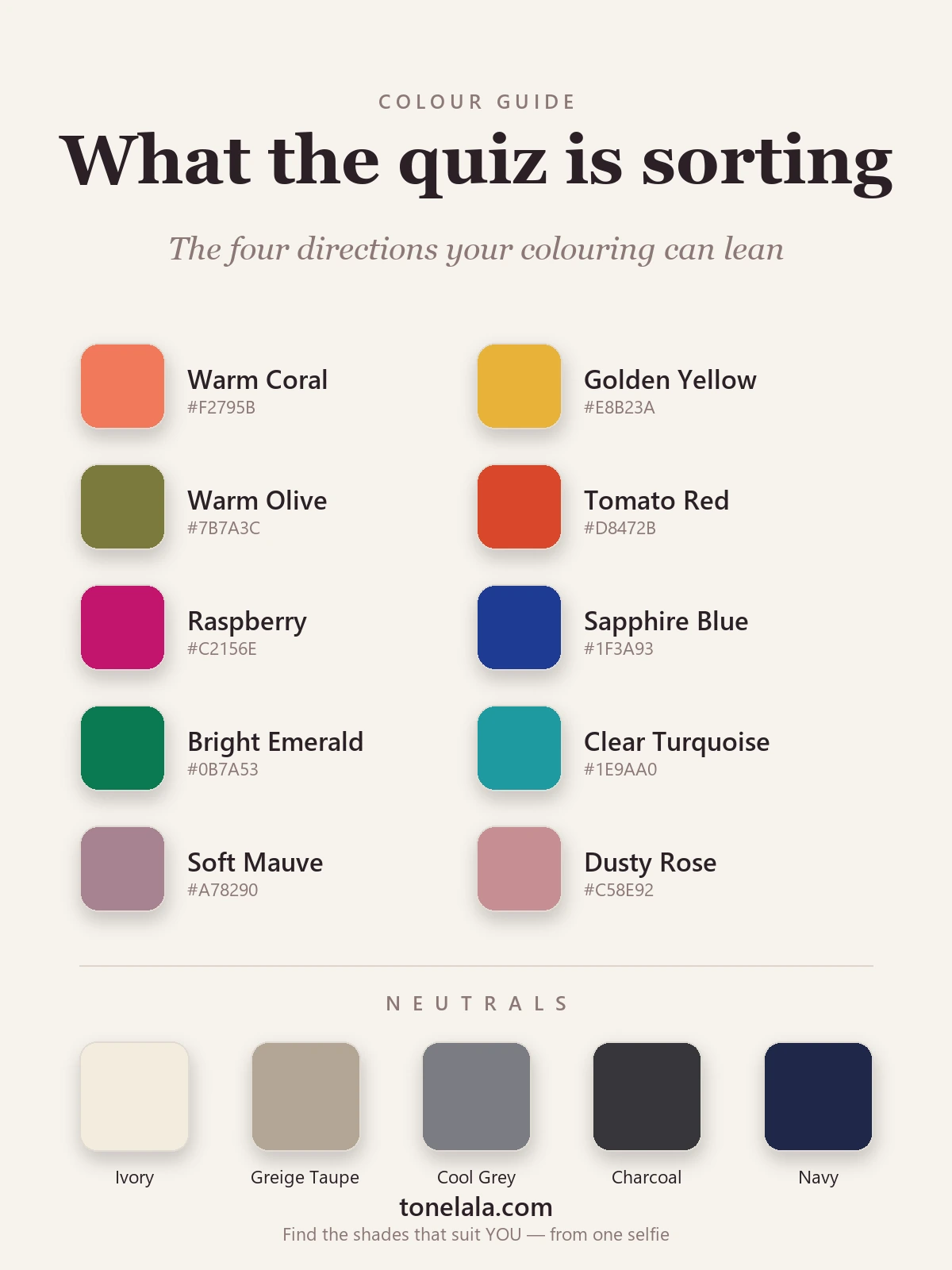
The four directions a quiz sorts
| Color | Hex | Leans |
|---|---|---|
| Warm Coral | #F2795B |
Warm (Spring) |
| Golden Yellow | #E8B23A |
Warm (Spring) |
| Warm Olive | #7B7A3C |
Warm (Autumn) |
| Tomato Red | #D8472B |
Warm (Autumn) |
| Raspberry | #C2156E |
Cool (Winter) |
| Sapphire Blue | #1F3A93 |
Cool (Winter) |
| Bright Emerald | #0B7A53 |
Bright / clear |
| Clear Turquoise | #1E9AA0 |
Bright / clear |
| Soft Mauve | #A78290 |
Soft (Summer) |
| Dusty Rose | #C58E92 |
Soft (Summer) |
The neutrals move with you too: warm coloring reaches for Ivory #F3ECDD and Greige Taupe #B3A695; cool coloring reaches for Cool Gray #7A7C82, Charcoal #36363B and Navy #1E2749. A quiz is, in effect, guessing which corner of this chart you live in, from your description of yourself rather than from your actual face.
Got a different answer every time you took a quiz?
Find your color season →Where a quiz runs out of road
The limits aren't a flaw in any one quiz, they're built into the format. Three things trip them up:
You're scoring your own face. Undertone is the dial people get wrong most often, because we're all quietly biased about our own coloring and bathroom lighting throws a cast over everything. If you pick "warm" when you're actually neutral-cool, every answer downstream inherits that error.
Dye and sun hide your value. A quiz asks about your hair, but it can't tell that your "dark brown" is dyed over natural mid-blonde, or that your tan is masking fair skin. Those two facts alone can shift your value by a whole step and send you to the wrong family.
The last call is the hardest one. Telling a Soft Summer from a True Summer, or a Deep Autumn from a Deep Winter, turns on fine reads of contrast and chroma, exactly the judgements that are hardest to make honestly in a mirror. This is why two quizzes built on the same theory hand you neighbouring seasons: they're both guessing at the subtle dial, and guessing differently.
So a quiz gets you to the right street and then leaves you to find the house number yourself. For the bigger picture of how the families relate, the color analysis guides lay out all twelve; if you want to slow down and read your own dials by hand before trusting any quiz, what color season am I walks through the three tests one at a time.
How a photo-based analysis is different
The fix for every limit above is to stop relying on your own reading of your face and let a clear image do the seeing. That's the whole idea behind a photo-based analysis.
Instead of asking you whether you're warm or cool, it judges undertone, value and contrast directly from a photo taken in even light, so dye, tan and bathroom bulbs can't quietly bias the answer. And rather than handing you a generic swatch card, it builds your palette on a picture of your own face, so you can actually see why a color lifts you and why another drains you. That's the difference between "I think I'm probably a Summer" and knowing precisely which Summer, and which reds, blues and neutrals are yours.
It's worth keeping the quiz, though. Take one first to learn the vocabulary and get your rough direction, then use a proper analysis to settle the call the quiz couldn't.
How to take our quiz and analysis
Ours pairs a short style quiz with a photo read, so you get the quick orientation and the accurate answer:
- Go to tonelala.com/onboarding and answer a few questions about your coloring and the way you like to dress.
- Upload two clear photos taken in even, natural daylight, no makeup, no filter, hair back off your face. The cleaner the light, the more accurate the read.
- Get your season and palette, shown on a picture of your own face, with the makeup, jewelry and wardrobe colors that go with it.
The whole point is to take the part a quiz outsources to your eye, the seeing, and do it properly.
Where to go from here
Treat a color analysis quiz as the opening move, not the verdict. Run one to learn the language and find your rough corner of the wheel; just don't be surprised when the next quiz nudges you one season over, because the fine call is genuinely hard to score about your own face. When you want the answer that holds, your exact season, on your own face, with a palette you can shop from, find your season and let a clear photo settle what a quiz only guesses at.
Frequently asked questions
What is a color analysis quiz?
A color analysis quiz is a short set of questions about your natural coloring, your skin's undertone, the depth of your hair and eyes, and how high or low the contrast is between your features. It scores your answers and points you toward one of the seasonal families, like Autumn or Winter. A good quiz is genuinely useful for narrowing things down, but it depends entirely on you reading your own face correctly, which is the part most people find hard. To settle the exact season you can start a photo-based analysis at tonelala.com/onboarding.
Are color analysis quizzes accurate?
A quiz is only as accurate as your answers, and the three things it asks about, undertone, value and contrast, are exactly the things people misjudge in their own mirror. Bathroom lighting, hair dye and a tan all distort what you see. A well-built quiz reliably points you to the right family two times out of three; the fine call between neighbouring seasons is where it tends to slip. A photo-based analysis reads your coloring from a clear image rather than your self-scoring, so it is far more reliable for the precise answer.
What questions does a color analysis quiz ask?
Most quizzes circle the same three dials. Undertone questions ask whether silver or gold suits you and which way your wrist veins read. Value questions ask how light or deep your hair, eyes and skin are together. Contrast questions ask how far apart your features sit, pale skin with near-black hair is high contrast, soft mid-blonde on light skin is low. Some quizzes also ask about eye color and how you tan. Your pattern of answers points to a family, then to a specific season within it.
Can a quiz tell me my exact color season?
A quiz can usually place you in the right family and often the right season, but the last step, say, telling a Soft Summer from a True Summer, or a Deep Autumn from a Deep Winter, turns on subtle reads of contrast and undertone that are hard to score honestly about your own face. That is where quizzes most often disagree with each other. For the exact season, a photo-based analysis judges all three dials from a clear picture of you and builds your palette on your own face.
How do I take the ToneLala color analysis?
Go to tonelala.com/onboarding, answer a short style quiz, and upload two clear photos taken in even, natural light with no makeup or filters. The analysis reads your undertone, value and contrast from the images, places you in your season, and builds a personalized palette shown on a picture of your own face, plus the makeup, jewelry and wardrobe colors that go with it. It is the difference between guessing your season and seeing exactly why a color works on you.
Related guides
What Color Season Am I
What color season am I? A color analyst walks you through undertone, value and contrast with simple self-tests to narrow down your seasonal palette.

Seasonal Color Analysis: The Complete Guide
A color analyst's complete guide to seasonal color analysis, how the 12 seasons work, the three dials that decide yours, and how to find your own.

Color Analysis Test: How to Find Your Colors
A color analyst's guide to the color analysis test, the vein, jewelry and draping checks you can do at home, plus how an accurate photo analysis works.

What Is My Color Palette?
What is my color palette? A color analyst shows how undertone, value and chroma decide your season and the exact colors that flatter you.

Korean Personal Color Analysis Explained
A color analyst explains Korean personal color analysis (퍼스널컬러), how the warm/cool tone system works, why it went viral, and how it maps to the seasons.

Color Analysis Mistakes to Avoid
A color analyst's guide to the most common color analysis mistakes, bad lighting, the vein test, fake tan, makeup and more, and how to get an honest result.
Prefer in person? Find color analysis near you
Browse local color analysts by city, or get the same season, palette and best-colors breakdown online from one selfie.
See your colors on a photo of you
Upload one selfie and ToneLala reveals your season, your full palette, and your best hair, makeup, jewelry and outfits, styled on you.