The short answer: the colors that go with burgundy are cream, camel, navy, forest green, emerald, blush pink, dusty rose, mustard gold, teal, plum, charcoal gray, denim blue and olive. The 12 combinations with hex codes are below, each with an outfit you can copy, and if you want to know which burgundy suits your own coloring, that is here.
Colors That Go With Burgundy: 12 Stylish Combinations (with Hex Codes)
By ToneLalaUpdated September 21, 2026
Contents
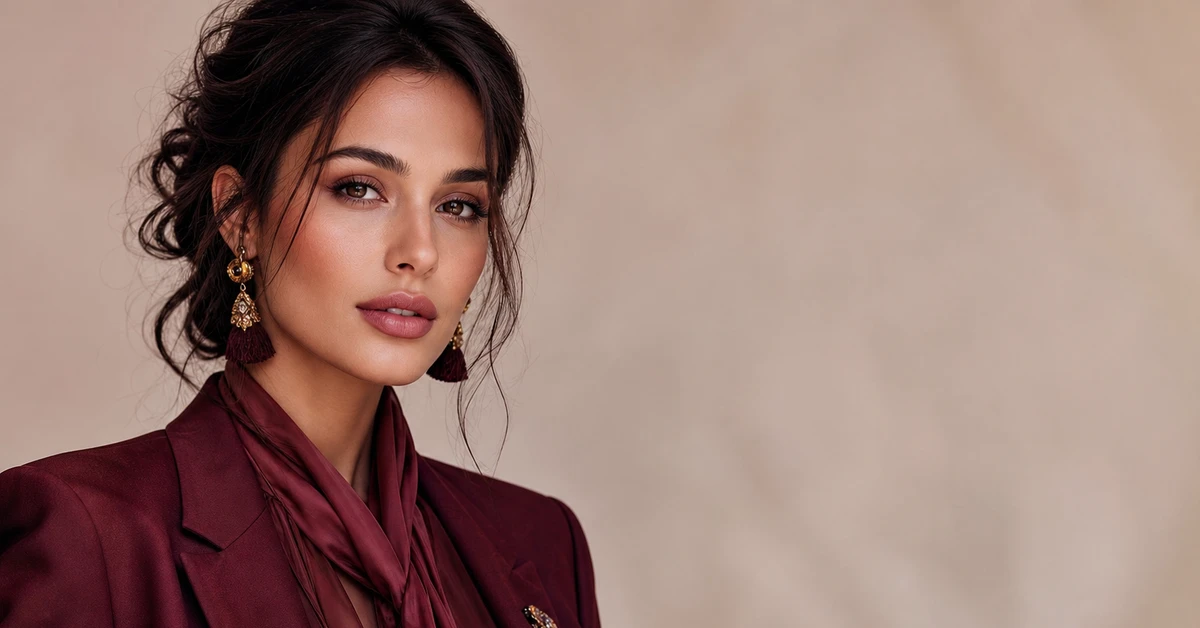
Most burgundy gets worn with black. It is easy, and it is not wrong, but it uses only half of what the color can do. Burgundy is a dark red with a blue lean, which gives it two sides: next to camel and cream it behaves like a dark neutral, and next to emerald or mustard it behaves like a jewel tone. Black only ever brings out the first side.
Below are 12 combinations that use both, with a hex code for each partner color so you can match it on a screen or in a shop, the three pairings that reliably go wrong, and a section on which version of burgundy suits which coloring, because there is more than one burgundy.
What kind of color burgundy is
Burgundy is a deep red with purple and a fair amount of brown in it, named after the French wine and sitting somewhere between #6E1423 and #800020. The purple is the part that matters. It separates burgundy from a warm brick red or a true scarlet, and it decides which colors sit well beside it.
Two things follow. Burgundy's complement on the color wheel is green, so forest green and emerald give the cleanest contrast. And because burgundy is dark and slightly muted, colors that share that softened quality, blush, dusty rose, plum and teal, blend with it, while clean, bright, warm colors compete with it.
It also helps to know which burgundy you own. Wine is the most purple version and often a touch lighter. Oxblood leans brick and brown. Maroon is browner and warmer still, and shops use all three names loosely. The purple end takes the cool pairings best; the brick end is happier with camel, mustard and burnt orange.
12 colors that go with burgundy
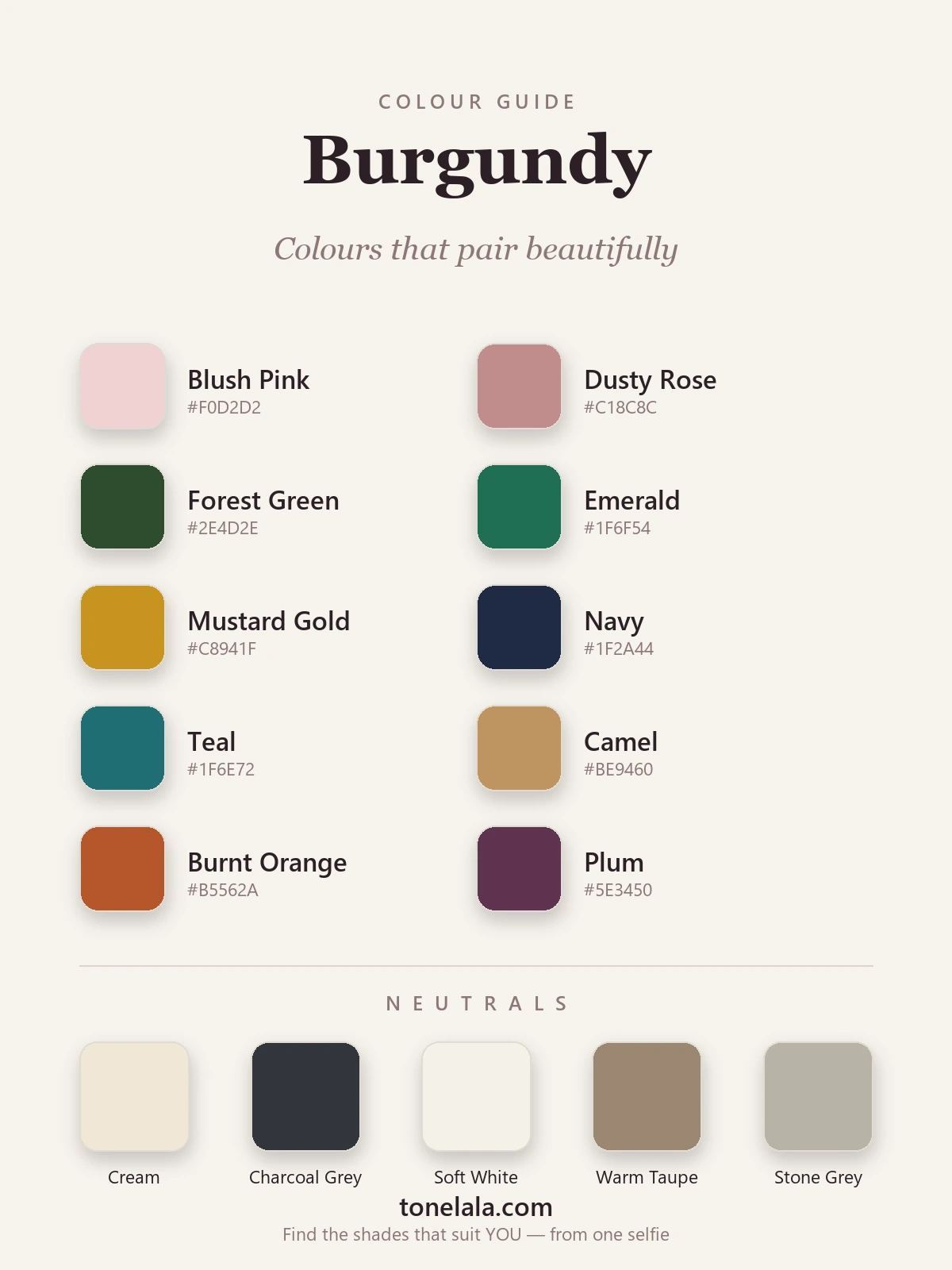
The palette image shows the core shades. Each combination below gives the hex code, what the pairing does, and one outfit built from it.
| Color | Hex | What it does with burgundy |
|---|---|---|
| Cream | #EFE7D4 |
Light, warm contrast. The easiest pairing to get right. |
| Camel | #BE9460 |
Warm tan that makes burgundy glow. |
| Navy | #1F2A44 |
A dark that shares burgundy's blue base. |
| Forest Green | #2E4D2E |
The near-complement, deep and classic. |
| Emerald | #1F6F54 |
The same contrast with more light, for evenings. |
| Blush Pink | #F0D2D2 |
Tonal and soft, same red family. |
| Dusty Rose | #C18C8C |
Blush with the brightness taken out. |
| Mustard Gold | #C8941F |
Warm ochre that takes the seriousness out. |
| Teal | #1F6E72 |
Cool, slightly unexpected, harmonizes rather than shouts. |
| Plum | #5E3450 |
Burgundy's purple cousin, for a near-monochrome look. |
| Charcoal Gray | #33363B |
The dark to use instead of black. |
| Denim Blue | #4C6A92 |
Everyday casual contrast. |
| Olive | #6B7A3C |
Earthy, muted green for autumn layers. |
1. Burgundy and cream
Cream #EFE7D4 (or soft white #F4F1EA) is the pairing to learn first. It is lighter and warmer than pure white, so it lifts burgundy without the hard edge that bright white can give. Outfit: a burgundy sweater, cream trousers, cream or tan boots. Swap in a bright white shirt when you want the contrast sharper, for example under a burgundy blazer at work.
2. Burgundy and camel
Camel #BE9460 brings out the brown that is already inside burgundy, which is why the two look expensive together even in cheap fabrics. Outfit: a camel coat over a burgundy dress, or a burgundy knit with camel wide-leg trousers, gold jewelry, tan shoes.
3. Burgundy and navy
Navy #1F2A44 is the dark to reach for instead of black. Both colors have a blue base, so they sit together instead of fighting, and the result is sharper than burgundy with black. Outfit: burgundy trousers, a navy blazer, a white or cream shirt, a gold watch or belt buckle.
4. Burgundy and forest green
Forest green #2E4D2E is burgundy's near-complement, and deep green against deep wine is the richest contrast in this list. It reads better in the evening and in autumn light than in bright sun. Outfit: a burgundy skirt with a forest green sweater, or a forest green coat over a burgundy dress, with black or dark brown boots.
5. Burgundy and emerald
Emerald #1F6F54 is the same idea with more light in it: jewel on jewel. It is a party and occasion pairing more than a daily one. Outfit: an emerald silk blouse with burgundy trousers, or a burgundy velvet dress with emerald earrings and shoes.
6. Burgundy and blush pink
Blush #F0D2D2 sits in the same red family, far lighter, so the pairing is tonal and soft rather than contrasting. It takes burgundy out of autumn and into spring. Outfit: burgundy trousers, a blush blouse, white sneakers or a soft white coat.
7. Burgundy and dusty rose
Dusty rose #C18C8C is blush with the brightness taken out, which puts it inside burgundy's own muted range. The two together look like one considered palette rather than two colors. Outfit: a dusty rose knit under a burgundy coat, or a dusty rose scarf with a burgundy sweater, with taupe trousers.
8. Burgundy and mustard gold
Mustard #C8941F is the pairing that stops burgundy looking serious. It is warm, so it suits the brick-leaning burgundies best and can look loud with the very purple ones. Outfit: a mustard sweater, burgundy corduroy or wool trousers, brown boots, cream coat.
9. Burgundy and teal
Teal #1F6E72 shares burgundy's blue undertone, which is why it harmonizes where a bright turquoise would clash. It is the least expected pairing here and one of the most flattering on cool coloring. Outfit: a teal blouse with a burgundy skirt, silver jewelry, black or charcoal shoes.
10. Burgundy and plum
Plum #5E3450 is burgundy's purple neighbor, so the two make a near-monochrome outfit with depth instead of flatness. Keep the fabrics different (knit against silk, wool against velvet) or the two shades merge. Outfit: a plum coat over a burgundy dress, or burgundy trousers with a plum sweater and gold jewelry.
11. Burgundy and charcoal gray
Charcoal #33363B (and its lighter cousin stone gray #B9B3A7) anchors burgundy the way black does without deadening it. It is the office pairing. Outfit: a charcoal suit with a burgundy knit or blouse, or burgundy trousers with a light gray sweater and black loafers.
12. Burgundy and denim blue
Denim #4C6A92 is the casual answer, and it works with every wash. Mid and dark washes keep burgundy rich; light washes make it look more summery. Outfit: a burgundy sweater or blazer with straight jeans and white sneakers, or a burgundy skirt with a chambray shirt.
One more for autumn: olive #6B7A3C. Olive is a muted, earthy green, so it gives the green contrast of pairing 4 in a quieter, more casual form. A burgundy sweater with olive cargo trousers, or an olive field jacket over a burgundy dress, is the classic version.
Which shade of burgundy suits you?
Find your color season →Colors to avoid with burgundy
- Bright, warm orange-reds. Tomato, coral and scarlet sit on the warm side of the undertone line; burgundy sits on the cool side. Two reds that disagree about temperature fight for attention. If the outfit needs warmth, use a muted one such as burnt orange
#B5562A. - Flat, muddy mid-browns. A plain chocolate brown can dissolve into burgundy until the whole outfit reads as one murky block. Camel or a warmer tan lifts it instead.
- Black, head to toe. It deadens burgundy's richness. Burgundy and black work with a lighter third color in the mix (a cream shirt, a camel coat, gold jewelry), but as a two-color outfit the pairing tends to look heavy.
A quick check while getting dressed: if a color makes the burgundy look browner, it is wrong. If the burgundy looks more like wine, keep it.
Shoes, bags and jewelry with burgundy
Tan, cognac and cream shoes suit the warm combinations (camel, mustard, olive, cream). Black and charcoal shoes suit the cool ones (navy, teal, gray, plum). Burgundy shoes with a burgundy outfit work when the shades are clearly different, for example oxblood loafers with a wine dress, and look like a mistake when they almost match.
Gold jewelry picks up the warmth in burgundy and is the default for most people. Silver reads cooler and crisper and suits burgundy worn with navy, teal or gray. A burgundy bag is one of the most useful accessories to own, because it works as a near-neutral with camel, navy, cream, gray and denim.
Which burgundy suits you
There is no single burgundy, and the version that suits a person depends on their own coloring more than on any pairing.
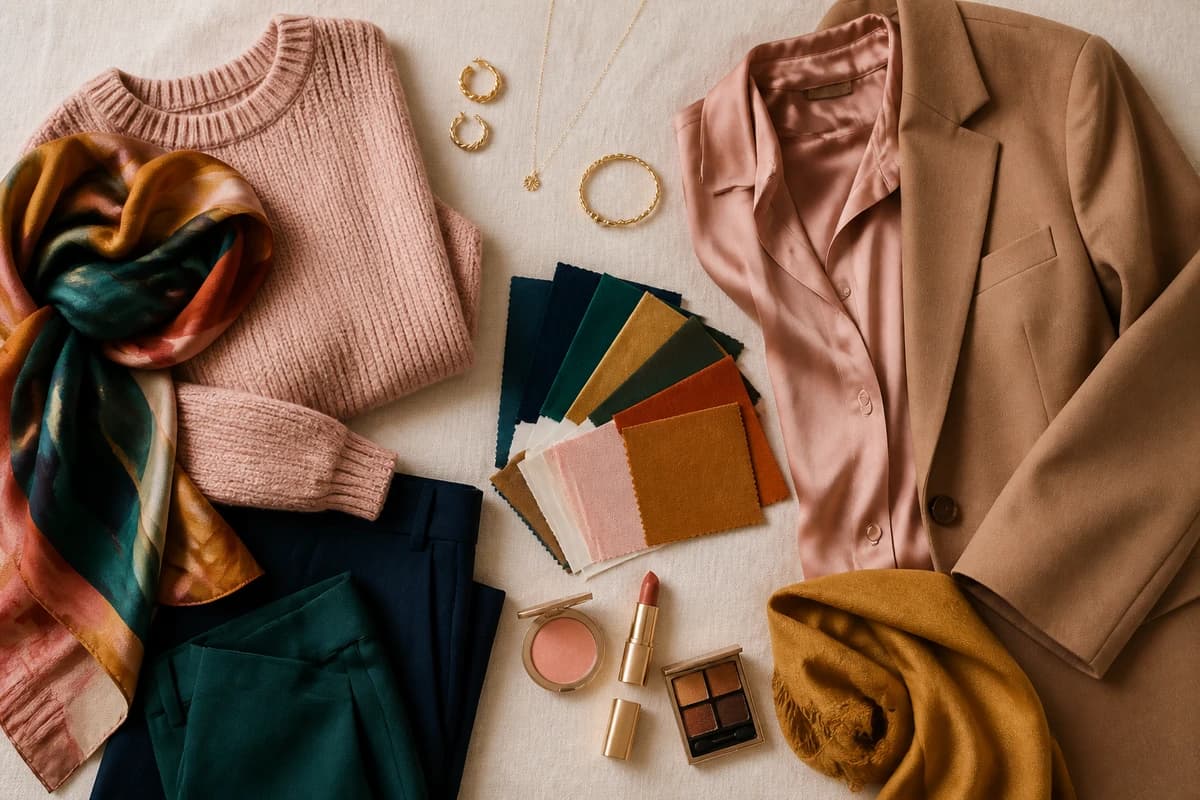
Deep, cool coloring, the True Winter and Deep Winter seasons, carries a true, blue-based wine burgundy well because it echoes the cool depth already in the skin, hair and eyes. Warm, deep coloring, Deep Autumn and True Autumn, looks better in a brick-leaning, earthier burgundy, with the pairings pulled warmer: camel, mustard, olive and burnt orange rather than blush and teal. Softer and lighter seasons usually do best with a muted, lighter burgundy closer to a deep dusty rose, or with burgundy kept away from the face as trousers, a skirt or shoes.
The test is the same one used in a proper analysis: hold the burgundy next to your face in daylight. The right version brightens the skin and the wrong one drains it, and the difference is hard to see in a bathroom mirror under warm bulbs. The color analysis guides explain how each season reads, and a personal analysis names the exact burgundy, and the exact pairings, for your coloring.
Frequently asked questions
What colors go with burgundy?
Cream, camel, navy, forest green, emerald, blush pink, dusty rose, mustard gold, teal, plum, charcoal gray, denim blue and olive all go with burgundy. Cream, camel and navy are the safest; green and mustard give the strongest contrast; blush and plum keep it soft and tonal.
What color best complements burgundy?
Green. Burgundy is a deep red, and green sits opposite red on the color wheel, so forest green and emerald give the cleanest contrast. For a pairing that is easier to wear every day, camel and navy are the most reliable partners.
What colors should you not wear with burgundy?
Bright warm reds such as tomato and coral, which clash with burgundy's purple lean; flat mid-browns, which blur into it; and black worn head to toe with nothing lighter in the outfit, which makes burgundy look heavy. Charcoal, navy or a cream layer solves the last one.
What neutrals go with burgundy?
Cream and soft white are the kindest light neutrals, warmer and more flattering than stark white. Warm taupe and stone gray sit quietly beside burgundy, and charcoal gray gives a dark anchor that is softer than black. Those five do most of the work in a burgundy wardrobe.
How do I wear burgundy for my skin tone?
Burgundy suits almost everyone, but the shade matters. Cool, deep coloring (the Winter seasons) carries a blue-based, true wine burgundy; warm, deep coloring (the Autumn seasons) looks better in a brick-tinged, earthier burgundy. Hold both near your face in daylight: the right one brightens the skin, the wrong one drains it. A personal color analysis names your exact shade.
Does burgundy go with black?
Yes, with a third color. Burgundy and black with a cream shirt, a camel coat or gold jewelry looks deliberate. Burgundy and black on their own tend to look flat, so if you want a dark base with nothing added, charcoal or navy works better.
Should I wear gold or silver with burgundy?
Both work. Gold brings out the warmth in burgundy and suits the camel, mustard and cream combinations. Silver reads cooler and suits burgundy with navy, teal or gray. If your own coloring is warm, gold is the safer default; if it is cool, silver.
Related guides
Colors That Go With Sage Green: 12 Stylish Combinations (with Hex Codes)
A stylist's pick of the colors that go with sage green, terracotta, blush, cream, navy and more, with hex codes, outfit ideas and shades to avoid.

Colors That Go With Teal: 12 Stylish Combinations (with Hex Codes)
The colors that go with teal: 12 combinations with an outfit for each, 10 pairing colors and 5 neutrals with hex codes, shoes and jewelry, and what to avoid.

Colors That Go With Black: 12 Stylish Combinations (with Hex Codes)
A stylist's guide to the best colors that go with black, 10 pairings plus 5 neutrals, with hex codes, outfit ideas and how to match black to your skin tone.
Colors That Go With Purple: 12 Stylish Combinations (with Hex Codes)
A stylist's guide to the colors that go with purple, 10 pairings and 5 neutrals with hex codes, outfit combinations, what to avoid
Colors That Go With Green: 12 Stylish Combinations (with Hex Codes)
A stylist's guide to the colors that go with green, blush, mustard, terracotta, navy, teal and more, with hex codes, neutrals, outfit ideas and what to avoid.

Colors That Go With Brown: 12 Stylish Combinations (with Hex Codes)
A stylist's guide to the best colors that go with brown, teal, cream, mustard, blush and more, with hex codes, outfit ideas and what to avoid.
Prefer in person? Find color analysis near you
Browse local color analysts by city, or get the same season, palette and best-colors breakdown online from one selfie.
See your colors on a photo of you
Upload one selfie and ToneLala reveals your season, your full palette, and your best hair, makeup, jewelry and outfits, styled on you.