In a sentence: 16-season color analysis takes the familiar four seasons and splits each into four sub-seasons instead of three, describing both the primary and secondary quality of your coloring, so people who sit on a border get a sharper palette than the 12-season system can give. See one color from every sub-season or find your own season.
16-Season Color Analysis Explained
By ToneLalaUpdated July 10, 2026

Contents
A client sat in my chair last spring convinced she was a Light Summer, and on the cool side of the fabrics she mostly was, until I laid a clear, slightly warm coral against her jaw and her skin lit up in a way the soft cool pastels never quite managed. She wasn't "wrong." She was sitting on the seam between two seasons, and the 12-season chart simply didn't have a drawer for her. That seam is exactly what the 16-season system was built to catch.
Most people meet seasonal color analysis as four seasons, then twelve. The 16-season method is the next level of resolution, and once you see how it's put together, it stops feeling like more jargon and starts feeling like a map of how coloring actually varies. Here's how the system works, where it extends the 12, and how to tell which of the sixteen you are.
A quick recap: from 4 seasons to 12
The original system had four seasons, Spring, Summer, Autumn, Winter, each tied to an undertone and a general mood. Useful, but blunt. Two people could both be "Autumn" and look nothing alike: one soft and muted, one deep and rich.
So analysts added a second layer. Each season was split into three, giving twelve: a light version, a deep version, and a "true" core, with bright and soft variations distributed across them. That's the system behind most of the palette guides you'll find, Soft Summer, Deep Winter, True Spring and the rest. Twelve seasons handle the vast majority of wardrobes beautifully.
The catch is the borders. Three sub-seasons per season leave gaps, and the people who fall in those gaps, the not-quite-Light, not-quite-Soft Summer, say, get rounded to the nearest label. Usually that's fine. Sometimes, as with my coral client, it isn't.
What the 16-season system actually is
The 16-season method comes out of the Sci-ART tonal approach, which describes coloring along three dimensions rather than one:
- Undertone: warm or cool.
- Value: light or deep.
- Chroma: bright (clear) or soft (muted).
Every season has a primary quality that defines it and a secondary quality that flavors it. Winter's primary quality is coolness; its secondary can lean deep, or clear-bright, or stay neutrally "true." Spring's primary quality is warmth; its secondary can lean light, or bright, or stay true. Run that logic across all four seasons and each one splits into four sub-seasons, a true core plus three directions it can drift, for sixteen in total.
That second dimension is the whole point. Twelve seasons tell you roughly where you sit. Sixteen tell you which way you lean from the center, and that lean is what decides whether your reds run scarlet or tomato, your pinks run icy or dusty.
The 16 seasons, season by season
Grouped by family, here's the full set. Each season keeps a true anchor plus three tonal cousins:
- Spring (warm + bright): Light Spring, True Spring, Bright Spring, and Warm Spring, the warmest, most golden of the four.
- Summer (cool + soft): Light Summer, True Summer, Soft Summer, and Cool Summer, the most neutral-cool of the group.
- Autumn (warm + soft): Soft Autumn, True Autumn, Deep Autumn, and Warm Autumn, earthy and rich.
- Winter (cool + bright): Deep Winter, True Winter, Bright Winter, and Cool Winter, the most saturated and high-contrast.
You'll notice some sub-season names appear to overlap with neighbours, a Bright Spring and a Bright Winter both live in clear, vivid territory; a Soft Summer and a Soft Autumn both live in muted territory. In the 16-season grid these stay as separate cells, distinguished by which season they belong to. A Bright Spring is bright and warm; a Bright Winter is bright and cool. The grid keeps that distinction instead of collapsing it, and that's precisely the extra information the 16 seasons give you over the 12.
The palette
To make the system tangible, here's one signature color pulled from each of the sub-seasons, warm to cool, light to deep, soft to bright. It's a tour, not a personal palette: yours would be a tight set of around 30–40 shades from a single one of these seasons.
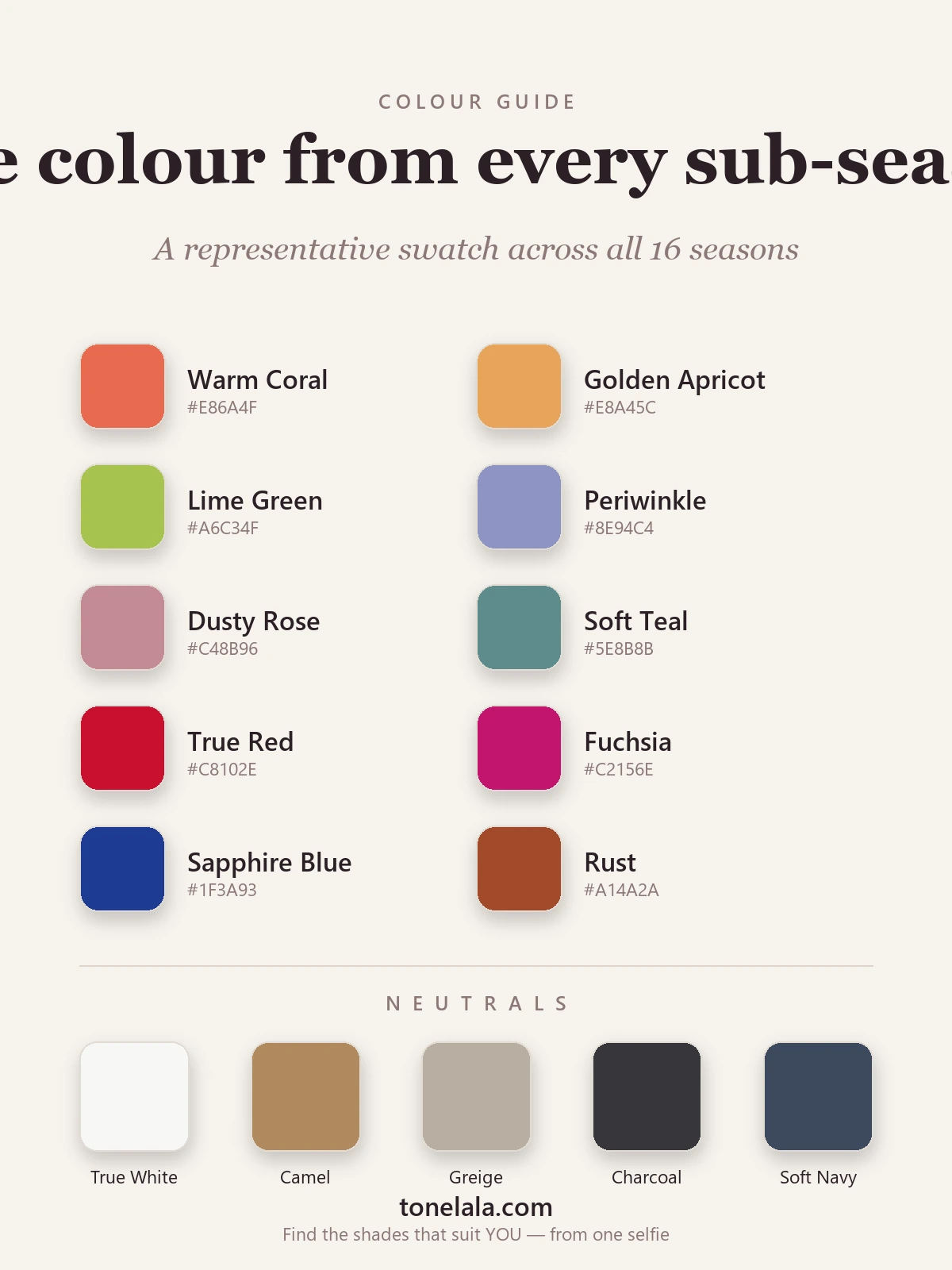
One color from every corner of the system
| Color | Hex | Leans |
|---|---|---|
| Warm Coral | #E86A4F |
Warm Spring |
| Golden Apricot | #E8A45C |
Light Spring |
| Lime Green | #A6C34F |
Bright Spring |
| Periwinkle | #8E94C4 |
Light Summer |
| Dusty Rose | #C48B96 |
Soft Summer |
| Soft Teal | #5E8B8B |
Cool / True Summer |
| True Red | #C8102E |
True / Cool Winter |
| Fuchsia | #C2156E |
Bright Winter |
| Sapphire Blue | #1F3A93 |
Deep Winter |
| Rust | #A14A2A |
Warm / Deep Autumn |
Neutrals across the system: True White #F7F7F4 for the cool, bright seasons; Camel #B08A5E for the warm ones; Greige #B8AEA1 for the soft middle; Charcoal #36363B and Soft Navy #3E4A5E for the deep end. No single person wears all five, your sub-season decides which two or three are yours.
Metals: the warm half of the wheel (Spring, Autumn) reaches for gold; the cool half (Summer, Winter) reaches for silver. The brighter your sub-season, the more polished the finish; the softer, the more brushed.
Want to know which of the sixteen is actually yours?
Find your color season →How 16 seasons extend the 12, without contradicting them
Here's the reassuring part: the 16-season system doesn't overturn the 12. It refines it. Every 12-season label still exists inside the 16; the grid just adds the missing fourth cell to each season and treats the shared "flow" seasons as their own categories.
Think of it as zoom. The 12-season chart is the city map; the 16-season chart is the street view. If the 12-season analysis already nails you, your reds, your neutrals, your metals all sit comfortably in one season, there's little to gain by going finer. But if you've always felt between two seasons, the 16-season grid is where that in-between finally has a name, a palette and a logic behind it.
This is also why a thoughtful analyst rarely starts at 16. We narrow to a season family first, confirm it with draping, and only then ask the finer question, does this person lean light or deep, bright or soft, within that family? The sixteenth-of-a-pie answer is the last step, not the first.
How to find your sub-season
You can get most of the way yourself by reading your three dials in order:
- Undertone first. Do warm, golden colors flatter you, or cool, blue-based ones? This points you toward the warm family (Spring/Autumn) or the cool family (Summer/Winter).
- Value next. Is your natural coloring light and delicate, or deep and strong? Light pulls you toward Light Spring or Light Summer; deep pulls you toward Deep Autumn or Deep Winter.
- Chroma last. Do clear, vivid colors suit you, or do muted, dusty ones? Bright points to the Clear seasons; soft points to Soft Summer or Soft Autumn.
Your strongest dial names your season; your second-strongest names the sub-season. Cool dominant, deep secondary? Deep Winter. Warm dominant, light secondary? Light Spring.
The honest caveat: dials are slippery to read on your own face. Bathroom lighting skews warm, screens skew cool, and dyed hair throws the whole read off. Even seasoned analysts drape rather than trust the eye. That's why the most reliable route is a draping session or a photo-based analysis, it reads your undertone, value and chroma for you and places you in one of the sixteen, then builds the palette on a picture of you rather than a generic chart. You can browse every season in our color analysis guides, or start your own analysis and skip the guesswork.
Is 16 seasons worth it over 12?
For most people, twelve seasons are plenty, easier to learn, easier to shop, and accurate enough that the wardrobe just works. The 16-season system earns its keep when you sit on a border, when two season labels both seem half-right, or when you simply want the most precise palette your coloring can support. It's not a different theory; it's a higher-resolution version of the same one.
If you take anything from this, let it be the shape of the system: four seasons, each pulling in four directions, sixteen destinations in all. Find your family, then find your lean, and dressing in color stops being a guessing game and starts being a map you already hold.
Frequently asked questions
What is 16-season color analysis?
16-season color analysis is an expanded version of the seasonal system that sorts coloring into 16 categories instead of 12. It keeps the four core seasons, Spring, Summer, Autumn, Winter, but splits each into four sub-seasons rather than three, adding a 'true' anchor in the middle of each season alongside the lighter, deeper, softer or brighter variations. The aim is a more precise palette.
What is the difference between 12 and 16 season color analysis?
The 12-season system gives each season three sub-seasons (for example Light, True and Soft Summer). The 16-season system, drawn from the Sci-ART tonal method, divides each season along two dimensions, its primary quality and its secondary quality, which produces four sub-seasons per season and 16 in total. In practice 16 seasons capture the in-between people that 12 seasons round off.
What are the 16 color seasons?
Light Spring, Warm (True) Spring, Bright (Clear) Spring; Light Summer, Cool (True) Summer, Soft Summer; Soft Autumn, Warm (True) Autumn, Deep Autumn; Deep Winter, Cool (True) Winter, Bright (Clear) Winter, plus the four shared sub-seasons (Bright Spring/Winter, Light Spring/Summer, Soft Summer/Autumn, Deep Autumn/Winter) that the 16-season grid keeps as distinct cells rather than merging.
Is 16 or 12 season color analysis better?
Neither is 'better', they're different levels of zoom. Twelve seasons are easier to learn and enough for most wardrobes. Sixteen seasons add precision for people who sit on a border between two seasons, because they describe both the primary and secondary quality of your coloring. A good analyst often starts with 12 and refines toward 16.
How do I find my 16 season sub-season?
Work out your three dials first, undertone (warm or cool), value (light or deep) and chroma (bright or soft). Your dominant dial names your season family; your second-strongest dial names the sub-season. Lighting and dyed hair make this hard to judge in a mirror, so a draping session or a photo-based analysis is the reliable way to pin down which of the 16 you are.
Related guides

12-Season Color Analysis Explained
A color analyst explains all 12 seasons, how they split from the classic 4, the three dials behind them, and how to find which season is yours.

Seasonal Color Analysis: The Complete Guide
A color analyst's complete guide to seasonal color analysis, how the 12 seasons work, the three dials that decide yours, and how to find your own.

Personal Color Analysis: The Complete Guide
A color analyst's complete guide to personal color analysis, the 4, 12 and 16 season systems, undertone, value and chroma, and how to find yours.

How to Build a Capsule Wardrobe
A color analyst's guide to building a capsule wardrobe around your palette, how to pick a base, neutrals and accents, with hex codes and a starter formula.

What Is Color Analysis
A color analyst explains what color analysis is, the 4 and 12 season systems, undertone, value and chroma, and what your result actually gives you.

What Color Season Am I
What color season am I? A color analyst walks you through undertone, value and contrast with simple self-tests to narrow down your seasonal palette.
Prefer in person? Find color analysis near you
Browse local color analysts by city, or get the same season, palette and best-colors breakdown online from one selfie.
See your colors on a photo of you
Upload one selfie and ToneLala reveals your season, your full palette, and your best hair, makeup, jewelry and outfits, styled on you.