In a sentence: The best colors for red hair are earthy warm tones and the greens and teals that sit opposite red on the color wheel, forest green, teal, olive, mustard, rust, peach, terracotta, denim blue, aubergine and warm coral, with cream, camel and chocolate brown as neutrals. Skip to the full palette or find your exact shades.
Best Colors for Red Hair: Your Best Shades (with Hex Codes)
By ToneLalaUpdated July 13, 2026
Contents
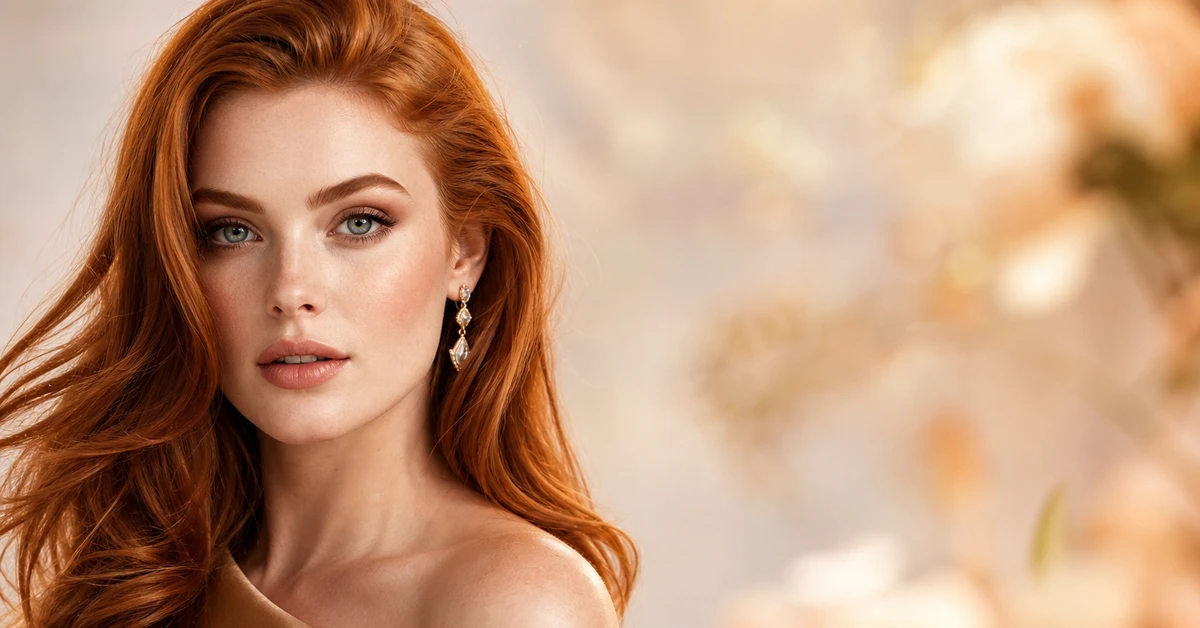
Put a redhead in a forest-green coat and watch what happens to her hair. It goes from "red" to molten, deeper, glossier, somehow more itself. That's not a fluke or a styling trick; it's color theory doing exactly what it's meant to. Green sits opposite red on the wheel, so the two lift each other, and your hair is the brightest thing you own. The job of everything else you wear is to make it look richer, not to compete with it.
Which is why I find red hair one of the most fun colorings to dress, and one of the most commonly mishandled. People with red hair are often told to avoid red (fair) and steered toward "neutral" grays and blacks that quietly flatten all that warmth. The real answer is more generous and more specific: lean into earthy, warm shades and the cool greens that complement your hair, then let your skin's undertone fine-tune the exact version. That last part is where the magic, and the precision, lives.
Red hair and color, what actually flatters
Red hair is, almost by definition, warm. There's gold, copper or auburn running through it, and that warmth is the single biggest clue to what flatters you. Warm hair wants warm company: ochres, rusts, olives and golden browns harmonize with it and make the whole look feel intentional. Cool, icy colors can work, but they have to be chosen with more care, because the wrong cool shade leaves your hair looking like it belongs to a different palette than the rest of you.
Then there's green, the special case. Because green is red's complementary color, it does something no other color does: it makes red hair read as more red. Forest, teal, olive, emerald, moss; almost the entire green family flatters, which is rare for any one coloring. So your two reliable directions are warm earth tones (which match your hair) and greens and blue-greens (which complete it).
But, and this is the part generic advice always skips, your skin's undertone matters most for the exact shade. Two people can both have gorgeous red hair and need genuinely different palettes, because one has cool, rose-pink skin and the other warm, golden-peach skin. Pale, cool redheads with porcelain skin often suit clearer, slightly cooler colors (teal, emerald, denim blue); warm, golden redheads with freckled or peachy skin glow in earthier, deeper shades (rust, terracotta, mustard). Your hair sets the direction. Your undertone decides the precise version.
The best colors for red hair
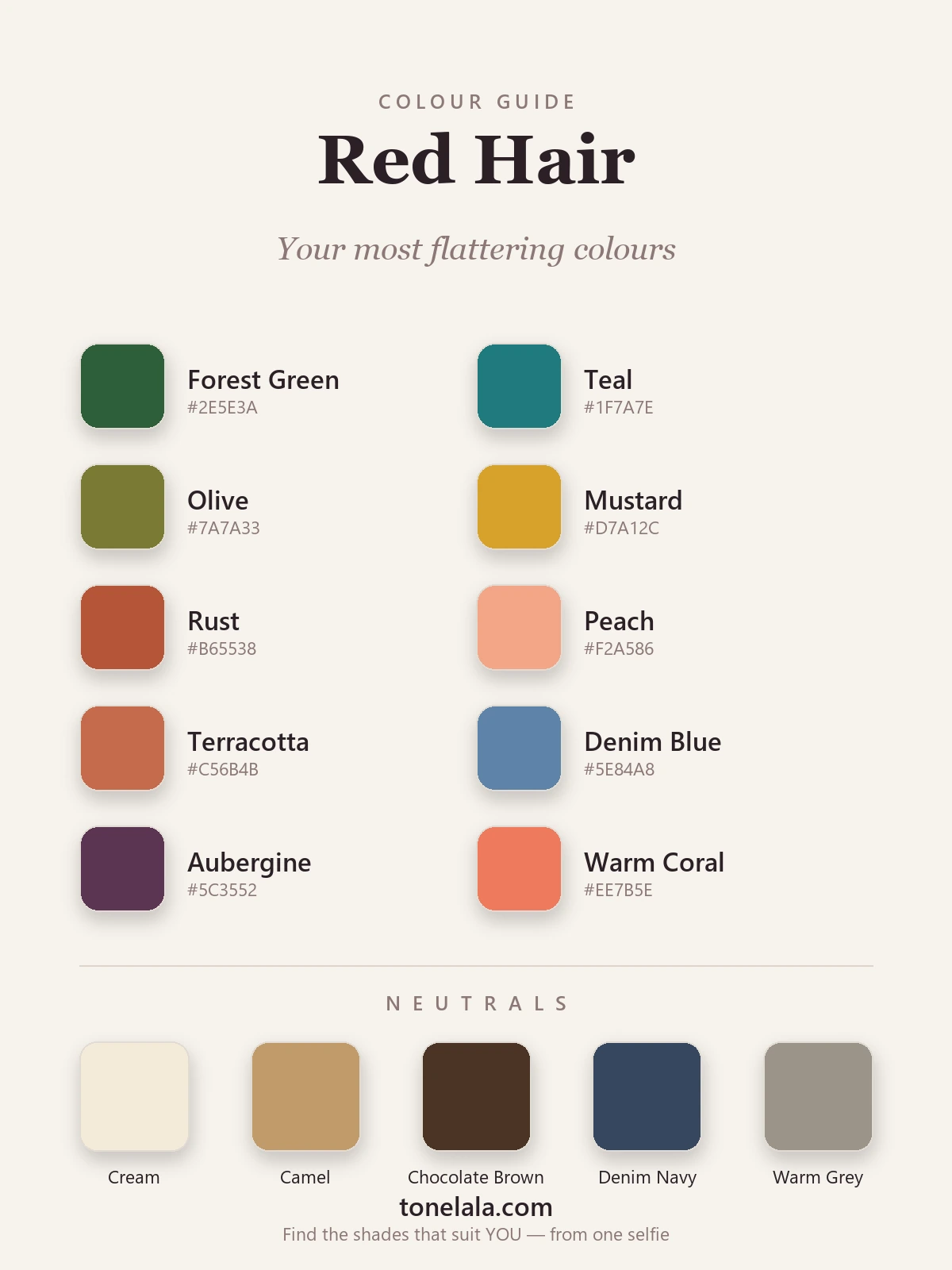
These ten flatter the broadest range of red coloring, a deliberate mix of warm earth tones and complementary greens and blues, so there's something here for every undertone.
| Color | Hex |
|---|---|
Forest Green #2E5E3A |
The single most flattering color for most red hair, as red's complement, it makes the hair look richer and the skin clearer all at once. My first pick, full stop. |
Teal #1F7A7E |
A blue-green that brings out warmth in the hair while staying fresh and a touch cool. Brilliant for redheads with cooler, pinker skin. |
Olive #7A7A33 |
A golden, earthy green that practically belongs to red hair, warm, grounded and quietly expensive against auburn and copper. |
Mustard #D7A12C |
A deep golden yellow that echoes the gold in red hair and warms the skin beautifully. Wear it near the face and watch the hair glow. |
Rust #B65538 |
A warm, brick-toned red-orange that's deep enough not to compete with the hair, it harmonizes instead of clashing. A redhead's secret weapon. |
Peach #F2A586 |
A soft, warm pink-orange that flatters fair, freckled skin and gives a healthy flush without fighting the hair. Gentle and easy. |
Terracotta #C56B4B |
A muted clay-orange that sits in perfect harmony with copper and auburn, earthy, rich and very wearable for warm coloring. |
Denim Blue #5E84A8 |
A soft, medium blue that cools things down without going icy; it lets the hair be the star and works for almost every redhead. |
Aubergine #5C3552 |
A deep warm purple that gives you drama and depth without the harshness of black, sophisticated against red hair. |
Warm Coral #EE7B5E |
A lively pink-coral with enough orange in it to stay friendly with the hair; it lifts the complexion and reads joyful, never garish. |
Best neutrals: Cream #F3EAD7 instead of stark white; Camel #C19A6B for an easy warm base that makes red hair look luxe; Chocolate Brown #4A3526 in place of black when you want depth near the face; Denim Navy #37475F for a cooler dark that still suits warm coloring; and Warm Gray #9C948A for a modern, low-key neutral that won't fight your hair.
Want YOUR exact most-flattering shades?
Find your color season →Colors to avoid with red hair
- Cool bright pinks, magenta and fuchsia. These blue-based pinks clash with the warmth in most red hair and tend to throw a pink cast onto the skin, so the whole face looks slightly inflamed. If you love pink, go warm and soft, peach, coral or a dusty rose, and keep the cool, electric versions away from your face.
- Bright orange and pure tomato-red. They sit so close to your hair's own color that the two start to compete, and the effect goes flat and a bit fancy-dress. You can absolutely wear warm reds and oranges, just deeper and earthier (rust, terracotta) so they complement the hair rather than mimic it.
- Large blocks of stark black at the neckline. Black is so much heavier than warm, fair coloring that it can look harsh and drain the face. It's not forbidden, wear it below the waist, or break it at the neck with chocolate brown, cream or one of your greens, and it behaves.
Red hair across the color seasons
In the seasonal system, red hair points most often to the warm families, True Autumn, Soft Autumn and True Spring: because the gold and copper in the hair are inherently warm. Deep, rich auburn with warm, golden skin tends toward True Autumn (olive, rust, mustard, forest green). Softer, more muted strawberry or hazy red coloring leans Soft Autumn (gentler, dustier versions of the same earthy palette). Bright, clear copper with light, warm, peachy skin can land in True Spring (clearer, warmer, more saturated shades). It's much rarer for natural red hair to sit in a cool Summer or Winter season, though dyed reds and cooler, pinker skin can occasionally push there, which is exactly why the system reads your coloring as a whole, not just your hair.
The deciding factor between those seasons is, yes, again, undertone and depth. Warmth is the constant; how deep, soft or clear your coloring is decides which warm season is yours, and they behave quite differently on a person even though they look related on paper. If you want to understand how undertone, depth and clarity combine into a season, the color analysis guides walk through each one, and a proper analysis tells you precisely which is yours.
Makeup & styling tips for red hair
Keep makeup as warm as your hair and let it tie the whole look together. Earthy, warm tones do the heavy lifting: peach, coral or warm rose on the lips and cheeks, with bronze, copper, soft gold or warm taupe on the eyes, these echo your coloring instead of fighting it. Be wary of cool, blue-based reds and bright pinks on the lips, and go easy on heavy black liner, which reads harsh against fair, warm skin; a soft brown or warm plum is far kinder. For brows, warm taupe-brown beats anything too dark or ashy. When you're building outfits, anchor them around your palette colors and break up any black or gray pieces with a green, teal or cream at the neckline, where it does the most work, and remember your hair is already the boldest color in the room, so you rarely need to add another loud one to compete.
Putting it together
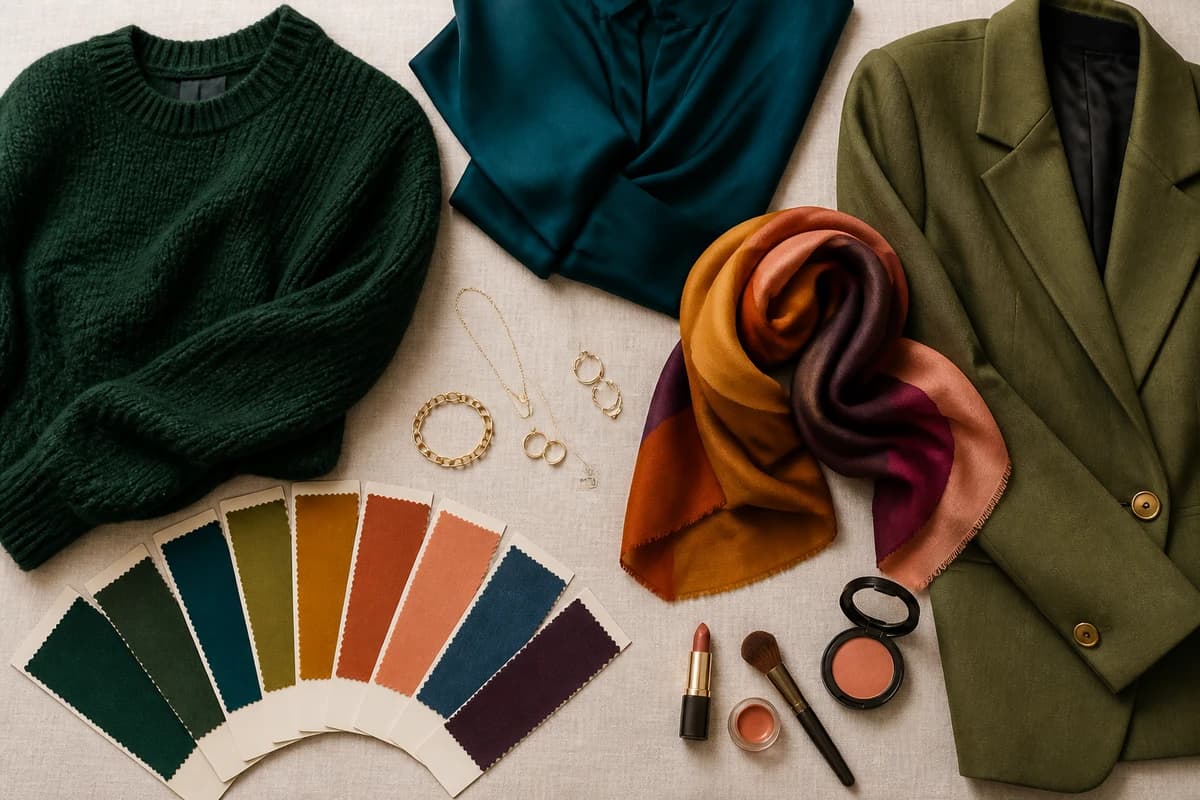
Red hair isn't a coloring to dress timidly, it's one that rewards warmth and a bit of color theory. Lean into earthy shades that match your hair (rust, terracotta, olive, mustard) and the greens and blue-greens that complete it (forest green, teal, denim blue), choose warm neutrals like cream, camel and chocolate brown over stark black-and-white, and your hair does exactly what it's meant to: glow. Pick three or four colors above plus a couple of those neutrals and you've got a wardrobe that flatters on autopilot. The only real misstep is letting someone talk you into "safe" grays that smother all that warmth. The fastest way to find your exact most-flattering shades, the right green, the right rust, the version that's genuinely yours, is a personal color analysis.
Frequently asked questions
What colors look good with red hair?
The most flattering colors for red hair are earthy, warm-leaning shades and the cool greens and blues that sit opposite red on the color wheel, forest green, teal, olive, mustard, rust, peach, terracotta, denim blue, aubergine and warm coral. Greens are the standout because they're red's complementary color, so they make the hair look richer; warm earth tones harmonize with it instead. The single best version depends on your skin's undertone, but those ten flatter the broadest range of red hair.
What colors should you avoid with red hair?
Three to watch. Cool-toned bright pinks, magenta and fuchsia tend to clash with the warmth in most red hair and pull a pink flush into the skin. Bright orange and tomato-red sit so close to the hair's own color that they compete with it and blur the effect. And large blocks of stark black near the face can look harsh against warm, fair coloring. None are banned outright, keep them away from your face, or break them up with a green, teal or cream that genuinely suits you.
What are the best neutrals for red hair?
Warm, soft neutrals beat stark black and white for almost everyone with red hair. Reach for cream or ivory instead of optic white, camel for an easy warm base, and chocolate brown when you want depth near the face, it flatters far more than black. Denim navy gives you a cooler dark that still plays nicely with warm coloring, and warm gray is the modern neutral that won't fight your hair. These give you contrast and polish without the harshness pure black-and-white forces onto warm tones.
Does red hair suit green?
Yes, green is the most reliably flattering color for red hair, and it's down to simple color theory. Green sits directly opposite red on the color wheel, so when you wear it the two intensify each other and your hair reads richer and more vivid. Forest green, teal, olive and emerald all work; the exact green depends on your undertone, with warmer reds loving olive and moss, and cooler coloring suiting clearer emerald and teal.
Does undertone change which colors are best for red hair?
Very much so, your hair color sets the direction, but your skin's undertone decides the exact shades. Most natural red hair is warm, which is why earthy, golden colors flatter so broadly, but skin ranges from cool, rose-pink to warm, golden-peach and that shifts your best palette. Warm, peachy skin glows in rust, terracotta, mustard and warm coral; cooler, pinker skin suits clearer teal, emerald and denim blue. That's why a personal color analysis is the only way to pin down your precise best shades.
Related guides
Best Colors for Red Hair And Green Eyes: Your Best Shades (with Hex Codes)
A color analyst's edit of the best colors for red hair and green eyes, 10 flattering shades and 5 neutrals with hex codes, what to avoid
Best Colors for Brown Hair And Brown Eyes: Your Best Shades (with Hex Codes)
The best colors for brown hair and brown eyes: teal, rust, emerald, plum and more with hex codes, colors that make brown eyes stand out, best neutrals and shades to avoid.
Best Colors for Gray Hair: Your Best Shades (with Hex Codes)
A color analyst's guide to the best colors for gray hair, 10 flattering shades and 5 neutrals with hex codes, what to avoid, and how to find your season.
Best Colors for Black Hair: Your Best Shades (with Hex Codes)
A color analyst's guide to the best colors for black hair, 10 flattering shades and 5 neutrals with hex codes, what to avoid
Best Colors for Fair Skin And Dark Hair: Your Most Flattering Shades (with Hex Codes)
A color analyst's guide to the best colors for fair skin and dark hair, 10 flattering shades and 5 neutrals with hex codes, what to avoid
Best Colors for Pale Skin And Blonde Hair: Your Most Flattering Shades (with Hex Codes)
A color analyst's guide to the best colors for pale skin and blonde hair, 10 flattering shades and 5 neutrals with hex codes, what to avoid, and your season.
Prefer in person? Find color analysis near you
Browse local color analysts by city, or get the same season, palette and best-colors breakdown online from one selfie.
See your colors on a photo of you
Upload one selfie and ToneLala reveals your season, your full palette, and your best hair, makeup, jewelry and outfits, styled on you.