In a sentence: the best jewelry metal for your skin tone follows your undertone, warm undertones glow in gold, copper and bronze; cool undertones suit silver, platinum and white gold; neutral undertones wear both, and rose gold flatters almost everyone. See the full metal palette or find your season.
Best Jewelry Metal for Your Skin Tone
By ToneLalaUpdated July 7, 2026

Contents
The fastest way I know to read someone's undertone is to put metal next to their face. I keep a gold drape and a silver one on my desk, and within a few seconds of holding each one up the answer is usually obvious, one side of the face evens out and looks lit, the other goes faintly gray or sallow. That tells me which way your skin leans, and it's the same thing that decides which jewelry genuinely flatters you. Gold, silver, rose gold: the "right" one isn't a matter of taste so much as a match to the warmth or coolness already living in your skin.
Here's the part the shop counter won't tell you. The reason a necklace can make your face look tired has almost nothing to do with the necklace and everything to do with temperature. A warm metal beside cool skin, or a cool metal beside warm skin, sets up a quiet clash your eye reads as "off." Get the temperature right and the opposite happens, the metal recedes, your skin looks healthy and even, and people compliment you rather than the jewelry. So this guide is about matching metal to undertone properly, with a couple of honest tests you can do at home, and then where to go if you want your exact version pinned down.
How undertone decides your metal
Undertone is the color sitting underneath your skin's surface, and it doesn't shift with a tan or a rough night's sleep. A warm undertone has gold, peach or yellow in it. A cool undertone leans pink, red or blue. A neutral undertone sits between the two with no strong pull either way. That single quality, not how light or deep your skin is, is what governs which metal flatters you.
The mechanism is simple. Metals have a temperature too: yellow gold, copper and bronze are warm; silver, platinum and white gold are cool. When the metal's temperature echoes your skin's, the two read as one harmonious thing and your complexion looks even. When they clash, the metal throws your skin's opposite quality into relief, warm metal can make cool skin look ruddy, cool metal can make warm skin look gray. Same face, same jewelry, completely different result depending on the match.
This is why two people can stand at the same counter and disagree completely about which tray looks better, and both be right, for themselves. It's also why "I just prefer silver" so often turns out, on a drape, to be "silver is what actually suits me." Your eye already knows; the test just makes it conscious.
Best metals for warm undertones
If you're warm, gold is home. Yellow gold in particular looks like it belongs on you, it mirrors the golden warmth in your skin and makes the whole complexion glow rather than competing with it. The deeper and richer your coloring, the more a slightly antique or burnished gold suits you over a bright, clean one; lighter warm skin can take a softer, brighter gold beautifully.
Beyond yellow gold, the whole warm-metal family is open to you: copper and bronze read as warm, earthy and a little vintage, and they sit against warm skin like they were made for it. Rose gold works too, leaning on its copper side. The metal to handle with care is bright, cold silver worn right against the face, it tends to gray warm skin and make the metal itself the loudest thing in the room. If you love silver, reach for a warmer-toned or slightly antiqued version, or keep it lower down (a bracelet rather than earrings) where it's not fighting your complexion.
Best metals for cool undertones
Cool undertones are the silver people, and they often look best in the cleanest, brightest versions. Sterling silver, platinum and white gold all share that crisp, slightly blue-white quality that flatters pink- and blue-based skin, the metal looks fresh and your complexion looks clear and even beside it. The deeper and cooler your coloring, the more striking a bright white metal becomes; it gives that high-contrast, polished look that warm metals can't quite manage on cool skin.
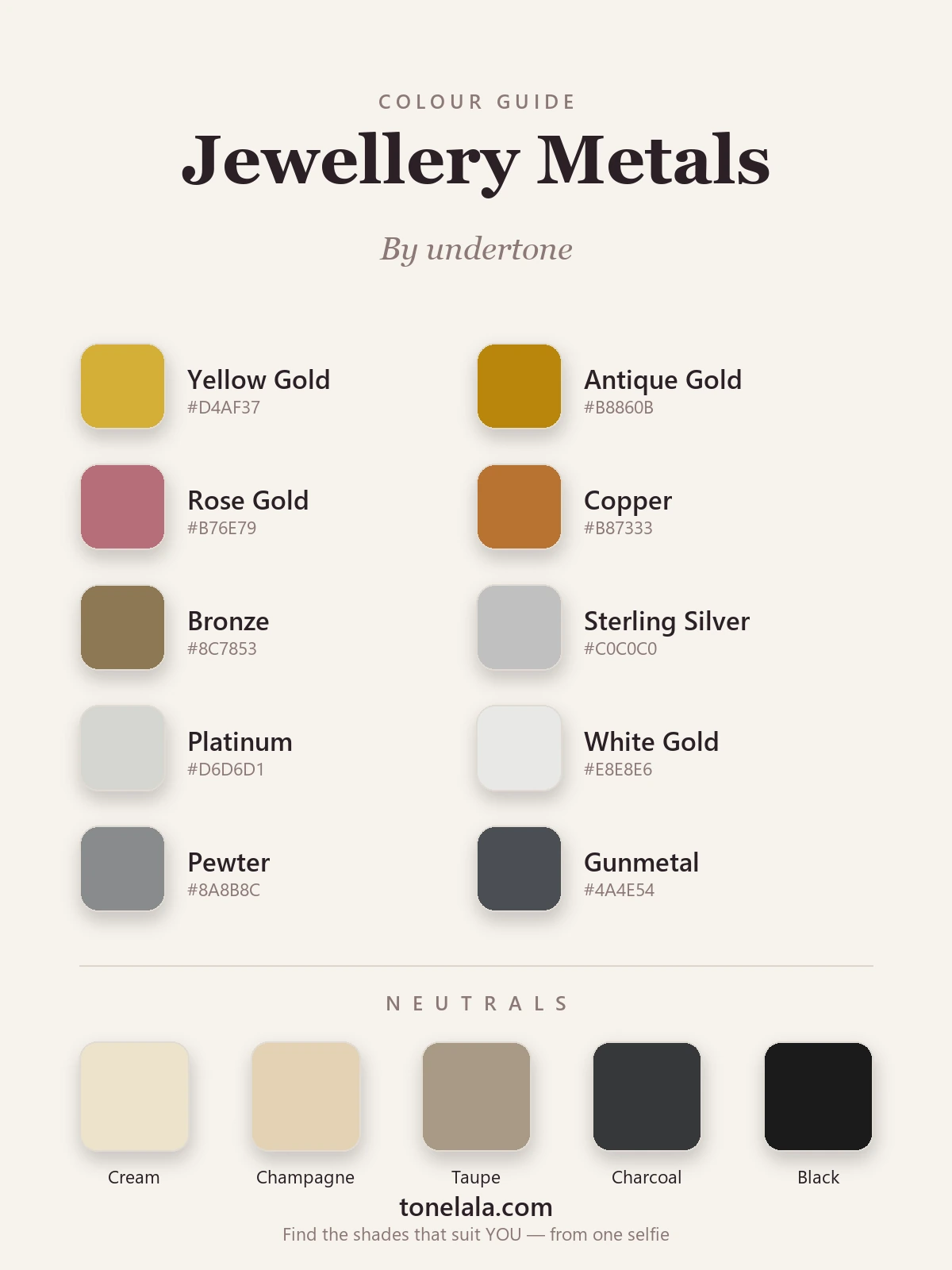
The trap for cool undertones is yellow gold worn against the face, which can look like it's sitting on the skin rather than with it, sometimes reading faintly orange or brassy. It's not banned, and a paler, cooler gold is friendlier than a deep brassy one, but silver-family metals will almost always look more natural. Rose gold is a kinder warm option here because its pink tilt meets cool skin halfway. And if you want warmth without the clash, white gold gives you the prestige of gold in a temperature that actually suits you.
Are you warm, cool or neutral?
Find your color season →Where rose gold and neutral undertones fit
Rose gold deserves its own paragraph because it breaks the rules in the best way. It's gold with copper and a whisper of pink folded in, which means it borrows from both temperature families at once, warm enough to flatter golden skin, pink enough to sit happily on cool skin. That's why it became such a runaway favorite: it's the most forgiving metal there is, and it looks especially lovely on light, soft coloring and on anyone neutral. The only complexions it flatters slightly less are very deep, very cool ones, where a clean silver reads sharper and more deliberate.
Neutral undertones are the lucky ones who can genuinely wear both gold and silver, which is rarer than the internet suggests, true neutral skin has no strong pull either way, so the choice becomes mood and outfit rather than rule. If that's you, mixed metals will look effortless, and you can let the colors you're wearing decide: gold to warm an outfit, silver to cool and sharpen it.
Mixing metals (and reading the swatch)
Mixing gold and silver used to feel like a mistake; now it's one of the quickest ways to look current, and it quietly side-steps the undertone question, because you're wearing both temperatures at once. The only thing that separates "stylish" from "accidental" is repetition: wear each metal at least twice so the eye reads it as a decision. Gold hoops and a gold ring against a silver necklace and a silver cuff looks intentional; one lone silver bangle with an otherwise gold outfit just looks like you forgot to take it off.
The swatch above lays the metals out by temperature so you can see the families side by side, the warm row (yellow gold #D4AF37, antique gold #B8860B, copper #B87333, bronze #8C7853), rose gold #B76E79 bridging the middle, and the cool row (sterling silver #C0C0C0, platinum #D6D6D1, white gold #E8E8E6, pewter #8A8B8C, gunmetal #4A4E54). The neutrals, cream, champagne, taupe, charcoal and black, are the backdrops these metals sit against in a wardrobe, and they shift the read too: gold glows warmest against cream and champagne, silver looks sharpest against charcoal and black.
Matching metal to your color season
This is where "what metal suits me" stops being one answer and becomes yours. Confirming warm or cool sets the direction, but your depth and contrast decide the exact version, and that maps onto seasonal color analysis neatly. The warm seasons, the Springs and Autumns, are gold's natural home: a True Spring suits a bright, clear gold, while a True Autumn carries deep antique gold, copper and bronze like nobody else. The cool seasons, the Summers and Winters, lean silver: a soft True Summer glows in gentle silver and rose gold, while a True Winter wears the brightest, coolest platinum and white gold for maximum contrast.
So a generic "warm equals gold" chart gets you most of the way, but not all of it, a Light Spring and a Deep Autumn are both warm and both gold people, yet their golds are worlds apart in depth. Our color analysis guides walk through every season, so once you know roughly where you sit you can read your exact metals and the colors to wear them with. And if you can't quite tell whether you're a light, deep, soft or bright kind of warm or cool, genuinely hard to judge in your own mirror, that's exactly what a personal analysis settles.
Putting it together
Match the metal to your undertone and jewelry stops being guesswork: warm skin reaches for gold, copper and bronze; cool skin reaches for silver, platinum and white gold; neutral skin takes its pick; and rose gold is the safe, lovely middle ground when you're not sure. Do the wrist test in daylight, trust the side where your skin looks even rather than the side where the metal shouts, and build from there. Get the family right from this guide, then let a proper analysis hand you your exact version, whether your gold runs bright or antique, and the precise shades that turn "this suits me" into "what is that, you look incredible."
Frequently asked questions
What is the best jewelry metal for my skin tone?
It comes down to undertone. Warm undertones (gold, peach or yellow under the skin) glow in yellow gold, antique gold, copper and bronze. Cool undertones (pink, red or blue under the skin) suit sterling silver, platinum and white gold. Neutral undertones genuinely carry both, and rose gold sits in the middle as the great in-betweener. Surface color and tan don't change the answer, your undertone does, which is why it's worth confirming rather than guessing.
Does gold or silver suit my skin tone?
Try the wrist test: lay a gold chain over one inner wrist and a silver one over the other in daylight. On warm undertones gold looks lit and the skin around silver can read slightly gray; on cool undertones silver looks crisp and clean while gold can seem to sit on top, almost orange. Whichever metal makes your skin look even and healthy rather than the metal itself standing out is the one for you. If both look good, you're likely neutral.
Does rose gold suit every skin tone?
Rose gold is the most forgiving metal because its copper-pink tone borrows from both families, warm enough for golden undertones, pink enough for cool ones. It's especially lovely on neutral undertones and on light, soft coloring. The only people it flatters slightly less are very deep, very cool complexions, where a clean silver or platinum tends to read sharper and more striking near the face.
Can I wear gold and silver jewelry together?
Yes, mixed metals are one of the easiest ways to look current, and they quietly solve the undertone question because you're wearing both. The trick is to make it look deliberate: repeat each metal at least twice (say, gold earrings and a gold ring against a silver necklace and bracelet) so it reads as a choice rather than an accident. Neutral undertones get away with it most effortlessly, but anyone can wear mixed metals well with a little balance.
How do I find which metal and colors suit me best?
The metal test tells you your undertone direction; a full color analysis tells you the exact version, whether your gold should be bright and clear or deep and antique, and the precise shades to wear with it. The reliable way is a photo-based analysis that reads undertone, depth and contrast together, so you get your specific metals and your specific palette rather than a generic chart. You can start one at tonelala.com/onboarding.
Related guides

Gold vs Silver: Which Suits You
A color analyst on whether gold or silver jewelry suits you, three quick undertone tests, why one metal lifts your face, and what to wear if you're neutral.
Olive Skin Undertones: Warm, Cool and Neutral Olive Explained
Olive skin is a green-gray cast that can sit over a warm, neutral or cool undertone. Five daylight tests to tell which olive you are, with the colors, makeup, hair and seasons for each.

Warm vs Cool Undertones
A color analyst's guide to warm vs cool undertones: simple at-home tests, the neutral middle ground, and example colors with hex codes for each.

Fair Skin Tone: Undertones & Best Colors
A color analyst's guide to fair skin tone, how to spot it, read your cool, warm or neutral undertone, the seasons it suits
Best Blush for Your Skin Tone
A color analyst's guide to the best blush for your skin tone, how to pick peach, coral, rose and berry by undertone and depth, with real hex codes.

Warm-Toned Skin: How to Tell & Best Colors
How to tell if you have warm-toned skin, the vein, jewelry and white-paper tests, plus the colors, metals and neutrals that flatter warm skin
Prefer in person? Find color analysis near you
Browse local color analysts by city, or get the same season, palette and best-colors breakdown online from one selfie.
See your colors on a photo of you
Upload one selfie and ToneLala reveals your season, your full palette, and your best hair, makeup, jewelry and outfits, styled on you.