In a sentence: warm-toned skin has gold, peach or yellow sitting underneath it, you'll usually see greenish veins, glow next to gold jewelry, and read golden against white paper, and it comes alive in coral, tomato red, golden yellow, terracotta, olive and the warm end of teal. Skip to the full palette or find your season.
Warm-Toned Skin: How to Tell & Best Colors
By ToneLalaUpdated July 7, 2026

Contents
A client once told me she'd "always looked a bit ill in photos," and brought along the white shirt she wore in most of them. We laid it next to her bare jaw in daylight and the answer was right there, beside that cold, blue-white, her golden skin turned faintly gray and tired. Swap the shirt for a warm cream and the same face looked lit from inside. She wasn't unphotogenic. She was warm-toned, dressing cool, and nobody had ever pointed it out.
Warm-toned skin is hugely common and quietly misdiagnosed. It hides behind "I tan easily" and "I just wear black," and so it ends up in icy pastels and stark white that work against it. The good news is that warmth is one of the easier things to confirm at home, and once you know the direction of your skin, a whole register of golden, earthy color opens up, the shades that make you look rested rather than washed out.
What "warm-toned" actually means
Undertone is the color sitting underneath the surface of your skin, and it doesn't shift with a tan, a flush or a bad night's sleep. A warm undertone has gold, peach or yellow woven through it. (Cool undertones lean pink, red or blue; neutral sits in the middle.) This is different from how deep or fair your skin is, depth is the surface level, undertone is the temperature beneath it. You can be very fair and warm, or deep and warm, and everything between.
That underlying temperature is the single most useful thing to know about your coloring, because every color you put near your face either echoes it or argues with it. A golden-yellow knit beside warm skin reads as one harmonious thing, and your eye sees an even, lit complexion. A cold, blue-based pink does the opposite, it throws the gold in your skin into relief, and suddenly you look sallow, as if the color borrowed the life out of your face. Same person, two outcomes, decided entirely by temperature.
How to tell if you have warm-toned skin
No single test is foolproof, so run a few and look for agreement. Do them in soft daylight, near a window, with no makeup and your hair off your face.
- The vein test. Turn your inner wrist to the light. Veins that read more green point warm; veins that look distinctly blue or purple point cool. If you genuinely can't decide, that's a clue you may be neutral.
- The jewelry test. Hold a piece of gold to one side of your jaw and silver to the other. On warm skin the gold side settles: skin looks even and lit, while the silver side can look faintly gray. This is one of the most reliable tells there is.
- The white-paper test. Hold a sheet of pure white paper up beside your bare face. Warm skin looks golden, peachy or yellow against the white; cool skin looks pink or rosy; olive skin looks muted and slightly green.
- How you react to sun. Warm skin often tans more than it burns, deepening to a golden or bronze rather than going pink and staying pink, though plenty of fair-warm skin still catches, so weight this one lightly.
- The "best white" test. Try a stark optic white next to a soft cream. If cream flatters and bright white drains you, that warmth is showing its hand.
The most decisive combination is the jewelry test agreeing with the white-paper test: glowing beside gold and reading golden against white is warm skin's signature. If your results are split, green-ish veins but silver suits you, say, you're likely warm-neutral, and the exact balance is worth confirming properly rather than guessing.
Warm undertone isn't the whole story
Here's the bit most online charts skip. "Warm" tells you the direction of your palette, not your exact shades. I've draped two women who were both unmistakably warm and handed them surprisingly different colors, one lived in soft peach and golden honey, the other in deep rust and forest green. Same undertone, different depth and clarity.
So treat warm as the foundation, not the finish line. Three dials decide your colors: undertone (warm, in your case), depth (how light or deep you are) and chroma (how clear or muted). Warm sets the temperature; the other two decide whether your coral is a bright sunny version or a roasted, earthy one. That's exactly why a generic "warm" list gets you most of the way but never the whole way, and why two warm-toned people can need quite different wardrobes.
Want to know which kind of warm you are?
Find your color season →The best colors for warm-toned skin
These are the ten I come back to for warm clients again and again, a spread of warm reds and oranges, golden yellows, earthy greens and the warm cousins of blue. Every one of them shares the gold-based DNA of your skin, so your face stays lit across all of them.
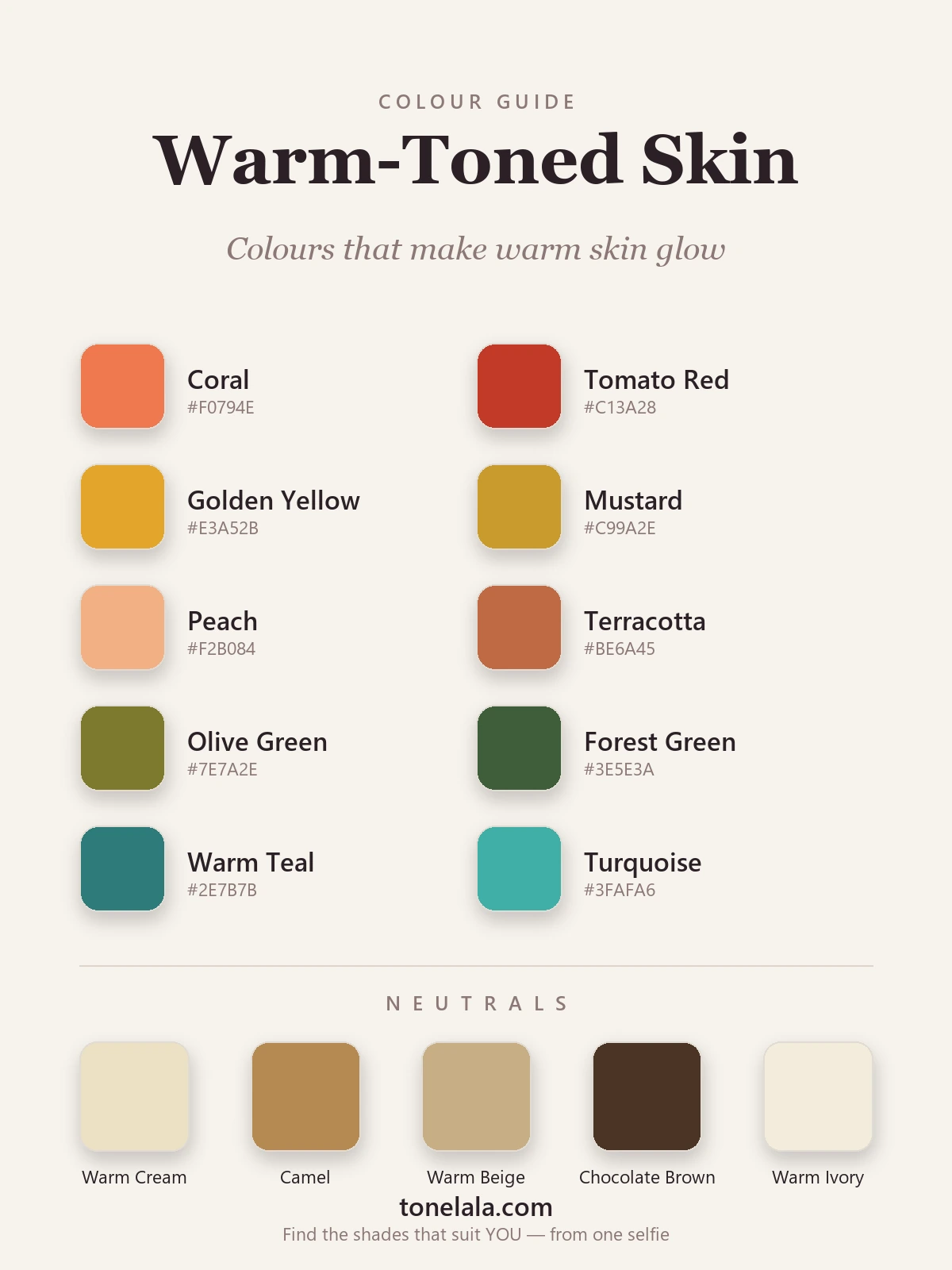
| Color | Hex | Why it works |
|---|---|---|
| Coral | #F0794E |
The warm skin's best friend, peachy-orange, it mirrors the warmth in your complexion almost exactly. |
| Tomato Red | #C13A28 |
Your red: orange-leaning, never blue, so it reads rich and alive rather than harsh. |
| Golden Yellow | #E3A52B |
Pure sunlight. A color most people fear, but warm skin carries it like nobody else. |
| Mustard | #C99A2E |
The earthier yellow, golden and a touch muted, it flatters warm skin where icy lemon would jaundice. |
| Peach | #F2B084 |
The soft option, flattering the way good morning light is. Lovely near the collar. |
| Terracotta | #BE6A45 |
That roasted, sun-baked warmth that looks quietly expensive on golden skin. |
| Olive Green | #7E7A2E |
Proof green isn't cool by default, a golden, earthy green made for warmth. |
| Forest Green | #3E5E3A |
A deep, warm green that gives your palette a rich anchor without going cold. |
| Warm Teal | #2E7B7B |
How a warm person wears blue-green: the gold and green folded in keep it on your side. |
| Turquoise | #3FAFA6 |
The brighter blue note, pick the version with green and gold in it and it sings instead of sulks. |
Best neutrals: Warm Cream #EDE0C4 (your soft off-white, far kinder than stark white), Camel #B68A52 (keeps a look tonal and expensive), Warm Beige #C7AE85 (the easiest everyday base), Chocolate Brown #4A3526 (your "dark", gentler at the face than black), and Warm Ivory #F3ECDC (a touch cleaner than cream, still never cold).
Metals and the colors to handle with care
For jewelry, gold is your hero: it echoes the gold already in your skin and makes you look lit. Brass, bronze, copper and rose gold all sit beautifully too. Silver and white gold can read slightly cold and gray up at the face, but you don't have to ban them: choose a warm-toned or champagne version, or wear plain silver at the wrist rather than the ears, away from your complexion.
A few colors tend to disappoint warm skin, and they're all the same idea, the wrong temperature. Icy, blue-based brights (fuchsia, icy pink, cool ruby, electric cobalt) pull the gold out of your face and leave it gray. Pure black and stark white are cool and high-contrast, so they overpower warmth rather than flatter it, black drops a hard shadow under the chin, bright white can make warm skin look yellow. And cool dusty grays sit flat and joyless against warmth. None are forbidden; just reach for the warmer cousin, tomato instead of cool red, cream instead of optic white, chocolate or navy instead of black.
Warm-toned skin and the color seasons
This is where "warm-toned" stops being one list and becomes yours. In seasonal color analysis, warm undertone is the through-line of two whole families, the Springs and the Autumns: but undertone is only one of the three dials.
Roughly: if you're warm and light and clear, you're Spring territory, your coral is bright, your yellow is sunny, your greens are fresh (Light Spring, True Spring). If you're warm and deep or muted, you're Autumn, your colors roast down into rust, golden olive and forest green (True Autumn, Soft Autumn, Deep Autumn). A Light Spring in deep terracotta can look weighed down, and a Deep Autumn in pale peach can look washed out, same warm undertone, opposite results.
Our color analysis guides walk through each season in detail, so once you know roughly where you sit you can read your exact palette. If you're specifically trying to pin the undertone down first, the companion piece on the best colors for warm undertones goes deeper on shades and what to avoid. And if you're unsure whether you're a light, deep, soft or bright kind of warm, genuinely hard to judge in your own mirror, that's exactly what a personal analysis settles.
Putting it together
Build a small warm capsule and getting dressed stops being a guessing game. Pick two warm neutrals you love, say camel and chocolate brown, then add two or three of the colors above, like coral, golden yellow and forest green. Everything mixes, because it all shares the same gold-based DNA, and your face stays lit in all of it. Keep your richest colors up near the collar and let the quieter neutrals do the work below.
Warm-toned skin isn't difficult, it's just specific. The moment you can see the warmth for what it is, the black-and-icy-pastel habit falls away and a whole register of golden, earthy color opens up, the shades that make you look like you slept well and stood in good light. Confirm your warmth from this guide, then let a proper analysis hand you your exact coral and your exact olive, the two shades that turn "this suits me" into "what is that, you look incredible."
Frequently asked questions
How do I tell if I have warm-toned skin? Run three quick tests in soft daylight. Look at the veins on your inner wrist, if they read more green than blue, that points warm. Hold a piece of gold jewelry to one side of your face and silver to the other, warm skin looks lit and even beside the gold, slightly gray beside the silver. And hold a sheet of pure white paper to your bare face, warm skin looks golden or peachy against it rather than pink or rosy. If two or three of those agree, you're very likely warm-toned.
What is the difference between warm and cool undertones? Undertone is the color sitting underneath your skin, and it doesn't change with a tan. Warm undertones have gold, peach or yellow in them; cool undertones lean pink, red or blue; neutral sits between the two. The fastest tells are veins (green-ish reads warm, blue-ish reads cool), the metal that flatters you (gold for warm, silver for cool), and how white paper reads against your face (golden for warm, rosy for cool).
What colors look best on warm-toned skin? Golden, earthy, sun-warmed shades flatter warm skin most: coral, tomato red, golden yellow, mustard, peach, terracotta, olive green, forest green, and the warm end of teal and turquoise. The thread through all of them is warmth, take any color you love and reach for its gold-based version rather than its icy, blue-based one. Warm cream, camel, warm beige, chocolate brown and warm ivory are the neutrals that hold it together.
Is gold or silver better for warm-toned skin? Gold is the natural hero for warm skin, it echoes the gold already in your complexion and makes you look lit. Silver and white gold can read slightly cold and gray up at the face. You don't have to give up cool metals entirely: choose a warm-toned, champagne or rose-gold version, or wear plain silver away from your face, at the wrist rather than the ears.
Which color seasons have warm-toned skin? Warm undertone is the through-line of two whole season families, the Springs and the Autumns. If you're warm and light or clear, you're Spring territory (Light Spring, True Spring); if you're warm and deep or muted, you're Autumn (True Autumn, Soft Autumn, Deep Autumn). Confirming you're warm is step one; depth and clarity decide your exact season, which is what a personal color analysis pins down.
Frequently asked questions
How do I tell if I have warm-toned skin?
Run three quick tests in soft daylight. Look at the veins on your inner wrist, if they read more green than blue, that points warm. Hold a piece of gold jewelry to one side of your face and silver to the other, warm skin looks lit and even beside the gold, slightly gray beside the silver. And hold a sheet of pure white paper to your bare face, warm skin looks golden or peachy against it rather than pink or rosy. If two or three of those agree, you're very likely warm-toned.
What is the difference between warm and cool undertones?
Undertone is the color sitting underneath your skin, and it doesn't change with a tan. Warm undertones have gold, peach or yellow in them; cool undertones lean pink, red or blue; neutral sits between the two. The fastest tells are veins (green-ish reads warm, blue-ish reads cool), the metal that flatters you (gold for warm, silver for cool), and how white paper reads against your face (golden for warm, rosy for cool).
What colors look best on warm-toned skin?
Golden, earthy, sun-warmed shades flatter warm skin most: coral, tomato red, golden yellow, mustard, peach, terracotta, olive green, forest green, and the warm end of teal and turquoise. The thread through all of them is warmth, take any color you love and reach for its gold-based version rather than its icy, blue-based one. Warm cream, camel, warm beige, chocolate brown and warm ivory are the neutrals that hold it together.
Is gold or silver better for warm-toned skin?
Gold is the natural hero for warm skin, it echoes the gold already in your complexion and makes you look lit. Silver and white gold can read slightly cold and gray up at the face. You don't have to give up cool metals entirely: choose a warm-toned, champagne or rose-gold version, or wear plain silver away from your face, at the wrist rather than the ears.
Which color seasons have warm-toned skin?
Warm undertone is the through-line of two whole season families, the Springs and the Autumns. If you're warm and light or clear, you're Spring territory (Light Spring, True Spring); if you're warm and deep or muted, you're Autumn (True Autumn, Soft Autumn, Deep Autumn). Confirming you're warm is step one; depth and clarity decide your exact season, which is what a personal color analysis pins down.
Related guides
Warm vs Cool Undertones
A color analyst's guide to warm vs cool undertones: simple at-home tests, the neutral middle ground, and example colors with hex codes for each.

Warm vs Cool Skin Tone: How to Tell
Learn how to tell if you have a warm, cool or neutral skin tone with simple at-home tests, plus the colors that flatter each undertone.
Olive Skin Undertones: Warm, Cool and Neutral Olive Explained
Olive skin is a green-gray cast that can sit over a warm, neutral or cool undertone. Five daylight tests to tell which olive you are, with the colors, makeup, hair and seasons for each.

Golden (Warm) Skin Tone: Best Colors
A color analyst's guide to a golden, warm skin tone, how to confirm it, the warm seasons that suit it, and 10 flattering colors with hex codes.

Types of Skin Tones Explained
A color analyst explains the types of skin tones, depth (fair to deep) and undertone (warm, cool, neutral), how they differ, and how to find yours.

Neutral Skin Tone: Undertones & Best Colors
A color analyst explains what a neutral skin tone is, how to tell if you have one, and the versatile colors and seasons that suit it (with hex codes).
Prefer in person? Find color analysis near you
Browse local color analysts by city, or get the same season, palette and best-colors breakdown online from one selfie.
See your colors on a photo of you
Upload one selfie and ToneLala reveals your season, your full palette, and your best hair, makeup, jewelry and outfits, styled on you.