In a sentence: Wear pink as the hero, then anchor it with one deeper, cooler partner, green, navy or chocolate, and keep a quiet neutral near your face. Skip to the pairing palette or find your most flattering colors.
How to Wear Pink: Outfit Ideas & Color Pairings
By ToneLalaUpdated July 8, 2026

Contents
The single most common pink mistake I see is treating it like a fragile thing, a blush scarf nudged in beside white jeans and beige sandals, the whole outfit floating at one soft, sweet pitch with nothing to push against. Pink doesn't want to be protected. It wants a foil.
I had a client who owned pink only in cautious doses, always next to cream. We put her blush jumper with deep olive trousers and a chocolate boot, and it stopped reading as girlish and started reading as expensive, same jumper, completely different outfit. That's the whole trick to wearing pink well: choose your pink, then give it a partner brave enough to take it seriously.
What pink brings to an outfit
Pink is red softened with white, a tint rather than a pure hue, so it carries red's warmth at a gentler, friendlier volume. That gives it a particular mood: approachable, a little romantic, never aggressive. Worn right it reads modern and confident; worn timidly it slides into sugary. The color itself isn't the problem, the dosage and the partner are.
It also flatters more skin than people expect, because "pink" is really a whole family. A cool, blue-based rose and a warm, golden coral-pink are different animals that want different friends, and somewhere in that range is a pink that genuinely lights up your face. Pink works hardest as a daytime lift, a softening note in tailoring, and a romantic evening color. It only struggles when you ask it to do everything at the same brightness as the rest of your outfit.
The best colors to pair with pink
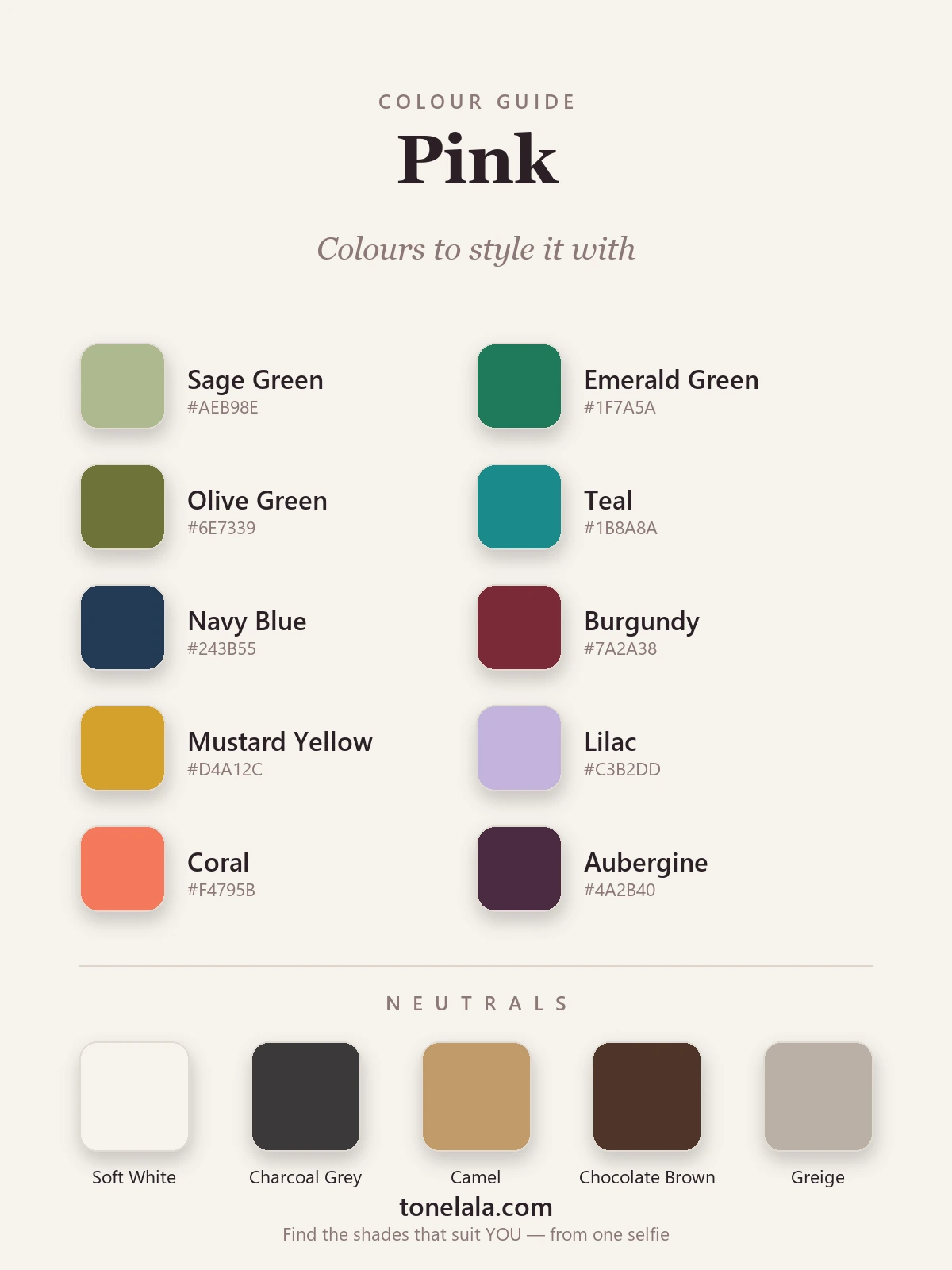
Ten shades I come back to again and again, pink's natural complement, a few jewel tones to make it look deliberate, and some warmer pops for the golden end of the family.
| Color | Hex |
|---|---|
Sage Green #AEB98E |
Pink's complement, muted right down. The easiest, most modern pairing there is, calm, grown-up and impossible to get wrong. |
Emerald Green #1F7A5A |
The dramatic version of pink-and-green. Rich and jewel-like, it makes a soft pink look deliberate and expensive. |
Olive Green #6E7339 |
Green with a khaki, earthy edge. Brilliant with warm and dusty pinks, a utility trouser under a blush knit. |
Teal #1B8A8A |
A blue-green that splits the difference between fresh and rich. Cool pinks especially sparkle against it. |
Navy Blue #243B55 |
The adult alternative to black. Navy anchors pink and quietly says you dressed on purpose. Works with every shade. |
Burgundy #7A2A38 |
Pink's deeper, moodier cousin. A tonal red-on-pink pairing that feels romantic and a little unexpected. |
Mustard Yellow #D4A12C |
A warm, golden pop that flatters coral and peachy pinks. Autumnal and confident, never sugary. |
Lilac #C3B2DD |
An analogous purple that sits beside pink on the wheel, giving a soft, dreamy tonal blend with zero clash. |
Coral #F4795B |
Pink turned up the warm dial. A tonal warm pairing that reads sunny and energetic rather than precious. |
Aubergine #4A2B40 |
A deep purple-brown that works like a soft, warm "dark." Sophisticated, and far gentler near the face than black. |
Neutrals to wear with pink: Soft White #F6F3EE keeps it fresh and crisp; Charcoal Gray #3C3A3B is the contrast color to reach for instead of black; Camel #C19A6B and Chocolate Brown #4E3629 warm pink up and make it look luxe; and a soft Greige #B9B0A6 is the understated everyday backdrop that lets the pink do the talking.
Is YOUR best shade of pink warm or cool?
Find your color season →Pink outfit formulas
- Everyday: a blush knit, olive wide-leg trousers and a chocolate boot, bag to match. Earthy, warm and quietly chic, my standing proof that pink can be grown-up rather than girlish.
- Work: a rose blouse or pink trouser with navy or charcoal tailoring and a structured bag. The deep neutral does the heavy lifting, so the pink reads polished. Gold studs to finish.
- Evening: a hot pink or fuchsia top with navy tailoring, or a rose slip dress under an aubergine coat. High-impact but anchored, the deeper color stops the pink tipping into loud.
- Warm-weather fresh: a coral-pink blouse, white denim and a camel coat or sandal. Sunny and light, with just enough warmth in the camel to keep it from floating.
Colors and styling to avoid with pink
- Orange and true red right up against it. Pink already carries red's warmth, so butting it against orange or a pure red muddies both, put a neutral between them, or pick one warm hero and let the other recede.
- A brown that matches your pink's depth. Chocolate and camel work because they differ in value from your pink. A mid-brown sitting at the same lightness as a dusty rose just goes flat and a touch dreary, keep a clear light-dark gap.
- Stark black on a pale pastel pink. Not banned, but heavy black against a delicate baby pink can look hard and a little aging. Charcoal, navy or aubergine give you the contrast without the harshness; save black for a hot pink that can hold its own.
Wearing pink for your coloring
Here's the part most styling guides skip: there's no single best pink. The most flattering version, and the partners that go with it, depends entirely on your coloring.
If you're warm (a Spring or Autumn), golden coral and salmon pinks light up your skin, and they want warm friends: camel, olive, mustard, coral. If you're cool (a Summer or Winter), blue-based rose, raspberry and fuchsia are your pinks, and they sing next to navy, charcoal, emerald and gray. Depth matters too, a light season wears soft blush beautifully, while a deep or bright season can carry a vivid magenta that would overwhelm someone gentler.
You can browse the full set of color analysis guides to see where you might land, but undertone and depth are genuinely hard to judge in your own mirror, and pink, which shape-shifts under different light, is one of the trickiest colors to read on yourself. A personal analysis tells you your exact shade of pink and the colors that partner it best on you.
Putting it together
Pink rewards a confident hand. Choose your pink first, be honest about whether it leans warm or cool, then pick one partner that earns its place: green when you want it modern, navy or burgundy when you want it expensive, camel or chocolate when you want it warm and grown-up. Keep one quiet neutral near your face and let the pink lead from there. Do that and pink stops being the color you wear in cautious doses and becomes one of the most useful, most flattering things in your wardrobe.
Frequently asked questions
How do you wear pink without looking too sweet?
Anchor it with something deeper and a little cooler. A blush jumper next to navy, olive or chocolate brown reads grown-up and considered; the same jumper next to white or beige can tip into nursery territory. The fix is rarely less pink, it's a braver second color and one neutral kept close to your face.
What should you wear with pink?
Pink loves green most of all (sage for easy, emerald for dramatic), then navy and burgundy to make it look expensive, plus teal, mustard, lilac and coral for variety. Ground the lot with soft white, charcoal, camel, chocolate brown or greige. Match the warmth of the partner to the warmth of your pink and it always lands.
Can you wear pink to work?
Easily. Keep the pink as one considered piece, a blush blouse, a rose knit, a pink trouser, and pair it with navy or charcoal tailoring. The deep neutral does the heavy lifting, so the pink reads polished rather than playful. Gold or silver studs and a structured bag finish it for the office.
What colors should you avoid wearing with pink?
Be careful putting orange or true red right up against pink, since they muddy each other; a brown that matches your pink's exact depth, which goes flat; and stark black on a delicate pastel pink, which can look heavy and aging. None are banned, they just need the right shade of pink and a little space between them.
Which shade of pink suits my skin tone?
Match the pink's temperature to your coloring. Warm, golden skin (Spring and Autumn types) glows in coral, salmon and peachy pinks; cool skin (Summer and Winter types) suits rose, raspberry and fuchsia. Depth matters too, light coloring wears soft blush beautifully, while deep or bright coloring can carry a vivid magenta. A personal color analysis pins down your exact pink.
Related guides

How to Wear Beige: Outfit Ideas & Color Pairings
A stylist's guide to wearing beige, 10 color pairings with hex codes, the best neutrals, outfit formulas by occasion and what to avoid.
How to Wear Brown: Outfit Ideas & Color Pairings
How to wear brown without looking dull: 10 color pairings with hex codes, 5 neutrals, outfit formulas by occasion, and the right shade for your coloring.

How to Wear Orange: Outfit Ideas & Color Pairings
A stylist's guide on how to wear orange, 10 pairing colors with hex codes, the best neutrals, outfit formulas, and the right shade for your coloring.
How to Wear Red: Outfit Ideas & Color Pairings
How to wear red without it wearing you, a stylist's outfit formulas, the 10 best colors to pair with red (plus neutrals)
How to Wear Navy: Outfit Ideas & Color Pairings
A stylist's guide to wearing navy, 10 color pairings with hex codes, 5 neutrals, outfit formulas by occasion, and the right shade of navy for your coloring.
How to Wear Lavender: Outfit Ideas & Color Pairings
A stylist's guide to wearing lavender, 10 color pairings and 5 neutrals with hex codes, outfit formulas by occasion, and the right shade for your coloring.
Prefer in person? Find color analysis near you
Browse local color analysts by city, or get the same season, palette and best-colors breakdown online from one selfie.
See your colors on a photo of you
Upload one selfie and ToneLala reveals your season, your full palette, and your best hair, makeup, jewelry and outfits, styled on you.