In a sentence: medium skin is a mid-range depth, not a color temperature, so your most flattering shades come from your undertone (warm, cool or neutral) layered on top of that depth, which is why saturated colors like teal, coral, emerald and raspberry suit you while pale, dusty shades fall flat. Skip to the full palette or find your season.
Medium Skin Tone: Undertones & Best Colors
By ToneLalaUpdated July 8, 2026
Contents
A client sat down last month certain she was an autumn because everyone she'd ever asked told her medium skin "means warm". Gold jewelry, terracotta, mustard, the lot. Half of it looked lovely on her and half of it pulled a faint gray into her cheeks, and she couldn't work out why the rule kept letting her down. When I held a cool berry up to her jaw, her whole face cleared. She had medium skin and a cool undertone, and the well-meaning advice had been steering her warm for a decade.
That mix-up happens constantly, because "medium skin tone" describes how deep your complexion is, not what color sits underneath it. Depth and undertone are two separate dials. Get them confused and you'll spend years buying shades that were never going to flatter you. Read them as two things, and dressing for medium skin becomes genuinely straightforward, you have more range than most, and a clear way to use it.
What "medium skin tone" actually means
Medium skin is the middle of the depth scale, the band between fair and deep. It has visible pigment, it tends to tan rather than burn badly, and against a white wall it reads clearly deeper than the wall but plainly lighter than a deep complexion. In foundation terms, you're usually matching shades labeled "medium", "medium-tan" or "golden medium". That's the whole of what the phrase tells you: roughly how light or rich a color should be before it suits you.
What it does not tell you is temperature. This is the part the internet skips. Depth answers "how deep?" while undertone answers "warm, cool or neutral?", and the two are independent. You can have medium skin with a cool, rosy base or medium skin with a golden, olive base, and those two people need noticeably different palettes despite sharing a depth. So the useful news is that medium skin is forgiving on depth (most mid-to-deep colors register well), and the decisive work is finding your undertone.
Finding your undertone on medium skin
No single test is foolproof, so I read several cues together and let the weight of evidence decide. Do these in natural daylight, with no makeup on, away from brightly colored walls.
- The wrist-vein check. Look at the veins on the inside of your wrist. Blue or purple suggests a cool undertone; green or olive-tinged suggests warm. A genuine blue-green that you can't call points neutral.
- Gold versus silver. Hold gold jewelry near your face, then silver. If gold makes your skin look lit and even, you lean warm; if silver looks cleaner and clearer, you lean cool. If both look good, you're likely neutral.
- How you tan. Medium skin that deepens to a golden-brown and rarely burns often skews warm; skin that pinks up first, or tans to a cooler, ashier brown, often skews cool. A soft clue, not a rule.
- White versus cream. Drape pure white under your chin, then cream. Cool medium skin looks crisp and fresh in pure white; warm medium skin looks healthier in cream, with white pulling a slight gray.
Tally the answers. Mostly green-vein, gold, cream, golden tan? You're warm. Mostly blue-vein, silver, pure white, pink-first? You're cool. A real split down the middle is the signature of a neutral undertone, common on medium skin, and nothing to force into a box. If you want to go deeper on this step alone, my full guide on how to find your undertone walks through every cue.
The best colors for medium skin tone
These ten are my reliable starting point for medium skin, saturated enough to register against your depth, balanced enough to suit most undertones with a small shift either way.
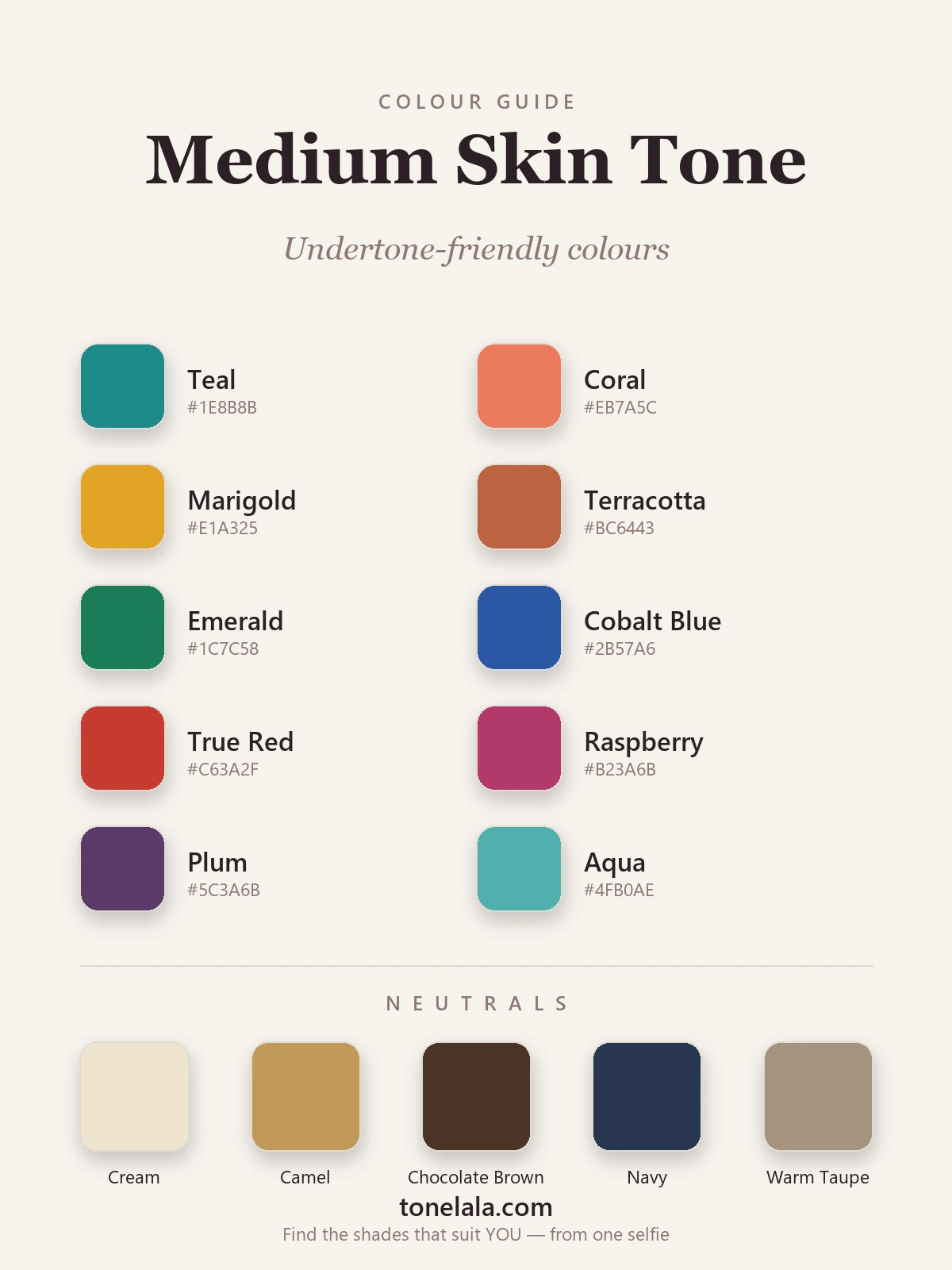
| Color | Hex | Why it works |
|---|---|---|
| Teal | #1E8B8B |
The near-universal winner. It sits between warm and cool, so almost every medium-skin undertone looks lit-up beside it. |
| Coral | #EB7A5C |
A warm pinky-orange that flatters medium skin the way it flatters a tan, fresh and healthy. Lean terracotta if you're warm. |
| Marigold | #E1A325 |
Golden yellow medium skin can genuinely wear, unlike pale lemon. Reads sunlit and rich rather than sallow. |
| Terracotta | #BC6443 |
An earthy clay-orange that glows on warm and neutral medium skin and reads quietly expensive. |
| Emerald | #1C7C58 |
The jewel green. Deep and clean, it gives medium skin instant depth, a cool-leaning showstopper. |
| Cobalt Blue | #2B57A6 |
A clear, confident blue that makes medium skin look bright by contrast. Hard to get wrong. |
| True Red | #C63A2F |
A balanced red with both warm and cool in it, the safest red for medium skin when you're unsure of your undertone. |
| Raspberry | #B23A6B |
A blue-based pink-red with real energy. Cool undertones light up; it makes the skin look luminous. |
| Plum | #5C3A6B |
A deep, rich purple, sophisticated against medium skin and brilliant for autumn and winter dressing. |
| Aqua | #4FB0AE |
A lighter, brighter cousin of teal for warmer days, fresh against medium skin without washing it out. |
Best neutrals: Cream #EFE5D0 (kinder than stark white), Camel #C29A5A (warm, tonal, expensive-looking), Chocolate Brown #4A3526 (a richer "dark" than black), Navy #27364F (the smart cool alternative to black), and Warm Taupe #A4937D (a greige that won't gray you out).
Want YOUR exact most-flattering shades?
Find your color season →Colors that tend to fall flat
- Chalky pastels: baby pink, mint, pale lemon, dusty lilac. They're too light to hold their own against medium depth, so the color fades and the skin looks tired. Choose richer, clearer versions instead (raspberry instead of baby pink).
- Muddy beige-yellows: putty and "nude" tones a shade off your own skin. They blend into medium skin and flatten everything, your face included. Camel or true cream have the contrast and life those don't.
- Stark optic white: not banned, but it can read a touch hard and pull the eye to itself rather than to you. Soft cream or ivory almost always looks more flattering.
None of these are forbidden. They're simply the shades that disappoint most often on medium skin, so treat them as handle-with-care rather than off-limits.
Medium skin and your color season
Here's the honest part: there is no single season for medium skin, because it shows up in every season family. Depth is only one of three dials that build a palette, the other two are undertone and chroma (how soft or bright your coloring is).
If your medium skin is warm, you sit on the Spring–Autumn side: lean into golden, earthy versions of everything above, terracotta, marigold, warm teal, with cream and camel as neutrals. If it's cool, you sit on the Summer–Winter side, and blue-based versions flatter you most: true emerald, cobalt, raspberry, plum, anchored by navy. Then chroma decides which season within that half. Bright, high-contrast medium coloring (a Winter or Bright Spring) can take these shades at full saturation, while softer, lower-contrast coloring (a Soft Summer or Soft Autumn) wants them slightly muted so nothing overwhelms the face.
That last layer is exactly what a chart can't read for you. My color analysis guides walk through each of the twelve seasons in detail, and if you've already settled your depth, the companion piece on the best colors for medium skin goes deeper on the shade list itself. A personal analysis pins down whether your medium skin is warm or cool, bright or soft, and therefore which teal, which red, which neutral is genuinely yours.
Makeup and styling notes
The same logic runs straight into your makeup bag. Medium skin tends to suit blush and lip shades with real pigment, warm coral, brick, berry and true rose rather than barely-there nudes, which can vanish against your depth. Match the temperature to your undertone (peachy-warm or rosy-cool). On metals, gold flatters warm medium skin while silver and white-gold sit better on cool; neutral skin gets both, so choose by outfit. When you build looks, let one saturated color lead and keep the rest in your neutrals, a teal knit with camel trousers, a raspberry dress with cream and gold. Medium skin doesn't need the whole rainbow at once; it needs one color turned up.
Putting it together
Medium skin tone is a starting point, not a verdict, it tells you the depth to aim for and nothing about the temperature. So run the wrist, jewelry, tan and white-versus-cream cues in daylight, weigh them together, and let them point you warm, cool or neutral. Then build a small wardrobe around the neutrals above and two or three feature colors from your side of the palette. The only real mistake with medium skin is playing it too safe, dressing in shades so pale they cancel you out when you could be carrying real color. Find your undertone, choose with a bit of conviction, and the last step is precision: confirming your exact season so every red, blue and neutral is chosen for you. That's what a personal analysis is for.
Frequently asked questions
What is a medium skin tone?
A medium skin tone is a mid-range depth that sits between fair and deep, it has visible warmth or color in it, tans rather than burning badly, and doesn't read as either very pale or very dark. It's a description of depth, not undertone, so two people can both have medium skin and have completely different bases beneath it (one warm, one cool). Knowing you're medium tells you roughly how light or rich to take a color; your undertone tells you which direction to push it.
How do I know if I have a medium skin tone?
Look at your bare face in daylight against a white background. Medium skin shows obvious pigment without reading dark, it usually tans easily, rarely burns to a deep red, and sits a few shades deeper than the white you're holding up but clearly lighter than a deep complexion. If foundation shades described as 'medium', 'medium-tan' or 'golden medium' tend to match you, that's a strong confirmation.
What undertones do medium skin tones have?
All three. Medium skin can be warm (a golden, peachy or olive base), cool (a pink, rosy or blue base) or neutral (a balance of the two). Undertone is independent of depth, so the only reliable way to find yours is to read the cues directly, the wrist-vein test, gold versus silver jewelry, and how you react to the sun, rather than assuming medium skin is automatically warm.
What colors look best on medium skin tone?
Medium skin carries saturated, mid-to-deep colors beautifully, teal, coral, marigold, terracotta, emerald, cobalt, true red, raspberry, plum and aqua all flatter it, anchored by cream, camel, chocolate brown, navy and warm taupe. The single best version of each (warmer or cooler, brighter or softer) depends on your undertone and contrast, which is what your color season pins down.
What color season is medium skin?
There isn't one, medium skin appears in every season. Depth is only one of three things that decide your season; undertone (warm or cool) and chroma (soft or bright) matter just as much. A warm medium skin leans Spring or Autumn, a cool medium skin leans Summer or Winter, and where exactly you land depends on whether your coloring is bright or muted. A personal analysis reads all three together.
Related guides
Warm-Toned Skin: How to Tell & Best Colors
How to tell if you have warm-toned skin, the vein, jewelry and white-paper tests, plus the colors, metals and neutrals that flatter warm skin
Neutral Skin Tone: Undertones & Best Colors
A color analyst explains what a neutral skin tone is, how to tell if you have one, and the versatile colors and seasons that suit it (with hex codes).
Warm vs Cool Undertones
A color analyst's guide to warm vs cool undertones: simple at-home tests, the neutral middle ground, and example colors with hex codes for each.
Olive Skin Tone: The Complete Guide
What olive skin tone actually is, how to tell if you have the green-gray cast, your likely undertone, the seasons it maps to and the colors that flatter it.
Light Brown Skin Tone: Best Colors
A color analyst's guide to light brown skin tone, how to spot it, read your warm, cool or neutral undertone
Golden (Warm) Skin Tone: Best Colors
A color analyst's guide to a golden, warm skin tone, how to confirm it, the warm seasons that suit it, and 10 flattering colors with hex codes.
Prefer in person? Find color analysis near you
Browse local color analysts by city, or get the same season, palette and best-colors breakdown online from one selfie.
See your colors on a photo of you
Upload one selfie and ToneLala reveals your season, your full palette, and your best hair, makeup, jewelry and outfits, styled on you.