In a sentence: foundation comes in four undertones, warm (yellow-golden), cool (pink-rosy), neutral (between) and olive (green-gray), labeled W, C, N and O or G in most shade names; find yours by swatching all three of the same depth on your jaw in daylight and keeping the one that vanishes. Skip to the chart, the shade-code decoder, or find your undertone from a photo.
Everyone has stood at a foundation counter holding two bottles that are the same depth and look completely different, one slightly yellow, one slightly pink, and wondered which one is "right." That difference is undertone, and it's the thing that decides whether foundation disappears into your skin or sits on top of it looking like makeup. Depth gets you close; undertone gets you invisible.
This is the chart I use with clients, expanded into a full guide: what each undertone looks like on the skin, how brands label them, how to test yours in ten minutes, and the two categories, neutral and olive, that most charts leave out. For the wider method (depth, testing spots, common mistakes) see how to find your foundation shade; for undertone in clothing and color analysis, how to find your undertone.
Depth versus undertone
Two separate dials:
- Depth is how light or dark the skin is, fair, light, medium, tan, deep. It's the number in a shade name and it changes with sun and self-tan.
- Undertone is the color underneath the surface, warm, cool, neutral or olive. It's the letter in a shade name and it never changes.
Two foundations can be identical in depth and still look wrong on you if the undertone is off. A pink-based shade on golden skin looks chalky; a yellow-based shade on pink skin looks orange. Get depth right first, then undertone; the chart below is the undertone half.
The four undertones
| Undertone | Looks like | Skin clues | Jewelry | Shade label |
|---|---|---|---|---|
| Warm | Yellow, golden, peachy | Tans easily, veins look green, cream flatters | Gold | W, G, Y, "golden", "warm" |
| Cool | Pink, rosy, bluish | Burns easily, veins look blue, white flatters | Silver | C, P, R, "rosy", "cool" |
| Neutral | Neither obviously | Both metals fine, veins look blue-green | Both | N, "neutral" |
| Olive | Green-gray cast | Looks sallow in pastels, foundation turns gray or orange | Both, often gold | O, "olive", sometimes N or G |
Warm skin has a golden or yellow base. It usually tans rather than burns, cream looks better than stark white against it, and gold jewelry makes it glow. Warm foundations have a yellow or golden pigment base.
Cool skin has a pink, rosy or slightly blue base. It tends to burn, white flatters it more than cream, and silver looks crisper than gold. Cool foundations have a pink or rosy base.
Neutral skin sits between, neither the yellow nor the pink dominates. Both metals look fine and both cream and white are wearable. Neutral foundations are a balance of yellow and pink, and they're the most common match in most ranges.
Olive skin carries a green-gray cast, usually over a neutral-to-warm base. It's the undertone most charts skip, and the one most foundations get wrong: warm shades turn orange on it, cool shades turn gray. Olive-labeled shades exist in a growing number of brands; otherwise a true neutral with a drop of green-leaning corrector does the job. The full story is in olive skin undertones.
How to test your undertone in ten minutes
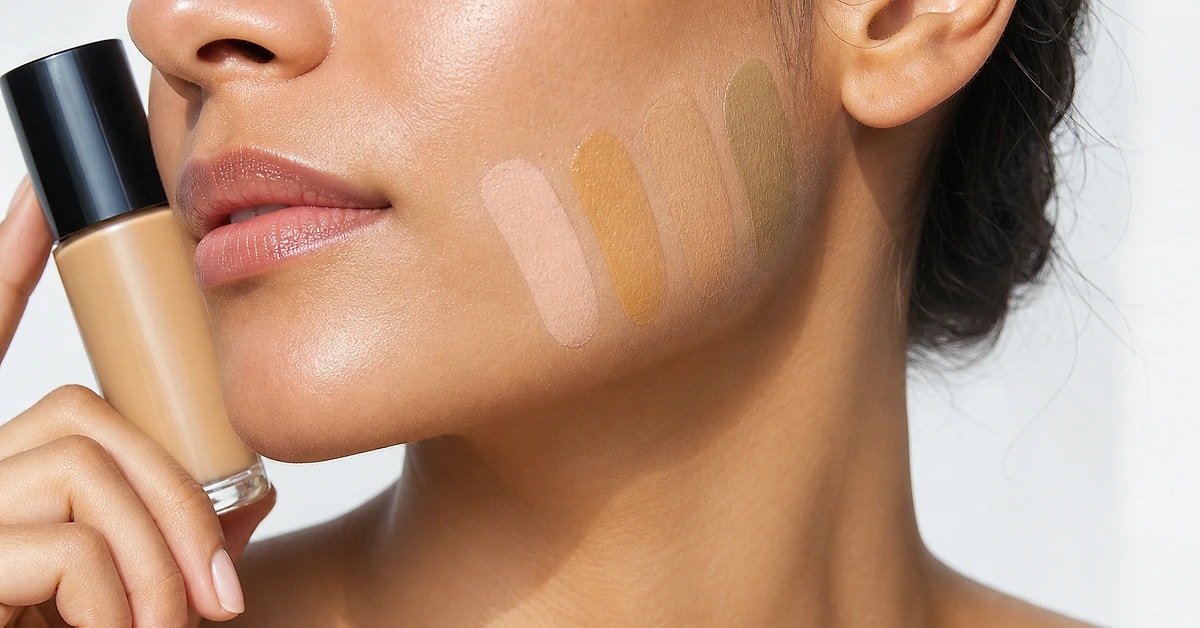
- Three stripes. Pick a warm, a cool and a neutral shade at the depth you think you are. Swatch all three side by side along the jawline, running down onto the neck.
- Daylight. Stand by a window. Bathroom bulbs turn everything yellow or gray.
- Wait ten minutes. Foundation oxidizes and darkens slightly as it dries.
- Find the one that vanishes. The stripe you can't see is your undertone. If the neutral looks faintly pink on you, you're warm or olive; if it looks faintly yellow, you're cool.
- Check with jewelry. Gold against the jaw versus silver: the one that makes your skin look clearer confirms the result. Both fine means neutral.
If two stripes tie, you're probably neutral or olive, try a neutral-warm and an olive shade next.
The foundation undertone chart
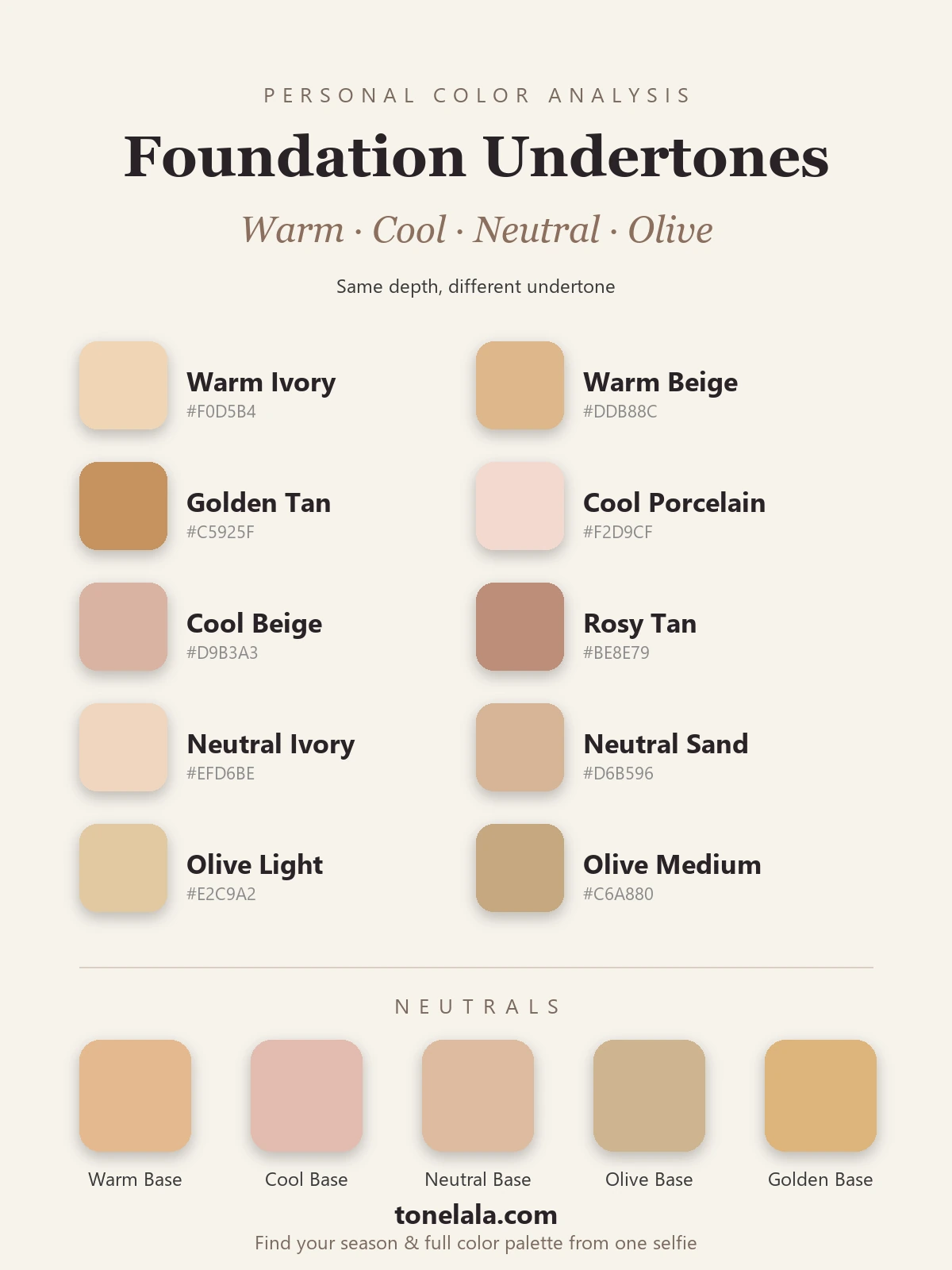
Ten shades across the four undertones at light-to-medium depth, so you can see the difference at the same depth, plus the five base tones brands build on.
| Shade | Hex | Undertone | Depth |
|---|---|---|---|
| Warm Ivory | #F0D5B4 |
Warm | Fair |
| Warm Beige | #DDB88C |
Warm | Light-medium |
| Golden Tan | #C5925F |
Warm | Medium-tan |
| Cool Porcelain | #F2D9CF |
Cool | Fair |
| Cool Beige | #D9B3A3 |
Cool | Light-medium |
| Rosy Tan | #BE8E79 |
Cool | Medium-tan |
| Neutral Ivory | #EFD6BE |
Neutral | Fair |
| Neutral Sand | #D6B596 |
Neutral | Light-medium |
| Olive Light | #E2C9A2 |
Olive | Light |
| Olive Medium | #C6A880 |
Olive | Medium |
Base tones: Warm #E3B98E, Cool #E2BBB0, Neutral #DDBCA0, Olive #CFB58F and Golden #DEB57C. Compare the warm and cool bases side by side and the whole concept clicks: same depth, one yellow, one pink.
Warm, cool, neutral or olive? Find out from a selfie
Find your undertone and season →Decoding foundation shade codes
Brands use letters and numbers, and once you know the system you can read any range:
- W / Warm / Y / G (Golden): yellow-golden base. "G" is usually a stronger golden; some brands use "Y" for yellow.
- C / Cool / P (Pink) / R (Rosy): pink-rosy base. "R" sometimes means red-warm in a few brands; check the description.
- N / Neutral: balanced. The safest first guess.
- O / Olive: green-gray base, still rare but growing.
- NW / NC (one major brand's system), confusingly, NW means neutral-warm but reads pink on most people, and NC means neutral-cool but reads yellow. Test rather than trust the label.
- Numbers: depth. Lower is lighter; the scale varies by brand (1–10, 100–500, 0–12). A "2N" is a light neutral; a "4W" is a medium warm; a "350N" in a 100-scale range is medium neutral.
When a range has no letters, the shade names carry the clue: "ivory", "porcelain" and "sand" tend to be neutral-to-cool; "honey", "golden", "warm beige" and "caramel" are warm; "rose", "pink beige" and "cool sand" are cool.
Common mistakes
- Choosing by depth alone. The right depth in the wrong undertone still looks like makeup.
- Testing on the hand or wrist. They're a different color from the face. Jaw and neck only.
- Assuming fair means cool. Plenty of fair skin is warm or olive; plenty of deep skin is cool.
- Trusting "neutral-warm" labels. Some read pink. Swatch it.
- Matching in winter and keeping it all year. Depth changes with sun and self-tan, see foundation after self-tanner, but the undertone letter stays the same.
- Ignoring olive. If every warm shade goes orange and every cool one goes gray, you're olive, and no amount of depth-hopping will fix it. Go neutral or olive.
Undertone and your color season
Foundation undertone and color-season undertone are the same thing seen from two angles. Warm foundation undertones are Springs and Autumns; cool ones are Summers and Winters; neutrals sit on the border and lean one way; olives are most often Autumns, Deep Winters or Soft Summers. So if you already know your season, you know your foundation letter, and if you find your foundation letter, you've done a third of a color analysis. The other two-thirds are depth and contrast, which a photo-based analysis reads together, and which decide your whole palette, not just your base.
Putting it together
Depth first, undertone second. Three stripes on the jaw, daylight, ten minutes, keep the one that disappears. Read the letter on the bottle and trust the swatch over the label. And if warm goes orange and cool goes gray, you're not "hard to match", you're olive, and now you know what to ask for.