In a sentence: finding your foundation shade is two jobs done separately, match your depth (how light or deep you are) and your undertone (warm, cool or neutral), test on your jaw in daylight, and the right one disappears. See the undertone swatches below, or find your season.
How to Find Your Foundation Shade & Undertone
By ToneLalaUpdated July 8, 2026

Contents
A woman once sat in my chair convinced she was "impossible to match." She'd bought six foundations that year and returned, mentally, all of them. We wiped her face, drew three stripes along her jaw, and stood by the window. Two of them sat there like a mask, one faintly pink, one going orange by the minute. The third melted into her neck and you genuinely couldn't see where it ended. Same skin, same light, and the only thing that separated the winner from the losers was undertone. Her depth had been right all along.
That's the part the beauty hall rarely explains. Foundation shade isn't one number you hunt for, it's two decisions stacked on top of each other. Depth tells you how light or deep to go. Undertone tells you which version of that depth flatters you: the golden one, the rosy one, or the balanced one in between. Get depth right and undertone wrong and you end up with the orange, pink or gray cast that makes a perfectly good product look like it's sitting on your face. Get both right and the foundation does the one thing it's meant to do, which is vanish.
Depth and undertone are two different things
Depth is the easy half. It's simply how light or deep your skin is on a scale from porcelain to espresso, and most ranges are built around it, that's the number on the bottle. If a shade looks too pale and chalky or too dark and muddy, that's a depth problem, and you fix it by going up or down the ladder.
Undertone is the half people skip, and it's where the matching actually lives. Underneath your surface color sits a constant cast that doesn't change when you tan: warm (gold, yellow, peach), cool (pink, red, blue) or neutral (a balance of both). Two people can be exactly the same depth and need completely different foundations because one is warm and one is cool. Brands signal this in their shade names and codes, W or G or "golden" for warm, C or P or "rose" for cool, N for neutral, but the labeling is wildly inconsistent between lines, which is half the reason matching feels like guesswork. Learn to read your own undertone and the codes stop mattering.
How to find your undertone
You don't need a kit. Take all three of these reads in daylight and weigh them together, because any one on its own can mislead.
- The vein test. Turn your inner wrist to a window. Veins that look greenish point warm; blue or purple veins point cool; a color you genuinely can't call either way points neutral.
- The jewelry test. Hold a piece of gold near your face, then silver. One makes your skin look lit and even, the other adds a faint gray or sallow tinge. Gold-flatters leans warm, silver-flatters leans cool. This is the most reliable of the three.
- The sun test. Think about how your skin behaves in summer. Tans easily and rarely burns? That leans warm. Burns, goes pink, then maybe tans? That leans cool.
- The white-paper check. Hold a sheet of pure white paper up beside your bare, clean face. Against true white, warm skin looks yellow or peachy and cool skin looks pink or bluish.
If the tests agree, you have your answer. If they pull in different directions or all feel borderline, you're almost certainly neutral: which is genuinely the most common result, and it means you can wear a balanced foundation and borrow gently from both warm and cool when a perfect neutral isn't on the shelf.
The undertone swatches
These run from porcelain to espresso, each one carrying a clear warm, cool or neutral lean so you can see how depth and undertone combine. Find your depth first, then slide sideways to the temperature your tests pointed to.
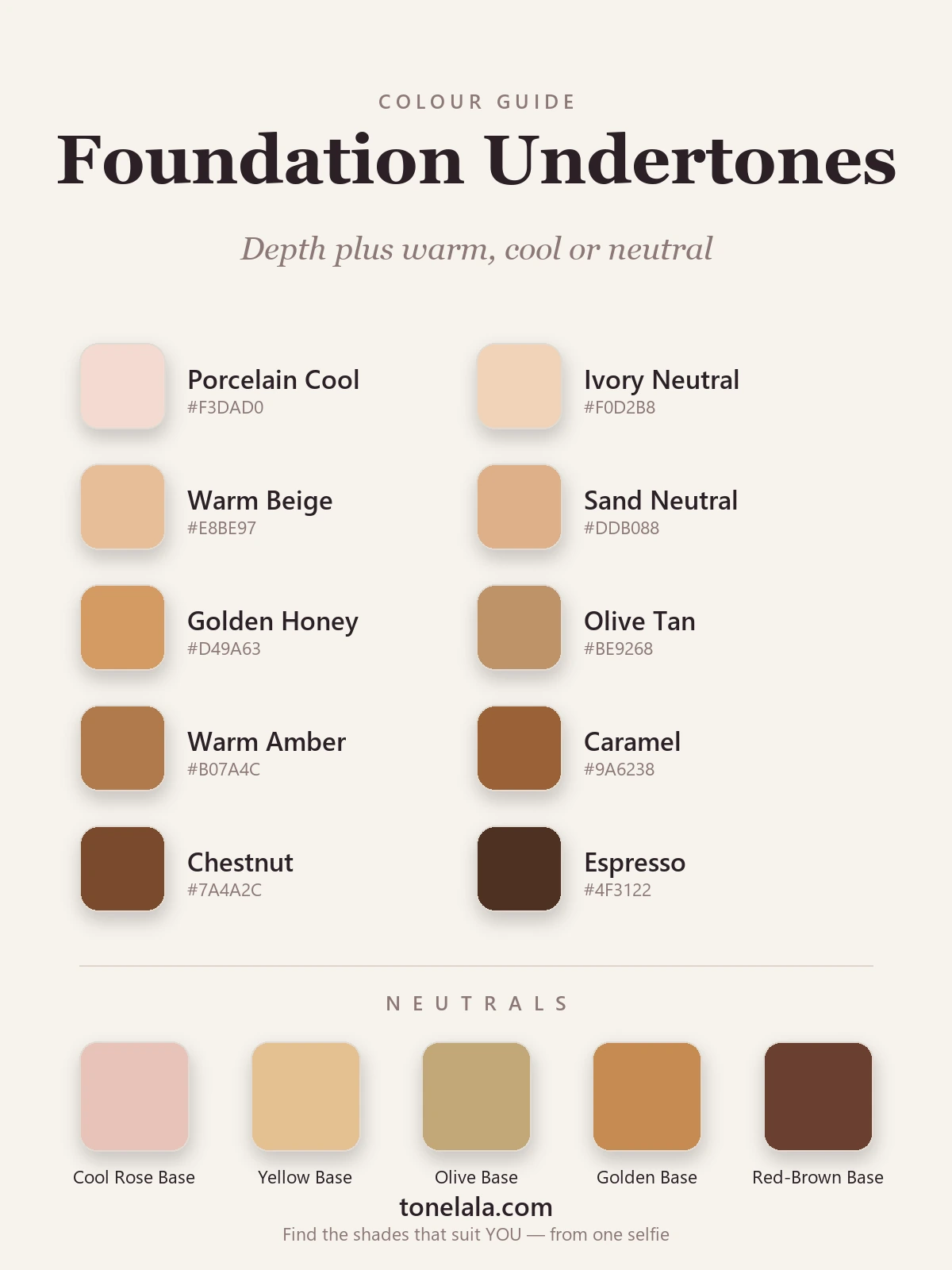
| Shade | Hex |
|---|---|
Porcelain Cool #F3DAD0 |
The fairest depth with a pink-rose base. Lights up cool, pale skin; reads slightly gray on warm. |
Ivory Neutral #F0D2B8 |
Fair and balanced, the safe middle for light skin that the warm and cool tests couldn't separate. |
Warm Beige #E8BE97 |
Light-medium with a peachy-gold lean. Flatters warm skin; can look faintly orange on cool. |
Sand Neutral #DDB088 |
Medium and even-handed, neither yellow nor pink, a true neutral workhorse. |
Golden Honey #D49A63 |
Medium with an unmistakable golden warmth that glows on warm complexions. |
Olive Tan #BE9268 |
Medium-deep with a green-gray undertone, the olive cast that pink-based shades fight. |
Warm Amber #B07A4C |
Deep-medium, golden and rich; pale or cool foundations go ashy here, this doesn't. |
Caramel #9A6238 |
Deep with warm red-brown depth, luminous on warm and neutral deep skin. |
Chestnut #7A4A2C |
Deep and warm; a touch of red keeps it from going flat or gray. |
Espresso #4F3122 |
The deepest, with a warm base. Cool or ashy deep shades read dull; this stays alive. |
Neutral skin-base tones to compare against: Cool Rose Base #E7C3B8 (the pink undertone that flatters cool skin and turns warm skin gray), Yellow Base #E4C091 and Golden Base #C68A52 (the warm bases that glow on golden skin and oxidize orange on cool), Olive Base #C2A878 (the green-gray neither pink nor pure yellow serves), and Red-Brown Base #6B4030 (the warm depth that keeps deep skin from looking chalky).
Not sure if you're warm, cool or neutral?
Find your color season →Where and how to test a shade
The wrong testing spot wrecks more matches than the wrong shade. Your hand, your inner arm and the back of your wrist are usually warmer, more weathered and a different depth from your face, match to any of them and you'll be off.
Swatch on the jawline, blending a stripe down onto the neck. That's the join you actually need to hide, and the correct shade is the one you lose there completely, with no line where face meets neck. Lay two or three candidates side by side, blend each lightly, then walk to a window. Shop lighting is almost always warm and yellow, which flatters warm shades and lies to everyone else, so the daylight check is non-negotiable. And give it time: many foundations oxidize within five to ten minutes, deepening and warming as they react with your skin, so test, wait, then judge, never decide on the first thirty seconds.
The mistakes that throw most people off
Nearly every "I can't match foundation" story comes down to one of these.
- Matching to your hand. The classic. Hands run warm and dark; your jaw and neck are the truth.
- Testing in shop light. Warm halls make warm shades look right and cool skin look sallow. Step outside or to a window before you buy.
- Ignoring oxidation. A shade that's perfect on contact can turn orange or muddy minutes later. Wait it out.
- Fixing an undertone problem with depth. When foundation looks orange or pink, the instinct is to go lighter or darker. That's the wrong axis, keep the depth, change the undertone.
- Forgetting your olive cast. Olive skin has a green-gray undertone that neither pink nor plain yellow flatters. If everything looks either ashy or orange on you, you likely need an olive-balanced shade.
- Trusting the letter codes across brands. One label's "warm" is another's "neutral." Read your own skin, then treat the codes as rough hints, not gospel.
Foundation, undertone and your color season
Here's where undertone stops being a single label and gets specific. Warm, cool or neutral gets you into the right family fast, but your exact match also depends on your depth and on how clear or muted your coloring is, and those three together are precisely what a color season describes.
A couple of examples. A Cool Summer and a Deep Winter can land at the same depth on the ladder yet need different undertones and different intensities of coverage to look right. A warm True Autumn glows in golden honey and amber bases that would oxidize orange on a cool complexion, while a Light Spring wants a fresh, light warm base that a deep wine-toned formula would completely overwhelm. The same rule, "warm skin likes warm foundation", splits into genuinely different shades once depth and chroma come in, which is why a single undertone test only carries you most of the way.
Our color analysis guides walk through each season in detail, so once you know roughly where you sit you can read your full makeup direction. If you'd like to nail the undertone question itself first, how to find your undertone sets out the warm-versus-cool reads, and the skin tone chart shows how depth and undertone map across the whole range.
Putting it together
Finding your foundation shade is two clean steps, not one lucky guess. Settle your depth, settle your undertone, swatch on the jaw and neck, and judge it in daylight after it's had a minute to settle. Do that and the right foundation simply disappears, no orange creep, no pink mask, no line at your jaw. Get the family from this guide, then let a proper analysis hand you your exact direction across foundation, blush and lip, so getting ready stops being a returns pile and starts being three minutes that always work.
Frequently asked questions
How do I find my foundation shade?
Work out two things separately: depth and undertone. Depth is how light or deep your skin is, swatch three candidate shades side by side along your jaw and the one that vanishes into your neck is your depth. Undertone is the warm, cool or neutral cast underneath, gold and peach is warm, pink and blue is cool, a balance is neutral. Match both and the foundation disappears; match only depth and it can still read too pink or too orange. Always judge the swatch in daylight after it has had a minute to settle and oxidize.
How do I find my undertone for foundation?
Three quick reads, taken together rather than alone. Look at the veins on your inner wrist in daylight, greenish leans warm, blue or purple leans cool, a mix is neutral. Hold gold jewelry then silver near your face, whichever makes your skin look lit rather than tired points to your temperature, gold for warm and silver for cool. And notice how you react to sun: tanning easily leans warm, burning and going pink leans cool. If the three disagree or sit on the fence, you are likely neutral, which is common.
Why does my foundation look too orange or too pink?
The depth is usually close but the undertone is wrong. Foundation that turns orange a few minutes after applying is too warm for you, it has oxidized golden against cool or neutral skin. Foundation that looks pink, ashy or slightly gray is too cool. The fix is to keep the same depth and step sideways to a different undertone in the range, not to go lighter or darker. Oxidation also matters: many formulas deepen and warm up within ten minutes, so test, wait, then decide.
Where should I test foundation to match my skin?
Along the jawline and down onto the neck, never the back of your hand or your inner arm, those rarely match your face and the hand is often warmer and more weathered. Swatch two or three shades as short stripes across the jaw, blend lightly, then check in natural daylight near a window. The correct shade is the one you lose against your neck with no line of demarcation. Matching to your hand is the single most common reason a foundation looks right in the shop and wrong in selfies.
How do I know my exact foundation undertone and shade?
The wrist, jewelry and sun checks get you to warm, cool or neutral, which narrows the field fast. Your precise best match also depends on depth and how muted or clear your coloring is, the same things your color season describes. A Cool Summer and a Deep Winter can share a depth yet need different undertones, and a photo-based color analysis reads undertone, depth and chroma together, so you get your specific direction rather than guessing at a counter. You can start one at tonelala.com/onboarding.
Related guides
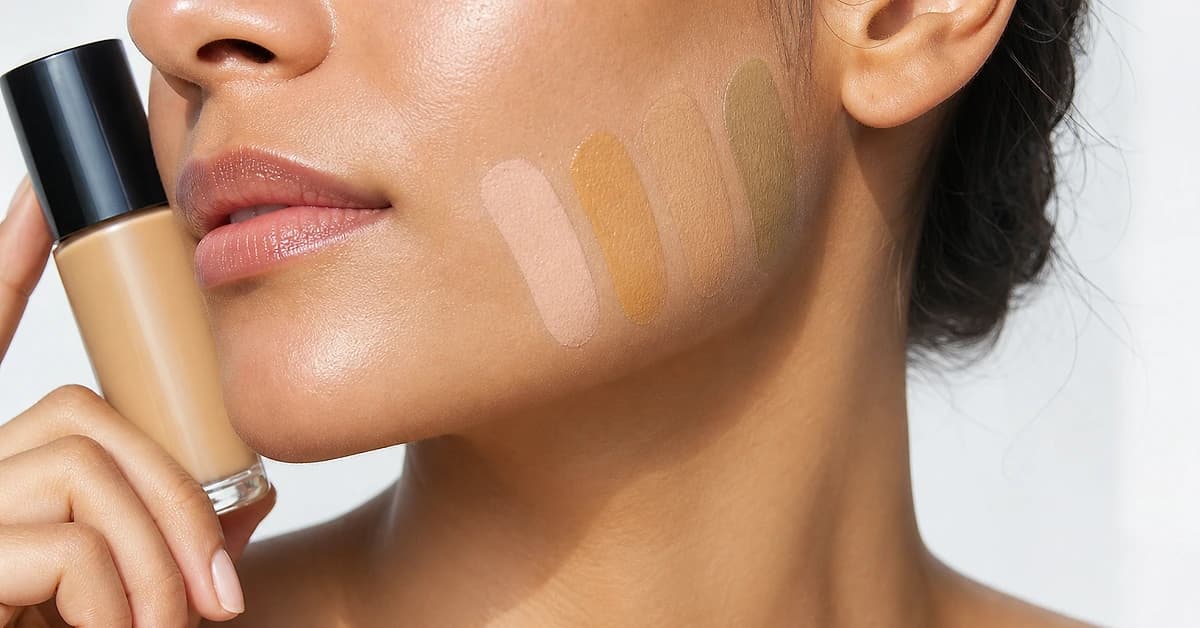
Foundation Undertone Chart: Warm, Cool, Neutral and Olive Shades Explained
A color analyst's foundation undertone chart, what warm, cool, neutral and olive shades look like, how brands label them (W, C, N, G, P), how to test yours and which to buy.

Skin Tone Chart: Find Your Shade & Undertone
A color analyst's skin tone chart to find your shade (fair to deep) and undertone (warm, cool or neutral) with simple at-home tests, and your color season.

Warm vs Cool Skin Tone: How to Tell
Learn how to tell if you have a warm, cool or neutral skin tone with simple at-home tests, plus the colors that flatter each undertone.

Olive Skin Undertones: Warm, Cool and Neutral Olive Explained
Olive skin is a green-gray cast that can sit over a warm, neutral or cool undertone. Five daylight tests to tell which olive you are, with the colors, makeup, hair and seasons for each.

Warm vs Cool Undertones
A color analyst's guide to warm vs cool undertones: simple at-home tests, the neutral middle ground, and example colors with hex codes for each.

What Is My Skin Undertone
A color analyst explains what your skin undertone is, how to find it with simple at-home tests, and the colors that flatter cool, warm and neutral undertones.
Prefer in person? Find color analysis near you
Browse local color analysts by city, or get the same season, palette and best-colors breakdown online from one selfie.
See your colors on a photo of you
Upload one selfie and ToneLala reveals your season, your full palette, and your best hair, makeup, jewelry and outfits, styled on you.