In a sentence: a skin tone chart maps two things at once, your depth (fair → deep) and your undertone (warm, cool or neutral), and where they meet points to your color season and your most flattering shades. Skip to the skin tone chart palette or find your season.
Skin Tone Chart: Find Your Shade & Undertone
By ToneLalaUpdated July 2, 2026

Contents
A client sat down last month certain she already knew her shade. She'd matched her foundation a dozen times, so "medium" felt settled. But when I held a sheet of pure white under her chin, her skin went faintly gray, and against cream it warmed straight up. Her depth was right, she really was medium. What she'd never named was the other half of the picture: the golden cast underneath, the part that decides whether a color lifts her face or quietly drains it. Foundation had told her how deep her skin was. It had never told her which way it leaned.
That gap is what a proper skin tone chart closes. Most charts you'll find online only show the depth axis, a strip of faces or foundation cards running pale to dark, and stop there. Useful for matching concealer, useless for picking a jumper. The version that actually changes how you get dressed reads two axes together: depth, and undertone. Find yourself on both and you've done most of the work of placing your color season.
What a skin tone chart actually shows
Think of the chart as a grid. One axis is depth: how light or deep your skin is, running fair, light, medium, tan, deep. This is the visible surface, and it's what shifts when you catch the sun. The other axis is undertone: the steady color sitting beneath the surface, which reads cool (blue, pink, rosy), warm (golden, peach, yellow) or neutral (a balance of the two). Undertone doesn't move with a tan; it's fixed.
Here's the part most charts miss. Depth and undertone are independent. You can be fair and warm, or fair and cool. You can be deep and warm, or deep and cool. That's why two friends who buy the same numbered foundation can look brilliant in completely different colors, same depth, opposite undertone. So a skin tone chart that only shows depth is half a map. The square you're standing in is the one where your depth and your undertone cross.
The depth axis: fair to deep
Depth is the easy half to read, because you can mostly see it. The quickest gauge is how your skin behaves in sun. Here's the spectrum I use, with a rough sun cue for each:
| Depth | What it looks like | In the sun |
|---|---|---|
| Fair | Porcelain to light; often shows freckles or visible veins | Burns easily, rarely tans |
| Light | A shade up from fair; "neutral light" in most ranges | Burns, then tans a little |
| Medium | Mid-range; the most common depth worldwide | Tans readily, burns sometimes |
| Tan | Warm mid-deep; holds color well | Tans deeply, burns rarely |
| Deep | Rich, dark complexions across many undertones | Rarely burns; deepens in sun |
Two honest caveats. First, the lines between these are soft, if you hover between "light" and "medium", you're simply light-medium, and nothing breaks. Second, depth on its own doesn't dictate your colors; it mostly tells you how light or how saturated to take a shade. A fair person and a deep person can both be cool Winters wearing the same true red, one just wears a touch lighter version of everything. If you want the depth-specific shortlists, I've written them out for fair skin, light skin, medium skin, tan skin, olive skin and deep skin.
The undertone axis: warm, cool or neutral
Undertone is the half that does the heavy lifting, and the half you can't simply eyeball. No single test is foolproof, so I read several cues together and let the weight of evidence decide. Do these in daylight, bare-faced, away from colored walls.
- Wrist veins. Blue or purple veins lean cool; green or olive-tinged veins lean warm. Genuinely can't tell, they look blue-green? That points neutral.
- Gold vs silver. Hold gold near your face, then silver. If gold makes your skin look lit and even, you're warm. If silver makes it look clean and clear, you're cool. Both fine, neutral.
- White vs cream. Drape pure white under your chin, then cream. Cool skin looks crisp in white; warm skin looks healthier in cream, and pure white can gray it slightly.
- Sun reaction. Burn-prone and stay pink? Often cool. Tan readily, rarely burn? Often warm. A soft clue, not a verdict.
Tally them. Mostly blue-vein, silver, white, burn-prone is cool; mostly green-vein, gold, cream, easy-tanning is warm; a real split down the middle is the signature of neutral. For the full method, including the white-paper test and how the pros read each cue, see how to find your undertone.
How to use the skin tone chart
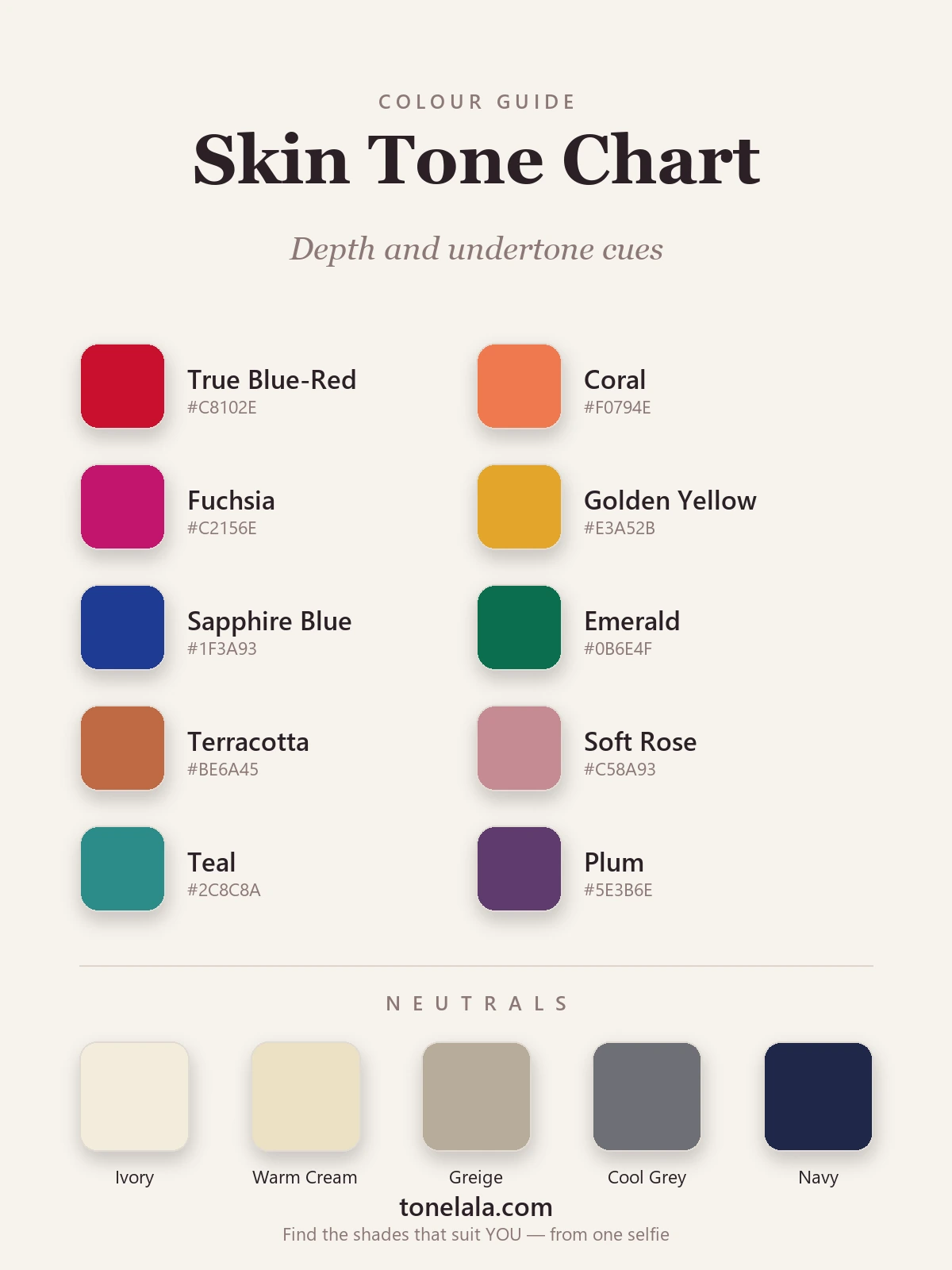
Now put the two axes together. The palette above is built to span the whole chart on purpose: cool cues, a true blue-red, fuchsia, sapphire, emerald and plum, sit alongside warm cues, coral, golden yellow, terracotta and soft rose, with a balanced teal in the middle that almost any skin can wear. The neutrals run the same way, from warm cream through greige to cool gray and navy, so each undertone has an anchor at its end.
To find your square, answer both axes and read across. Say you land on medium depth, warm undertone: your colors are the warm, golden, earthy versions, coral, golden yellow, terracotta, taken at full mid-saturation, anchored by warm cream and camel. Land on medium depth, cool undertone instead and you swing the other way: blue-red, fuchsia, emerald and sapphire, anchored by cool gray and navy, at the same saturation your depth supports. Same depth, opposite halves of the palette. That single crossing is what a depth-only chart can never tell you, and it's where the undertone deep-dives earn their keep, the best colors for warm undertones, best colors for cool undertones and best colors for neutral undertones each lay out the full shade list for that side.
Want to know exactly which square on the chart is yours?
Find your color season →From your square to your color season
Your spot on the chart isn't the destination, it's the doorway into seasonal color analysis, which is just this chart with a third dimension added. Every season is built from undertone (warm or cool), depth (light or deep) and chroma (soft and muted, or bright and clear).
Your undertone makes the first cut. Cool sends you to the Winter and Summer families; warm sends you to Spring and Autumn. Then depth and chroma split each pair:
- Cool + deep + bright → Winter. High contrast, clear saturated color.
- Cool + light + soft → Summer. Lower contrast, muted dusty hues.
- Warm + bright + clear → Spring. Light-to-mid depth, fresh and lively.
- Warm + deep + muted → Autumn. Rich, earthy, low-contrast warmth.
So two cool people on the chart can need very different palettes: a deep, high-contrast cool reads Winter and wants color at full strength, while a soft, low-contrast cool reads Summer and wants the muted version of the same hues. The same fork happens on the warm side between Spring and Autumn. Depth nudges you within your pair; chroma decides how loud or soft your shades run. If you want to walk through all twelve, the color analysis guides cover each season in detail.
Where charts fall short
I'll be straight about the limits, because they matter. A chart is a brilliant starting frame, but it can't read the subtle middle ground, and that's where most people actually live. Neutral undertones, in particular, are hard to place from a bathroom mirror: the tests come back mixed, and the difference between a neutral-warm and a neutral-cool can be a single degree that completely changes which red flatters you. Chroma is harder still to self-assess; almost nobody can judge from a chart whether they want color bright or muted, yet getting that wrong is the most common reason a "right" color still looks off.
That's the gap a personal reading closes. It looks at your undertone, depth and contrast together, against your skin, and resolves the borderline calls a static chart leaves open, the exact reason draping has been the professional standard for decades.
Putting it together
Find your square in two moves and you've done the important work. Read your depth off the surface, fair, light, medium, tan or deep, using how you react to sun as the tiebreaker. Then read your undertone by weighing the vein, jewelry and white-versus-cream tests together until they point cool, warm or neutral. Where the two answers cross is your spot on the chart, your half of the color palette, and the doorway to your season. Build a small wardrobe around the neutrals at your end and two or three feature colors from your side, and getting dressed turns from guesswork into a quick check. The only step left is precision, confirming your exact season and the specific reds, blues and neutrals that flatter you, and that's what a personal analysis is for.
Frequently asked questions
What is a skin tone chart?
A skin tone chart is a visual reference that maps complexions along two axes: depth, how light or deep your skin is, from fair through light, medium and tan to deep, and undertone, the cool, warm or neutral cast sitting beneath the surface. The depth axis is what foundation brands use to number their shades. The undertone axis is the part that decides which clothing and makeup colors flatter you. A useful chart shows both together, because two people at the same depth can need opposite palettes once you account for undertone.
How do I find my skin tone on a chart?
Work it out in two steps. First, place your depth: in daylight with bare skin, decide whether you read fair, light, medium, tan or deep, roughly, how much your skin tans versus burns. Second, find your undertone by reading several cues together: blue or purple wrist veins, flattering silver jewelry and skin that looks crisp against pure white all point cool; green veins, flattering gold and skin that looks healthier against cream point warm; a genuine tie points neutral. Your shade is the meeting point of those two answers.
What is the difference between skin tone and undertone?
Skin tone is the surface depth you can see, fair, light, medium, tan or deep, and it shifts with sun exposure and the seasons. Undertone is the permanent base color underneath, which reads cool (blue or pink), warm (golden or peach) or neutral (a balance), and it does not change with a tan. On a skin tone chart, depth runs one way and undertone the other. For choosing clothes, makeup and hair color, undertone does most of the work; depth mainly tells you how light or dark to take a shade.
Which skin tone and undertone make which color season?
Undertone sorts you into a half of the seasonal system, and depth and clarity decide the exact season within it. Cool undertones fall into the Winter and Summer families, deep, high-contrast cool skin leans Winter, soft low-contrast cool skin leans Summer. Warm undertones fall into Spring and Autumn, bright, clear warm coloring leans Spring, deeper muted warm coloring leans Autumn. Depth nudges you within each pair. A full personal color analysis reads undertone, depth and contrast together to pin down which of the twelve seasons is yours.
Can my skin tone be neutral or change over time?
Your depth can change, skin gets deeper with a tan and lighter over winter, but your undertone stays put through all of it. A neutral undertone is common and real: it means your warm and cool pigments are close to balanced, so the gold-versus-silver and vein tests come back mixed. Most neutral skin still leans a touch warm or a touch cool, and finding that small lean is what sharpens your palette. You only need to find your undertone once; after that it is a fixed point for every color decision.
Related guides

Types of Skin Tones Explained
A color analyst explains the types of skin tones, depth (fair to deep) and undertone (warm, cool, neutral), how they differ, and how to find yours.

How to Find Your Foundation Shade & Undertone
A color analyst's guide on how to find your foundation shade, matching depth and undertone, where to swatch, the daylight check and the mistakes to skip.

Warm vs Cool Skin Tone: How to Tell
Learn how to tell if you have a warm, cool or neutral skin tone with simple at-home tests, plus the colors that flatter each undertone.

Olive Skin Undertones: Warm, Cool and Neutral Olive Explained
Olive skin is a green-gray cast that can sit over a warm, neutral or cool undertone. Five daylight tests to tell which olive you are, with the colors, makeup, hair and seasons for each.

Warm vs Cool Undertones
A color analyst's guide to warm vs cool undertones: simple at-home tests, the neutral middle ground, and example colors with hex codes for each.

What Is My Skin Undertone
A color analyst explains what your skin undertone is, how to find it with simple at-home tests, and the colors that flatter cool, warm and neutral undertones.
Prefer in person? Find color analysis near you
Browse local color analysts by city, or get the same season, palette and best-colors breakdown online from one selfie.
See your colors on a photo of you
Upload one selfie and ToneLala reveals your season, your full palette, and your best hair, makeup, jewelry and outfits, styled on you.