In a sentence: To find your color season, work through four home tests, jewelry, white, vein and drape, to pin down whether you're warm or cool and light or deep, then confirm the exact season; the four families sit in the palette, or you can find your season from a photo.
How to Find Your Color Season
By ToneLalaUpdated July 12, 2026

Contents
A client once arrived convinced she was a Winter because she'd always worn black and bought stark white shirts. We held a piece of cream up to her face, then the white, and the white visibly hardened her, drew out every shadow, grayed her skin. She was a warm Autumn who'd spent fifteen years in the one color family that fought her hardest. That's the thing about finding your season: most people guess from the colors they like, when the answer lives in how light actually behaves against their skin.
Your color season is the family of shades that share your natural coloring, your undertone, how light or deep you are, and how soft or vivid you read. Get it right and a strange thing happens: your skin looks clearer, your eyes sharpen, and you stop needing makeup to fix a tiredness that was only ever the wrong color near your face. You can do a surprising amount of this at home with nothing but daylight and a few fabrics, and below I'll walk you through exactly how. I'll also be honest about where home testing runs out of road, and why a photo tends to be the more reliable judge.
First, what a color season actually is
Seasonal color analysis sorts everyone by three qualities of their natural coloring. Undertone is the quiet color under your skin, warm (golden, peachy) or cool (blue, pink, rosy). Depth is how light or deep your overall coloring is, hair and eyes included. Chroma is how clear and bright you are versus soft and muted. Stack those three together and you get the four season families:
- Spring: warm and light, clear and fresh.
- Summer: cool and light, soft and muted.
- Autumn: warm and deep, rich and earthy.
- Winter: cool and deep, bright and high-contrast.
Finding your season is really just answering those three questions in order: warm or cool first, then light or deep, then soft or bright. Nail the first one and you've already halved the system.
The four home tests, in order
Do all of these in bright, indirect daylight: stand near a window, not under a yellow bulb or a cool-white LED, both of which lie. Take your makeup off, tie your hair back, and have a neutral gray or white top on so nothing else throws color onto your face.
1. The jewelry test (warm vs cool)
Hold a piece of gold jewelry under your chin, then a piece of silver. Look at your skin, not the metal. If gold makes your face look healthy and lit-up and silver looks a bit gray or harsh, you lean warm (Spring or Autumn). If silver looks clean and gold makes you look sallow, you lean cool (Summer or Winter). This is the single most useful test, which is why it goes first.
2. The white test (confirming temperature)
Drape a piece of pure, optic white fabric across your shoulders, then swap it for warm cream. Cool coloring loves pure white, it looks crisp and the skin stays clear. Warm coloring prefers cream, pure white tends to drain it or make it look slightly ruddy. If this agrees with your jewelry result, your temperature is settled.
3. The vein test (a tie-breaker)
Turn your wrist to the light. Veins that read blue or purple point cool; veins that read green point warm. It's not infallible on its own, skin thickness muddies it, so I treat it as a confirmation rather than a verdict. If it disagrees with the first two tests, trust the first two.
4. The drape test (light vs deep, soft vs bright)
Now you're separating the two seasons inside your temperature. Gather a few large fabric swatches, a light dusty one, a deep rich one, a muted one and a clear bright one, and hold each under your chin in turn.
- If light, soft colors make you glow and deep ones overwhelm you, you're a light season (warm = Spring, cool = Summer).
- If deep, rich colors look balanced and pastels wash you out, you're a deep season (warm = Autumn, cool = Winter).
- Watch for contrast too: if there's a stark gap between your hair, skin and eyes, you lean bright/Winter; if everything blends softly, you lean muted/Summer or Soft Autumn.
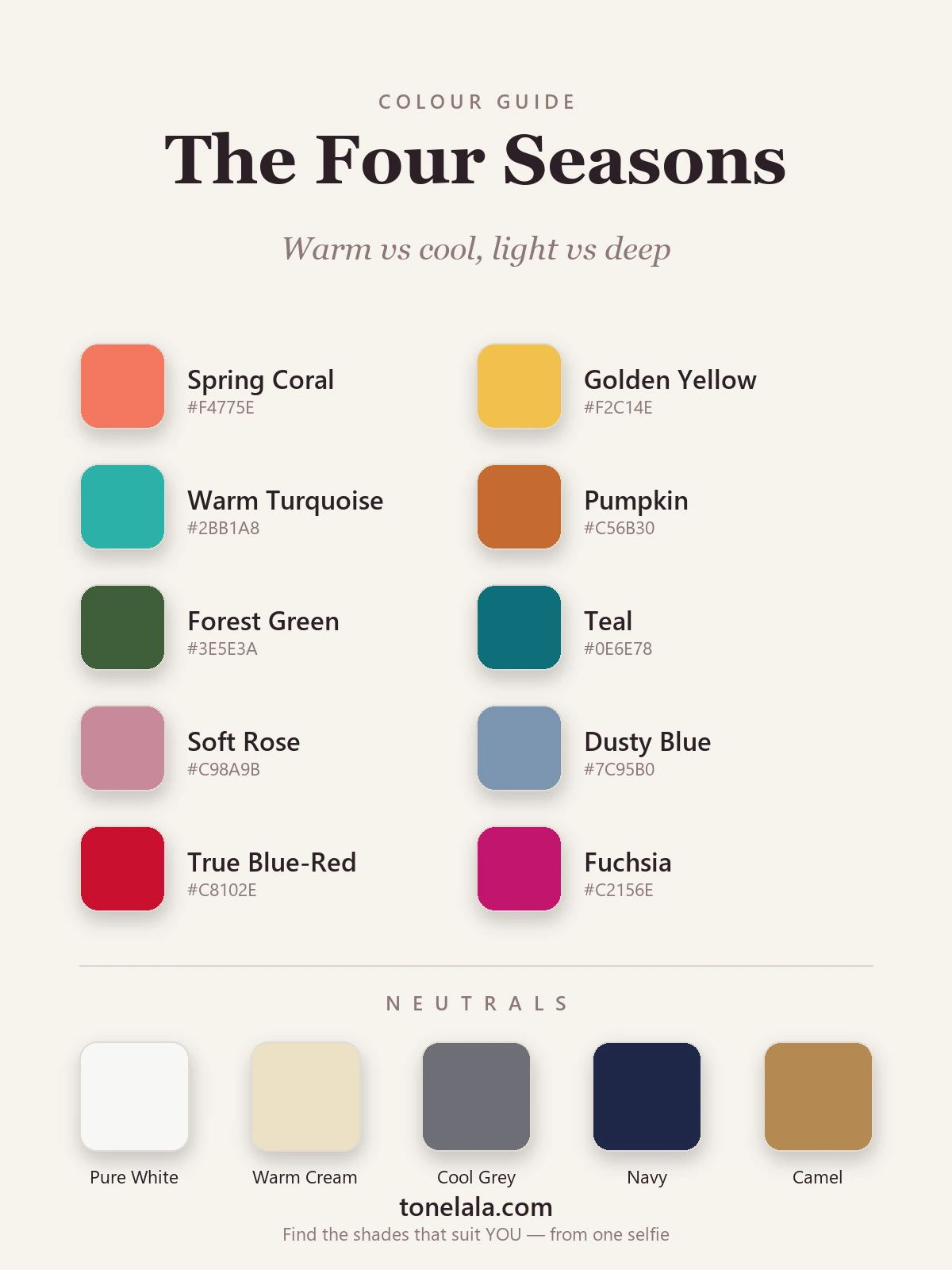
The palette above shows the four families side by side, warm Spring and Autumn shades on one side, cool Summer and Winter on the other, with the neutrals each leans on. Use it as a reference while you drape: find the row your face prefers and you've found your half of the map.
How to read your results
Line your four answers up. If they all point one way, gold, cream, green veins, deep rich drapes, you're almost certainly a warm, deep season, i.e. an Autumn, and you can move on to the sub-types. Clean agreement like that is common and trustworthy.
What trips people up is disagreement. Gold suits you but you also look good in some cool colors; pure white works but so does cream. That usually means one of two things: you're a neutral undertone sitting on the border between warm and cool, or your lighting is fooling you. Both are real, and both are exactly where home testing starts to wobble.
Not sure which way your tests point?
Find your color season →Why a photo analysis is more reliable
I love the home tests, they're how I first learned this, and they'll get most people to the right half of the system. But there are three reasons they go wrong, and all three are things a photo fixes.
Lighting is the silent saboteur. Your bathroom bulb is probably warm-toned, your kitchen LEDs probably cool, and both shift how every color reads against your skin. The drape that looked perfect at the window can look wrong an hour later. A photo freezes one consistent light source so the comparison stops moving.
You can't see yourself objectively. You've spent your whole life looking at your own face, and you have strong opinions about which colors you like, which is not the same as which colors like you. It's genuinely hard to judge your own undertone in a live mirror. A photo lets you (or an analyst) compare colors side by side, frozen, without your eye adjusting and without the pull of habit.
Three dimensions are a lot to judge at once. Temperature is reasonably easy at home. Depth and chroma are harder, and contrast, the gap between your features, is the one people misread most. Getting all three right at the same time, in poor light, on the face you're least objective about, is a tall order. This is exactly why misjudgement clusters around the exact season even when people nail the broad family.
A photo-based analysis sidesteps all of it. You upload a couple of clear pictures in natural light, and the reading assesses undertone, depth and contrast together, against consistent reference colors, then matches you to your season and hands you a tailored palette. It's the same method I'd use in person, minus the bad lighting and the guesswork. You can start one here.
From family to exact season
Once you know your family, there's one more layer. Most modern analysts split each of the four into three, giving twelve sub-seasons, so an Autumn is really a Soft, True or Deep Autumn, each with a noticeably different palette. This is where precision pays off: a Soft Summer and a True Winter are both cool, but put one in the other's reds and the color falls flat.
If you've landed your family and want to go deeper, the color analysis guides break down every season in detail. The two most common places people land are the Autumn color palette and the Winter color palette, so those are a good next read if your tests pointed deep, warm or cool respectively.
Putting it together
Finding your season at home is a real skill, and the four tests above will get you a long way: gold or silver, white or cream, blue or green veins, light or deep drapes. Do them in daylight, judge your skin rather than the color, and trust agreement when you see it. Where it gets slippery is the exact season, the place lighting and self-perception quietly mislead you, and that's the gap a photo closes. Pin down your temperature this afternoon with the tests; when you want the precise season and the palette that comes with it, a personal analysis reads it from a photo, so you never have to second-guess a color again.
Frequently asked questions
How do I find my color season at home?
Work through four checks in good natural daylight with no makeup on: the jewelry test (does gold or silver flatter you more), the white test (pure white versus cream against your face), the vein test (blue-purple veins read cool, green read warm), and a simple drape test with warm and cool fabrics. If they all point the same way, you've found your temperature, warm means Spring or Autumn, cool means Summer or Winter. From there you judge depth and clarity to land on the exact season.
How do I determine my color season accurately?
The home tests get you to the right half of the system, but accuracy means reading three things together, undertone (warm or cool), depth (light or deep) and chroma (soft or bright), and most people misjudge at least one in their bathroom mirror. The reliable route is a photo-based analysis that assesses all three under consistent lighting, because the camera removes the two things that ruin home testing: bad light and your own bias about which colors you like.
What are the four color seasons?
Spring (warm and light, clear and fresh), Summer (cool and light, soft and muted), Autumn (warm and deep, rich and earthy) and Winter (cool and deep, bright and high-contrast). Most modern analysts split each of these into three, giving twelve sub-seasons, but the four families are where everyone starts.
Can I find my season from a photo?
Yes, and it's usually more reliable than a mirror. A clear photo in natural light lets you compare colors against your face side by side, freeze the comparison, and judge undertone, depth and contrast without the lighting shifting or your eyes adjusting. A photo-based color analysis does exactly this and then matches you to your season and a tailored palette.
Why do online color-season quizzes get it wrong?
Quizzes ask you to self-report things you can't see objectively, your undertone, your contrast level, whether you 'suit' a color, and small misreadings compound into the wrong season. They also can't see your actual coloring. An analysis that reads your real photo, rather than your answers about yourself, avoids that whole problem.
Related guides

How to Do Color Analysis at Home
A color analyst's step-by-step guide to draping yourself at home with household items, the kit, the method, the tests and the pitfalls that throw people off.

Seasonal Color Analysis: The Complete Guide
A color analyst's complete guide to seasonal color analysis, how the 12 seasons work, the three dials that decide yours, and how to find your own.

What Is My Color Palette?
What is my color palette? A color analyst shows how undertone, value and chroma decide your season and the exact colors that flatter you.

Color Analysis Mistakes to Avoid
A color analyst's guide to the most common color analysis mistakes, bad lighting, the vein test, fake tan, makeup and more, and how to get an honest result.

What Color Season Am I
What color season am I? A color analyst walks you through undertone, value and contrast with simple self-tests to narrow down your seasonal palette.

Color Analysis Test: How to Find Your Colors
A color analyst's guide to the color analysis test, the vein, jewelry and draping checks you can do at home, plus how an accurate photo analysis works.
Prefer in person? Find color analysis near you
Browse local color analysts by city, or get the same season, palette and best-colors breakdown online from one selfie.
See your colors on a photo of you
Upload one selfie and ToneLala reveals your season, your full palette, and your best hair, makeup, jewelry and outfits, styled on you.