In a sentence: the best colors for pale skin are clear, medium-to-deep shades that give light skin some contrast: teal, emerald, soft navy, berry, raspberry, lavender, dusty rose, periwinkle, soft coral and plum, with soft white, greige, charcoal and cocoa as neutrals. Your undertone and hair color decide which of those suit you best. Skip to the full palette or find your exact shades.
Best Colors for Pale Skin: Your Most Flattering Shades (with Hex Codes)
By ToneLalaUpdated November 6, 2026

Contents
- 01 What "pale" tells you, and what it doesn't
- 02 Check your undertone first
- 03 The best colors for pale skin
- 04 The best neutrals for pale skin
- 05 Best colors by undertone
- 06 Best colors by hair color
- 07 Colors guides disagree on
- 08 Colors to avoid with pale skin
- 09 Pale skin and the color seasons
- 10 Makeup & styling for pale skin
- 11 Where to start
Pale skin is the lightest end of the human range. Dermatologists sort skin by how it reacts to the sun, and on the Fitzpatrick scale (created by Thomas Fitzpatrick in 1975) the two palest types are described this way by DermNet: type I is pale white skin that always burns and does not tan, and type II is fair skin that burns easily and tans poorly. If that sounds like you, this page is about what to wear. If you are still working out whether you count as pale, or what undertone you have, start with our pale skin tone guide, which covers identification in more detail.
The common problem is easy to describe. Many people with very light skin are told to wear light colors, so they buy baby pink, pale lemon and oatmeal, and then wonder why they look tired. Those colors sit at almost the same lightness as the skin, so nothing separates face from fabric. Most of the guides that rank for this question agree on the fix: add depth or clarity, then let undertone choose the temperature.
What "pale" tells you, and what it doesn't
"Pale" describes lightness only, what color analysts call value. It says nothing about undertone. Two people can be equally fair while one has a pink or blue cast and the other a peach or golden one, and they will look best in different colors. One ranking guide (mycoloranalysis.ai) puts it bluntly: a porcelain-skinned person with black hair and a peachy person with strawberry blonde hair share very few colors.
So read every recommendation below through two questions:
- Undertone: is your skin cool, warm, neutral or olive?
- Contrast: how dark are your hair, brows and eyes compared with your skin?
Value is the one thing all pale people share, and it explains the main rule. Colors that are much lighter or much the same as your skin tend to flatten you; colors with some depth or clarity give the face an edge.
Check your undertone first
You do not need a lab for this. Try three checks in daylight near a window, with no makeup on:
- Metals. Hold a silver and a gold piece of jewelry against your jaw. If silver looks cleaner, lean cool; if gold looks better, lean warm; if both look fine, you may be neutral.
- White and cream. Hold a bright white T-shirt and a cream one under your chin. Cool skin usually looks fresher in white; warm skin looks healthier in cream.
- Your flush. Pale skin shows redness easily. Tone & Fit and mycoloranalysis.ai both warn that rosacea, sunburn or a flush can make warm skin look pink, so judge the skin along your jaw and neck, not your cheeks.
The vein test (blue veins for cool, green for warm) is the check most guides mention and the least reliable one, because thin pale skin shows blue veins on almost everyone. Our undertone guide goes through each test step by step.
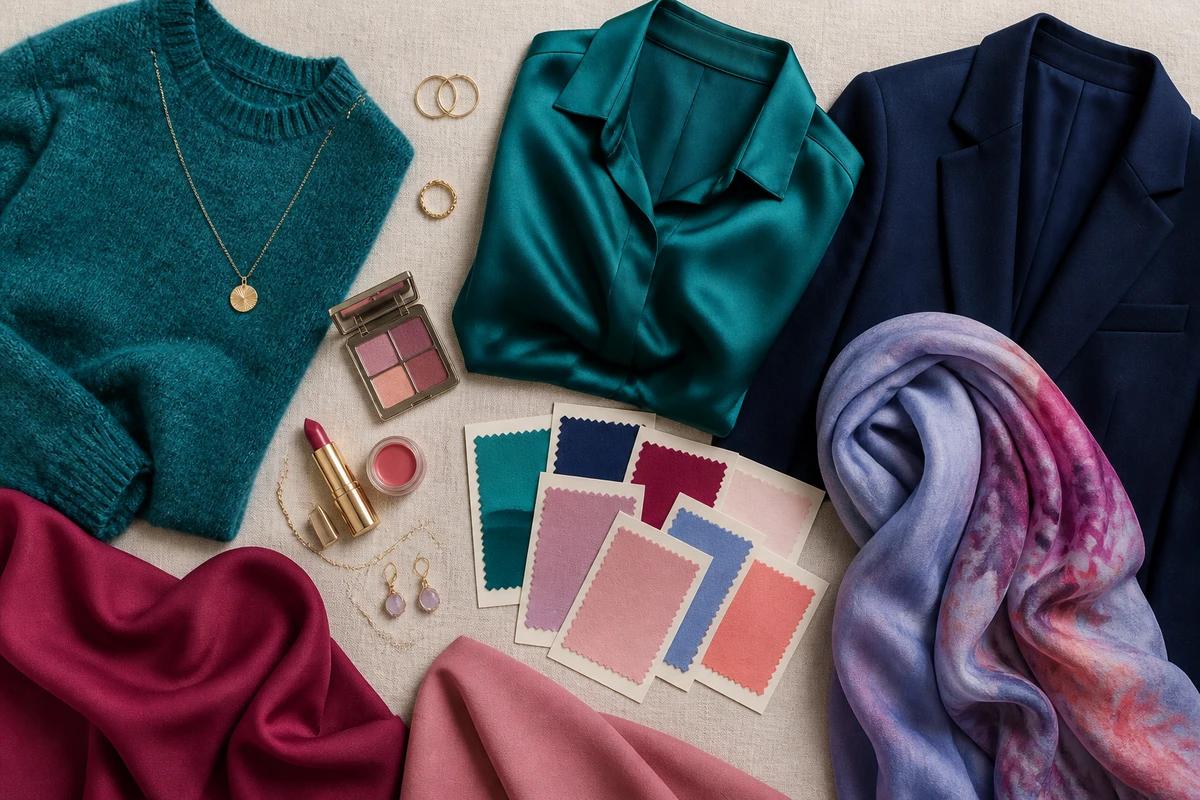
The best colors for pale skin
These ten shades have enough depth or clarity to stand out against light skin without swamping it. Navy, emerald and some kind of brown were recommended by all six ranking guides we compared; purple, lavender, pink and coral by five.
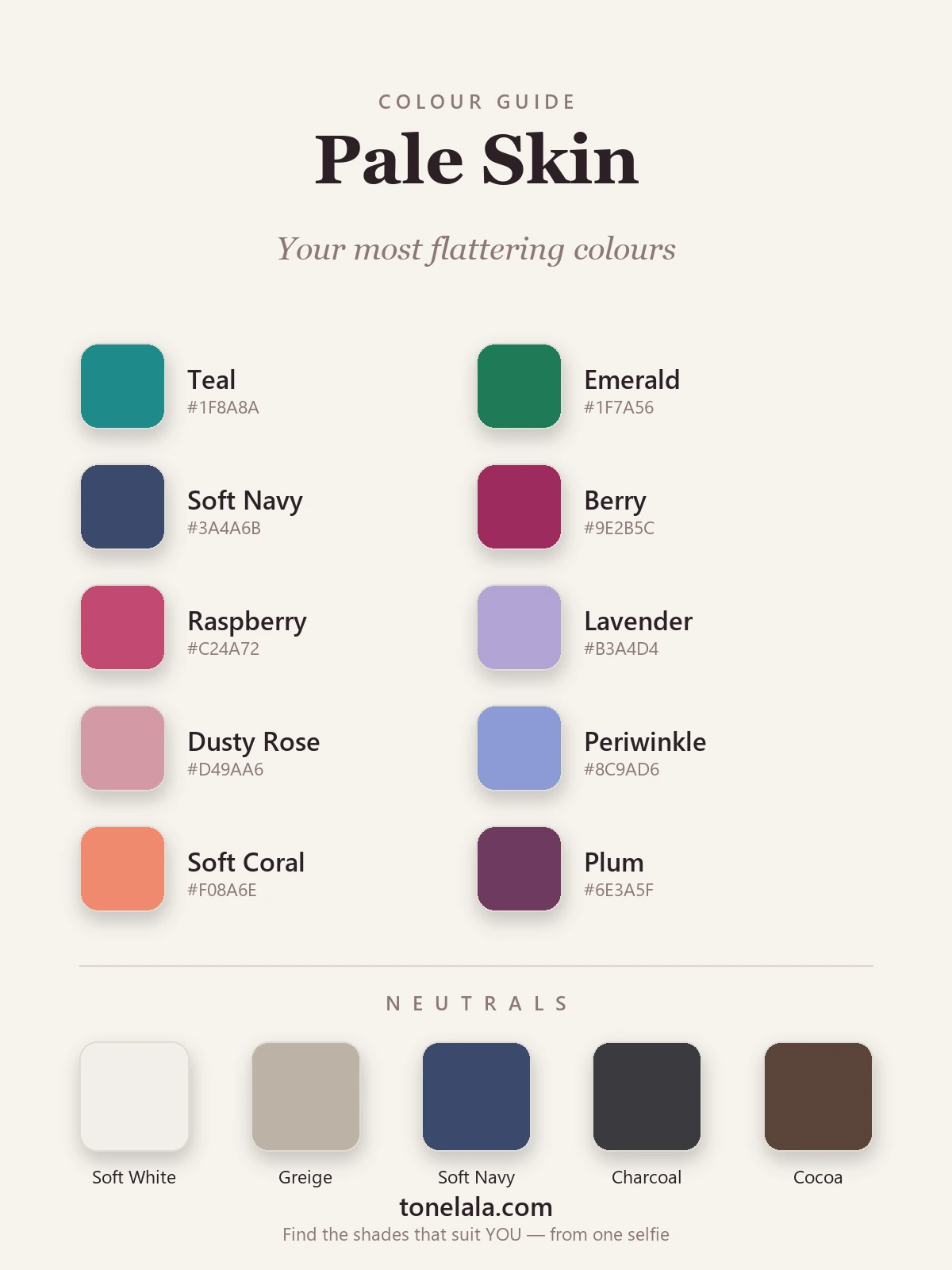
| Color | Hex | Why it works |
|---|---|---|
| Teal | #1F8A8A |
A blue-green that sits between warm and cool, so it suits most pale undertones. Deep enough to define a light face. |
| Emerald | #1F7A56 |
A clear jewel green. Recommended by all six guides we compared, and especially good with red hair or green eyes. |
| Soft Navy | #3A4A6B |
The dark neutral that works on almost every pale person. It gives definition with less shadow than black. |
| Berry | #9E2B5C |
A deep blue-pink. Strongest on cool pale skin, where it adds color to the cheeks. |
| Raspberry | #C24A72 |
A lighter, brighter cool pink. Easy to wear as a top or scarf. |
| Lavender | #B3A4D4 |
A pastel that holds its color. Cool and clear rather than chalky, so it does not wash out cool pale skin. |
| Dusty Rose | #D49AA6 |
A muted pink with enough pigment to read as a color. Good for soft, low-contrast coloring. |
| Periwinkle | #8C9AD6 |
A blue-violet halfway between warm and cool, so it suits a wide range of pale skin. |
| Soft Coral | #F08A6E |
The warm-undertone pick: a golden pink that suits peachy pale skin and freckles. |
| Plum | #6E3A5F |
A deep, soft purple that works as a dark without the hardness of black. |
Teal
Teal is the safest color on this list if you are unsure of your undertone. Wear it as a knit or a blouse with soft navy pants, or as a scarf with a gray coat.
Emerald
Emerald gives the strongest contrast of the greens. A dress or a sweater works well; with red hair or green eyes, it is the color most guides put first.
Soft navy
Navy appears on every ranking list, usually as the answer to "what instead of black." A navy blazer, coat or pair of pants does the job of black in a wardrobe while sitting more softly against light skin.
Berry and raspberry
Both are cool pinks. Berry is the deeper one, good for knitwear and evening; raspberry is brighter and works in summer tops. Warm pale skin should try coral first and keep these further from the face.
Lavender, dusty rose and periwinkle
These three are proof that pale skin can wear soft colors. The difference from the pastels that wash people out is pigment: each holds a clear color rather than fading toward white. Wear them with soft white or gray.
Soft coral
Coral is the warm option, and it suits pale skin with peach or golden undertones, freckles and strawberry blonde or red hair. A coral top with denim is an easy start.
Plum
Plum is useful for anyone who finds black too strong. A plum sweater with charcoal pants or a plum dress for evening gives depth while keeping the face soft.

Free E-Book
How to Look Younger With the Right Colors
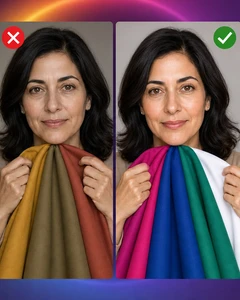
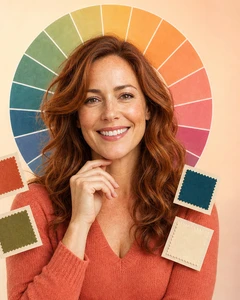
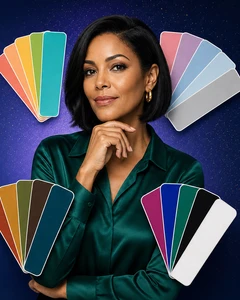
Color Analysis
Know Your Colors Before Your Next Shopping Trip
A personal color analysis from one selfie, ready in minutes.
The best neutrals for pale skin
Neutrals make up most of a wardrobe, so they matter as much as the colors:
- Soft white
#F2EFE8: a softened white that sits more gently near the face than optic white. - Greige
#BDB3A6: an everyday light neutral with enough depth not to merge with pale skin. - Soft navy
#3A4A6B: the most useful dark. - Charcoal
#3C3B40: a dark gray for contrast without pure black. - Cocoa
#5A4438: a warm brown for warm and olive undertones.
Five of the six ranking guides tell pale people to be careful with beige and nude shades that match the skin exactly. Greige works because it is deeper and grayer than most pale skin.
Best colors by undertone
Cool pale skin
Pink, rosy or porcelain skin that looks better with silver. Lean on berry, raspberry, lavender, periwinkle, soft navy, emerald and sapphire-type blues. Be careful with mustard, orange, camel and khaki, which Tone & Fit and mycoloranalysis.ai both say can make cool pale skin look sallow.
Warm pale skin
Ivory or peachy skin, often with freckles, that looks better in gold and cream. Soft coral, peach, warm teal, emerald, golden browns, camel and cream are the safest picks. Icy pastels, cold gray and stark white tend to look harsh; Tone & Fit lists all three as cautions for warm pale skin.
Neutral pale skin
If both metals look fine and white and cream both work, you have the most choice. Teal, periwinkle, dusty rose, soft navy, greige and plum all sit near the middle. Go for medium clarity rather than the brightest or most muted versions.
Olive pale skin
None of the six ranking pages covers fair olive skin separately, but it exists: light skin with a green or gray cast that can look sallow in yellow and orange. Teal, emerald, plum, berry, soft navy and charcoal tend to work. Our fair olive skin guide covers it in detail.
Best colors by hair color
Hair changes the contrast, and contrast decides how deep you can go.
Pale skin with blonde or light hair
Low contrast. Medium-depth colors suit you better than very dark ones: soft navy over black, dusty rose and periwinkle over hot pink. See best colors for pale skin and blonde hair.
Pale skin with dark hair
High contrast, often called the Snow White look. You can carry black, pure white, cobalt, emerald and fuchsia, and mycoloranalysis.ai lists black and pure white as wear colors for this type only. See best colors for fair skin and dark hair.
Pale skin with red hair and freckles
Usually warm. Emerald, teal, coral, rust and camel tend to flatter; mycoloranalysis.ai cautions against icy pink and lavender for redheads. See best colors for red hair.
Colors guides disagree on
The ranking guides split on several colors. Here is who says what, so you can test them yourself.
- Black. Regenesupreme tells pale people to avoid it outright; Yes Madam says it can look elegant; Tone & Fit and mycoloranalysis.ai say it depends on contrast, fine with dark hair and too strong with light hair. Busbee Style suggests navy or brown if black feels harsh.
- White. Regenesupreme says avoid all white; Palette Hunt and Yes Madam prefer ivory or soft white; mycoloranalysis.ai lists pure white for cool pale skin with dark hair. A celebrity stylist quoted by Parade in February 2025 (Éteri Yusufova) even recommends white on white.
- Pastels. Regenesupreme warns against them near the face; Palette Hunt, Yes Madam and Busbee Style recommend dusty or clear pastels. The difference is chalkiness: a pastel with real pigment works, a whitened one does not.
- Bright colors. Busbee Style calls the idea that pale skin should avoid bold colors a myth and recommends cobalt and red; Yes Madam and Regenesupreme warn against neon. Bright tends to suit high contrast and cool undertones best.
- Yellow. Busbee Style likes lemon; Yes Madam and mycoloranalysis.ai prefer golden or mustard yellow over pale lemon, and Regenesupreme recommends mustard. Warm pale skin usually handles golden yellow; cool pale skin often looks greenish in it.
Colors to avoid with pale skin
"Avoid" is too strong for most colors, but these are the ones most likely to work against light skin:
- Beige and nude that match your skin. Five of the six guides list them. With no difference in value, the face merges with the clothing.
- Chalky, whitened pastels. Baby yellow, pale mint and the faintest pinks. Choose a pastel with more pigment instead.
- Neon. Acid green, neon orange and highlighter yellow overpower very light skin; three guides warn against neon.
- Muddy earth tones on cool skin. Mustard, khaki, camel and rust can look sallow on pink-based pale skin. Warm pale skin often wears them well.
- Optic white and pure black on low-contrast coloring. If your hair and eyes are light, both can look harsh near the face. Soft white, soft navy and charcoal do the same job more gently.
Pale skin and the color seasons
Pale skin does not belong to one season. What places you is your undertone and the contrast between your skin, hair and eyes.
Cool, pink-leaning pale skin usually lands in Summer or Winter: Summer if your coloring is soft, Winter if it is clear and high contrast, such as very fair skin with dark hair. Warm, golden pale skin tends toward Spring. If you are fair with low contrast and soft features, you may be one of the light seasons, Light Summer or Light Spring, where the whole palette stays delicate. Palette Hunt's guide names Light Summer, Cool Winter and Light Spring as the usual seasons for pale skin. The full set of color analysis guides goes through each one.
Makeup & styling for pale skin
The same value logic applies to makeup. A clear rose, raspberry or soft coral lip, matched to your undertone, adds life to a light face; very deep matte lipstick can look heavy unless your hair is dark. A sheer rose or peach blush replaces the color pale cheeks lack. For eyes, taupe, plum, periwinkle and soft navy define light eyes more gently than heavy black, and brown or gray-brown liner is softer than jet black. Our lipstick guide by skin tone has more detail.
For metals, silver and white gold usually suit cool pale skin, and soft gold suits warm pale skin; neutral pale skin can wear either, and rose gold sits between them. Shoes and bags in soft navy, charcoal, cocoa or greige are easier on very light skin than a lot of hard black, though black accessories are fine if your hair is dark.
Where to start
If you are not sure what you are, begin with the colors every guide agrees on: soft navy, teal and emerald. Wear each one near your face in daylight and look at your skin, not the clothing. If your skin looks clearer and the shadows under your eyes look lighter, the color suits you.
Then take the undertone checks above and use the matching section: berry and lavender for cool, coral and warm teal for warm, the middle colors for neutral. Swap pale beige and chalky pastels for greige and pastels with real pigment. If your hair is dark, try black and white near your face; if it is light, keep soft navy and charcoal as your darks.
Frequently asked questions
What colors suit pale skin?
Clear, medium-to-deep colors that give light skin some contrast: teal, emerald, soft navy, berry, raspberry, lavender, dusty rose, periwinkle, soft coral and plum. Navy and emerald are the two colors every ranking guide we compared recommends. Your undertone then decides the temperature: cool pale skin leans to berry and lavender, warm pale skin to coral and warm teal.
What colors should you avoid with pale skin?
Beige and nude shades that match your skin, chalky whitened pastels, and neon are the most common cautions. Cool pale skin can look sallow in mustard, khaki and camel, and if your hair and eyes are light, optic white and pure black can look harsh near the face. Few colors are truly off limits; a deeper or clearer version of the same color usually works.
What are the best neutrals for pale skin?
Soft white #F2EFE8, greige #BDB3A6, soft navy #3A4A6B, charcoal #3C3B40 and cocoa #5A4438. Soft navy and charcoal give contrast with less shadow than pure black, greige is deep enough not to merge with light skin, and cocoa suits warm and olive undertones.
Does undertone change the best colors for pale skin?
Yes. Undertone matters more than how light you are. Cool, pink-leaning pale skin suits berry, raspberry, lavender, periwinkle and soft navy; warm, peachy pale skin suits soft coral, peach, warm teal, emerald and camel. Neutral pale skin can wear the middle of both lists, and fair olive skin does well in teal, emerald, plum and charcoal.
How do I find my exact best shades for pale skin?
Pale skin spans several color seasons, so your exact palette depends on undertone, depth and contrast, which are hard to judge in your own mirror. Start with the daylight checks on this page (metals, white versus cream, colors near the face). A personal color analysis reads all three from a clear photo; you can start one at tonelala.com/onboarding.
Can pale skin wear black?
It depends on your contrast. With dark hair and brows, black usually looks sharp. With light hair and eyes, black can look harsh near the face, which is why several guides suggest soft navy, charcoal or plum instead. Guides disagree here: some say avoid black, others say it can look elegant, so test it in daylight.
Should pale skin avoid white?
Not necessarily. Optic white can look stark on warm or low-contrast pale skin, so soft white or ivory is the safer choice. Cool pale skin with dark hair often wears pure white well.
Do pastels wash out pale skin?
Chalky, whitened pastels often do, because they sit at the same lightness as the skin. Pastels with more pigment, such as lavender, dusty rose and periwinkle, hold their color and usually work, especially on cool or soft coloring.
Is pale skin always cool-toned?
No. Pale describes how light your skin is, not its undertone. Pale skin can be cool, warm, neutral or olive. Redness and flushing are common on light skin and can make warm skin look pink, so judge undertone along the jaw and neck in daylight.
Related guides

Best Colors for Pale Skin And Blonde Hair: Your Most Flattering Shades (with Hex Codes)
A color analyst's guide to the best colors for pale skin and blonde hair, 10 flattering shades and 5 neutrals with hex codes, what to avoid, and your season.
Best Colors for Dark Skin And Brown Eyes: Your Most Flattering Shades (with Hex Codes)
A color analyst's guide to the best colors for dark skin and brown eyes, jewel tones, bright clears and the neutrals that glow, with hex codes.
Best Colors for Tan Skin And Green Eyes: Your Most Flattering Shades (with Hex Codes)
The best colors for tan skin and green eyes, from olive, teal and rust to plum and gold, with hex codes, undertone picks, neutrals and what to avoid.
Best Colors for Olive Skin And Brown Eyes: Your Most Flattering Shades (with Hex Codes)
The best colors for olive skin and brown eyes: teal, terracotta, rust and deep jewel tones with hex codes, neutrals, makeup, metals and the shades to avoid.
Best Colors for Medium Skin: Your Most Flattering Shades (with Hex Codes)
A color analyst's guide to the best colors for medium skin, teal, coral, marigold, emerald and more, with hex codes, the right neutrals and what to avoid.
Best Colors for Fair Skin: Your Most Flattering Shades (with Hex Codes)
A color analyst's guide to the best colors for fair skin, 10 flattering shades plus 5 neutrals, with hex codes, what to avoid, and how undertone changes it.
Prefer in person? Find color analysis near you
Browse local color analysts by city.