In a sentence: the colors that go best with brown are cream and ivory, teal, denim and sky blue, navy, mustard, burnt orange, forest and sage green, blush pink, coral, burgundy and camel, with black and gray as the pairings guides argue about. Skip to the full pairing palette or find your most flattering colors.
Colors That Go With Brown: 12 Stylish Combinations (with Hex Codes)
By ToneLalaUpdated October 18, 2026
Contents
- 01 What kind of color brown is
- 02 The best colors to go with brown
- 03 12 brown color combinations, with an outfit for each
- 04 Brown with black, gray and purple: where guides disagree
- 05 Colors to avoid with brown
- 06 Match the partner to the shade of brown
- 07 Shoes, bags and jewelry with brown
- 08 Brown outfit combinations
- 09 Brown for men
- 10 How to wear brown for your color season
- 11 Brown at home
- 12 Which brown pairing to start with
Brown has had a better few years than most neutrals. Pantone made a soft coffee brown, Mocha Mousse (17-1230), its Color of the Year for 2025, and several fashion guides now run a section titled some version of "brown is the new black". That attention has not made brown easier to pair, though. It behaves like a neutral in some outfits and like a color in others, and the same chocolate coat can look rich over cream and muddy over the wrong gray.
This guide compares the pairings that 14 ranking guides recommend most often, then goes through 12 brown color combinations one at a time with a hex code and an outfit for each. After that come the pairings guides disagree about (black, gray and purple), the few combinations to avoid, how to match the partner to the shade of brown you own, shoes and jewelry, and how your own coloring changes the answer.
What kind of color brown is
Brown is not its own hue on the color wheel. It is a dark, low-saturation orange: orange with the light turned down and a little gray mixed in. Some browns lean red (mahogany, chestnut), some lean yellow (camel, caramel, walnut), and the coolest ones (taupe, mushroom) carry so much gray that they sit near the center of the wheel. That one fact explains most of how brown behaves.
Because brown is a muted orange, its complement is blue. Teal, denim and navy give brown the contrast that makes it look warm instead of flat, and that is why they appear on every list of colors that go with brown. Brown also sits next to the other earth tones (mustard, rust, terracotta) on the wheel, so those pairings read as tonal and calm rather than contrasting. And because brown is muted, it pairs best with colors that have some softness or depth of their own; a neon bright beside it looks like it arrived from a different outfit.
"Brown" also covers a wide range of depth, from pale greige and taupe through camel and tan to chocolate and espresso. The light browns work as soft neutrals. The dark browns can stand in for black. Every pairing below works across that range once you adjust the partner color to the depth of the brown.
The best colors to go with brown
Ten pairings and five neutrals, with the reason each one works.
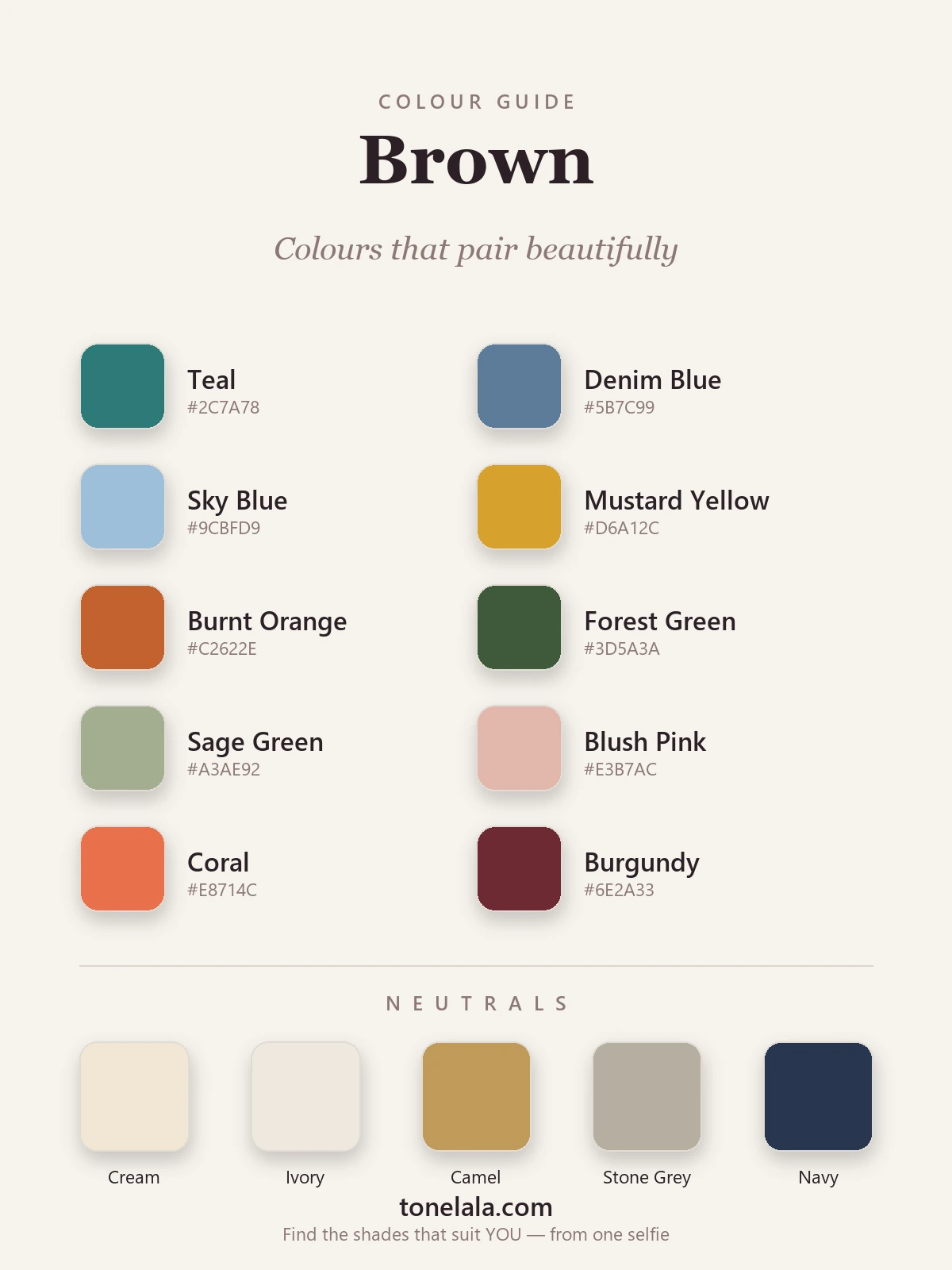
| Color | Hex | Why it works |
|---|---|---|
| Teal | #2C7A78 |
Brown's complement with a touch of green. Cool enough to make the warmth visible, soft enough not to fight it. |
| Denim Blue | #5B7C99 |
The everyday version of the blue-and-brown contrast. Faded denim beside chocolate or tan is the pairing most people already own. |
| Sky Blue | #9CBFD9 |
A lighter blue that keeps a brown outfit from feeling heavy. Works especially well with camel and caramel. |
| Mustard Yellow | #D6A12C |
A neighbor on the wheel. Golden and earthy, it makes brown look sunlit rather than drab. |
| Burnt Orange | #C2622E |
Orange is brown's parent hue, so this pairing reads as deliberate and tonal. |
| Forest Green | #3D5A3A |
Brown and green is the pairing found in nature. Deep forest gives chocolate a rich, woodland depth. |
| Sage Green | #A3AE92 |
The soft, grayed green for when forest feels too strong. Calm and current. |
| Blush Pink | #E3B7AC |
A warm, dusty pink that flatters brown the way it flatters skin. Soft rather than sweet. |
| Coral | #E8714C |
A brighter warm note for when the outfit needs energy. Brown grounds it so it never reads loud. |
| Burgundy | #6E2A33 |
A deep wine red that shares brown's warmth and depth. The fall pairing. |
Neutrals that go with brown: Cream #F1E7D3 (the softest and most reliable partner), Ivory #EDE8DD (a clean off-white that is kinder than stark white), Camel #C19A5B (keeps a look tonal), Stone Gray #B6AEA0 (a warm gray that does not drain the brown) and Navy #27364F (the dark most fashion guides now prefer over black with brown).

Free E-Book
How to Look Younger With the Right Colors
Color Analysis
Know Your Colors Before Your Next Shopping Trip
A personal color analysis from one selfie, ready in minutes.
12 brown color combinations, with an outfit for each
The 14 guides compared for this article (fashion, interiors and design pages) agree on more than they disagree. White or cream, blue, green and yellow appear on every single list. Pink, black and a second brown appear on 13 of the 14; orange and rust on 12; red or burgundy on 11; purple on 11; gray on 10; gold on 10; teal on 8; and denim is named on 7. The order below follows that frequency, with the most agreed-on pairings first.
1. Brown and cream or ivory
Cream #F1E7D3 and ivory #EDE8DD are the partners nobody argues about. The off-white lifts the brown without the hard edge that pure white can give, and the two share a warm base, so the outfit reads as one idea rather than two. Outfit: a chocolate coat over an ivory roll-neck, cream wide-leg pants and tan loafers. Pure white works too, with more contrast; it suits lighter browns and summer fabrics best.
2. Brown and teal or turquoise
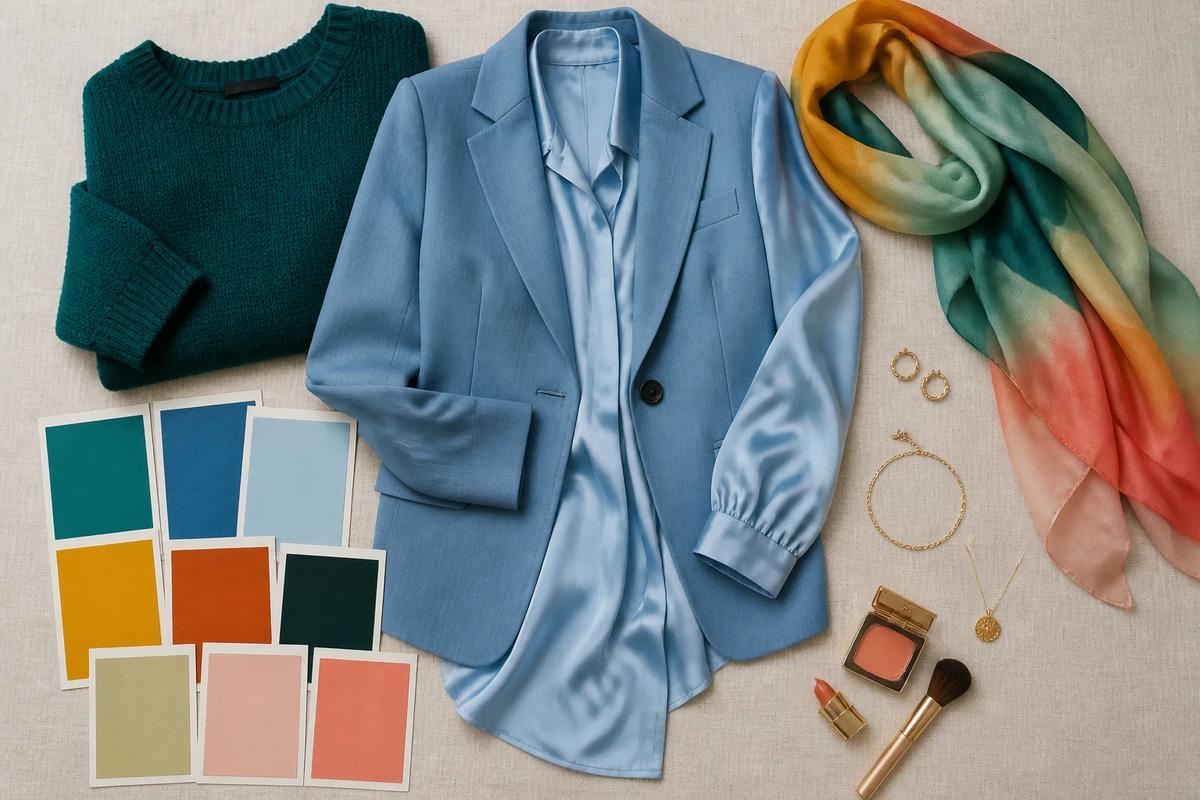
Teal #2C7A78 is the pairing to try when brown feels dull. It is brown's complement with some green mixed in, so it makes the warmth in the brown visible instead of flattening it, and it never looks as expected as navy. Outfit: a camel trench, a teal knit, dark jeans and brown ankle boots. Turquoise does the same job in a brighter register and suits tan and caramel better than it suits espresso. There is a full guide to colors that go with teal if you want to build the pairing the other way around.
3. Brown and denim or light blue
Denim blue #5B7C99 and sky blue #9CBFD9 are the easiest way to wear the blue-and-brown contrast, because most wardrobes already contain both. Mid and light washes give brown the most contrast; a dark indigo works with camel but loses definition next to espresso. Outfit: a tan suede jacket, a light blue oxford shirt, faded jeans and brown boots. A sky blue shirt under a chocolate blazer is the office version.
4. Brown and navy
Navy #27364F is the dark that fashion guides reach for before black when the outfit is built on brown, and two of the guides compared here call it their most-worn pairing. It gives brown the depth of black with more warmth. The one caution, raised by a German fashion house's guide, is that a very dark brown next to a very dark navy can blend into one murky block; keep one of the two lighter, or put cream between them. Outfit: navy pants, a caramel knit, a navy coat and chocolate loafers. The reverse pairing is covered in colors that go with navy blue.
5. Brown and mustard yellow
Mustard #D6A12C sits next to brown on the color wheel, so the pairing is tonal rather than contrasting: warm on warm, with enough difference in brightness to stay interesting. It is the fall pairing most guides name, and the one that can look dated if the yellow is too bright, so stay with a grayed or ochre mustard rather than a clean yellow. Outfit: a mustard sweater, chocolate corduroy pants and tan boots. See how to wear mustard yellow for the shade that suits your coloring.
6. Brown and burnt orange or rust
Burnt orange #C2622E and rust are brown's parent hue at full strength, which makes the combination read as a planned tonal outfit rather than an accident. The depth difference matters: a rust top with a chocolate skirt works because one is clearly lighter and brighter. Outfit: a rust knit, a tan jacket, faded denim and brown suede boots. The pairing has its own page at colors that go with rust.
7. Brown and forest green
Forest green #3D5A3A with brown is the pairing people recognize from the outdoors, and interiors guides use it as often as fashion guides do. The green supplies the cool note brown needs while keeping the earthy mood. Outfit: a forest green coat over a cream shirt, chocolate pants and brown boots. Olive does the same job with less contrast and suits a more casual, military-leaning outfit.
8. Brown and sage green
Sage #A3AE92 is the grayed, soft green for when forest feels too strong. It reads calm beside both camel and chocolate and appears on most of the fashion lists compared here. Outfit: a sage shirt dress, a camel cardigan and tan sandals. Keep the rest of the outfit in cream or stone; a third strong color crowds the sage.
9. Brown and blush pink
Blush #E3B7AC flatters brown the same way it flatters skin: it warms it and softens it. The pairing proves brown can do pretty rather than only earthy, and it works across the whole brown range, from a blush top with camel pants to a blush coat over espresso. Outfit: a blush blouse, chocolate pants, a camel coat and gold jewelry. Dusty rose and peach are the variations; a cold, blue-pink fights the brown.
10. Brown and coral or red
Coral #E8714C is the bright for a brown outfit that needs energy, and red is its stronger cousin. The guides split on how bright to go: an interiors designer quoted in one ranking guide pairs chocolate with bold red for a dramatic room, while a fashion guide tells readers to avoid bright red with brown and a third says use a true red rather than an orange-red. The practical version: a clear coral or true red reads as a deliberate accent, while an orange-red sits too close to the brown and blurs. Outfit: a coral top, chocolate wide-leg pants and tan sandals; swap the coral for a true red sweater in fall.
11. Brown and burgundy
Burgundy #6E2A33 shares brown's warmth and depth, so the pairing is rich and low-contrast, and the texture of the fabrics does most of the work. It is the pairing for fall and winter, when both colors can be worn in wool, suede and leather. Outfit: a burgundy knit, chocolate wool pants, a camel coat and brown boots. If the two colors are close in depth, add cream at the neck so the outfit has a light point. The reverse pairing is in colors that go with burgundy.
12. Brown and camel, tan or another brown
Camel #C19A5B with a darker brown is the tonal outfit that most fashion guides include and most people get slightly wrong. The rule from the guides is simple: use browns that are clearly different in depth (camel with espresso, tan with chocolate), never two that are nearly the same, and keep the number of browns to two or three. Outfit: a camel coat, a chocolate roll-neck, tan pants and dark brown boots, with cream for the lightest point. The separate guide to colors that go with tan covers the lighter end of the range.
Brown with black, gray and purple: where guides disagree
Black. The old rule against brown and black is the single biggest gap between this article's first version and the ranking guides: 13 of the 14 recommend the pairing, and none tell you to avoid it. The rule itself comes from an English menswear tradition, "no brown in town", which treated brown as a country color unfit for the city. Modern guides treat it as outdated and give the same advice in different words: let one of the two colors dominate, keep a clear contrast in depth or texture, and sandwich the brown between black pieces rather than splitting the outfit in half. A camel coat over black works; black pants with a chocolate knit works; a very dark brown next to black with nothing between them does not, because both read as a muddy version of the other. The one guide that keeps a caution is the German fashion house, which advises against black shoes with an all-brown outfit. The reverse view, black as the base and brown as the accent, is covered in colors that go with black.
Gray. Here the guides contradict each other outright. One fashion guide lists light gray among the colors that do not go with brown, because it drains the brown of contrast. A design guide calls brown and gray one of the most classic combinations and recommends warm grays beside chocolate. Two more split the difference: light gray with dark brown, charcoal with camel. The pattern underneath the disagreement is temperature. A warm gray or greige works with any brown; charcoal works with dark brown; a cool, bluish light gray is the version that falls flat, and it is the one the first guide is warning about. The stone gray #B6AEA0 in the palette above is a warm gray for that reason.
Purple. Lilac and lavender get recommended more often than deep purple. One fashion guide and one color-season site both caution against dark purple with brown, while a stylist's guide recommends eggplant and bright purple. The pairing works when the purple is either clearly light (lavender with camel) or clearly bright (a violet top with chocolate); a dark, muted purple next to a dark brown has the same problem as navy and espresso, two dark colors with no contrast.
Colors to avoid with brown
- A second brown that almost matches. Two browns a shade apart look like a mismatch rather than a choice. Use browns that are clearly different in depth, or stop at one.
- Neon brights. Electric pink, acid lime and vivid cobalt overpower brown's muted warmth, and the pairing reads as costume. If you want brightness, coral and mustard carry their own warmth.
- Icy pastels with a very warm brown. A cold mint or icy pink next to caramel or chocolate pulls in opposite temperature directions. Dusty versions of the same pastels (blush, sage, powder blue) work.
- Orange-red. A red that leans orange sits so close to brown that it blurs into it. Choose a true red or a coral that is clearly brighter than the brown.
- Bone white, according to one guide. A single fashion guide rejects bone white with brown as too yellow; the others happily pair cream and ivory. Treat it as a matter of the exact shades in hand rather than a rule.
Match the partner to the shade of brown
Most ranking guides split their advice by shade of brown, and the split matters more than any single pairing.
Camel, tan and light brown
Light browns behave like soft neutrals, so they take almost any partner and look best with the lighter and brighter versions: sky blue, coral, blush, mustard, lavender, white. Navy and black give camel a dark anchor, and chocolate gives it a tonal one. The thing to avoid is a partner so pale that the whole outfit washes out; a camel coat over cream needs a dark shoe or a deep bag.
Chocolate, espresso and dark brown
Dark browns can stand in for black and take the same kind of partners black does: cream, white, blush, teal, burgundy, forest green, rust and mustard all work, and the contrast with a light partner is what keeps the outfit from going heavy. The pairings to handle with care are the other darks, navy, black and dark purple, which need a light piece between them.
Taupe, mushroom and cool browns
Cool browns carry enough gray to sit beside cool partners: gray, navy, dusty blue, plum, dusty rose and silver jewelry. They are the browns for cool coloring, and they look wrong with the warmest partners (mustard, burnt orange) that flatter chocolate and camel. A taupe coat over a dusty blue knit is the pairing to copy.
Shoes, bags and jewelry with brown
Shoes. Brown shoes with a brown outfit follow the same rule as any two browns: clearly different in depth, with dark brown boots under a camel coat and tan loafers under chocolate pants. Cream or white sneakers lighten a brown outfit; black shoes work when black appears elsewhere in the outfit (a bag, a belt, a coat) and look like a mistake under an all-brown look, which is the one caution a fashion guide still keeps.
Bags and belts. Match the leather to the shoes or to the darkest brown in the outfit. A cognac bag with chocolate and cream is the tonal version; a navy or black bag gives a camel outfit its dark point.
Jewelry. One fashion guide's FAQ asks whether brown goes better with gold or silver, and its answer matches the color wheel: gold, brass and copper echo brown's warmth and are the default, while silver suits the cool browns and outfits that already contain navy, teal or gray. Your own undertone decides as much as the brown does; the gold vs silver guide covers how to tell.
Denim. Light and mid washes first, dark indigo with the lighter browns, black denim treated like black, and white or ecru denim with chocolate for summer.
Brown outfit combinations
- Chocolate + cream + teal. A brown coat over a cream knit with a teal scarf or bag. The combination to start with.
- Camel + ivory + gold. Camel pants, an ivory shirt and gold jewelry. The tonal formula.
- Tan + denim + burnt orange. A tan jacket, faded jeans and a rust tee or knit. Fall weekends.
- Espresso + blush + sage. Deep brown pants, a blush top and a sage jacket. Brown doing pretty.
- Camel coat + black. A camel coat over an all-black outfit. The pairing the old rule banned and current guides recommend.
- Chocolate + navy + cream. Navy pants, a cream shirt and a chocolate blazer or cardigan. Office brown.
- Taupe + dusty blue + silver. A taupe coat, a dusty blue knit, gray pants and silver jewelry. The cool-brown version.
- Burgundy + chocolate + camel. A burgundy knit, chocolate wool pants and a camel coat. Winter, low contrast, rich fabrics.
Brown for men
Menswear guides are where the brown-and-black rule survived longest, and even they have dropped it. The current advice: brown shoes with navy or gray suits, a chocolate knit over a light blue shirt, tan chinos with white or navy, and a brown suit with cream or sky blue rather than white. Medium and light browns (tan, camel, caramel) are the easiest to wear in daylight; dark brown suits and overcoats work for evening and winter. The one combination still flagged, by a womenswear guide rather than the menswear ones, is an all-brown outfit with black shoes.
How to wear brown for your color season
The pairings above hold for everyone. Which brown to buy does not. Warm and deep coloring (True Autumn and Deep Autumn) suits golden, chocolate and espresso browns and carries the deeper partners, burgundy and forest, with ease. Light, warm coloring looks fresher in camel and tan with cream and blush. Cool coloring is better served by taupe, mushroom and cocoa browns with cooler partners (teal, denim, soft navy, dusty rose), and golden-orange browns are the ones to keep away from the face. Soft coloring (Soft Autumn especially) wears the muted end of everything here: sage over forest, dusty blue over sky blue, blush over coral.
Most guides agree on the broad split, golden browns for warm skin and taupe for cool, and stop there. The color analysis guides go season by season, and a personal analysis names the exact brown and the exact partner shades for your coloring. For wearing brown as a garment rather than pairing it, see how to wear brown.
Brown at home
About half of the pages that rank for this search are about rooms rather than clothes, and the pairings carry over with one difference: interiors guides are bolder. Interior designers quoted in those guides pair chocolate with bold red for a dramatic room, and the recommended lists run to 20 and even 41 pairings, with teal, cream, mustard, sage, lavender and burnt orange recurring. The rule of thumb they share with fashion is that brown needs a light partner (cream walls, ivory upholstery) to avoid going heavy, and a cool accent (teal, blue, green) to keep the warmth from reading as dated.
Which brown pairing to start with
Pick one brown you already own and wear it with cream first; that pairing works on every list and shows you whether your brown leans warm or cool. Then add one blue (denim if the brown is light, navy or teal if it is dark). After that the earth tones (mustard, rust, burgundy) and the soft accents (blush, sage) slot in without planning, because they all share brown's warmth. The only decision left is which shade of brown sits closest to your face, and that is the part a color analysis answers.
Frequently asked questions
What colors go with brown?
Cream, ivory and white are the pairings every guide agrees on, followed by the blues (denim, sky blue, navy and teal), the greens (forest, olive and sage), warm neighbors such as mustard, burnt orange and coral, and soft or deep accents such as blush pink and burgundy. Camel and tan work as a tonal partner, and navy or black can be the dark. Across the 14 ranking guides compared for this article, white or cream, blue, green and yellow appeared on every single list.
What color best complements brown?
Blue. Brown is a darkened, muted orange, and orange sits opposite blue on the color wheel, so blue is brown's complement. Teal, denim and navy all use that contrast, which is why a chocolate coat over faded jeans or a tan jacket with a teal scarf looks right without any effort. If you want a single answer for a neutral rather than a color, cream is the partner that fails least often.
What colors should you not wear with brown?
Almost nothing is banned, but a few pairings disappoint more than others: a second brown that is close in tone but not the same (it reads like a mismatch rather than a choice), neon brights that overpower brown's muted warmth, icy pastels against a very warm brown, and orange-reds that blur into the brown instead of standing against it. Black is the pairing people argue about: it is on 13 of the 14 ranking guides, so wear it with a clear contrast between the two rather than avoiding it. Light gray is the one some guides reject and others call classic.
What neutrals go with brown?
Cream (#F1E7D3) and ivory (#EDE8DD) are the softest and most reliable; camel (#C19A5B) keeps an outfit tonal; stone gray (#B6AEA0), a warm gray, is kinder than a cool blue-gray; and navy (#27364F) is the dark that most fashion guides now prefer over black with brown. Pure white works too, with more contrast than cream, and black works when one of the two colors clearly dominates.
How do I wear brown for my skin tone?
Match the brown to your undertone before you worry about the partner color. Warm and deep coloring suits golden, chocolate and espresso browns; cool coloring is better served by taupe, mushroom and cocoa browns that carry a little gray; light coloring usually looks fresher in camel, tan and milk chocolate than in the darkest espresso. Most guides agree that golden browns belong to warm skin and taupe to cool skin. A personal color analysis settles which side you sit on and which exact shade to buy.
Does brown go with black?
Yes, according to almost every current fashion guide; the old rule against it came from an English menswear tradition and is now widely treated as outdated. The combinations that work keep a clear difference in depth or texture: a camel coat over black, black pants with a chocolate knit, or a black bag with a brown dress. The pairing that still looks wrong is a very dark brown next to black with no contrast, where both read as a muddy version of each other.
Does brown go with gray?
It depends on the gray. A warm gray or greige sits comfortably beside chocolate and camel, and charcoal gives dark brown a sharp, tailored partner. The combination guides disagree on is light, cool gray: one ranking guide tells readers to avoid it because it drains brown of contrast, while another calls brown and gray one of the classic pairings. If your gray leans blue, add a cream or white piece between the two.
Should I wear gold or silver jewelry with brown?
Gold, brass and copper echo the warmth in brown and are the safer default, especially with camel, caramel and chocolate. Silver works when the brown is cool (taupe, mushroom, cocoa) or when the outfit already includes cool partners such as navy, teal or gray. Your own undertone matters as much as the brown: warm coloring reads better in gold, cool coloring in silver, and neutral coloring can mix the two.
What color denim goes with brown?
Mid and light washes give brown the most contrast and are the pairings guides name first; a faded blue with a tan or camel jacket is the classic. Dark indigo works with lighter browns such as camel and caramel, but next to espresso it loses definition. Black denim pairs with brown the same way black does: fine when the brown is clearly lighter. White or ecru denim with chocolate is the freshest version for spring and summer.
Related guides
Colors That Go With Sage Green: 12 Stylish Combinations (with Hex Codes)
Colors that go with sage green: 12 combinations with hex codes and outfits, from white, cream and navy to terracotta and burgundy, plus the pairings guides disagree on.
Colors That Go With Teal: 12 Stylish Combinations (with Hex Codes)
The colors that go with teal: 12 combinations with an outfit for each, 10 pairing colors and 5 neutrals with hex codes, shoes and jewelry, and what to avoid.
Colors That Go With Burgundy: 12 Stylish Combinations (with Hex Codes)
12 colors that go with burgundy, each with a hex code and an outfit to copy: cream, camel, navy, green, blush, gold, teal, gray, denim, olive and more, plus what to avoid and which burgundy suits you.
Colors That Go With Black: 12 Stylish Combinations (with Hex Codes)
The best colors that go with black: 12 combinations with hex codes and outfit ideas, plus navy, brown and gray answered, and how to match black to your skin tone.
Colors That Go With Purple: 12 Stylish Combinations (with Hex Codes)
The 12 colors that go with purple, with hex codes and an outfit for each, plus the pairings guides disagree on, shoes, jewelry and which purple suits you.
Colors That Go With Green: 12 Stylish Combinations (with Hex Codes)
The colors that go with green: 12 combinations with hex codes and an outfit for each, plus neutrals, denim, shoes, jewelry, the pairings guides disagree on and which green suits you.
Prefer in person? Find color analysis near you
Browse local color analysts by city.