In a sentence: The colors that go with rust best are teal, denim blue and petrol blue (its complements), with olive and forest green, mustard gold, blush, plum and burgundy for range, grounded by cream, camel, chocolate and charcoal. Skip to the full pairing palette or find your most flattering colors.
Colors That Go With Rust
By ToneLalaUpdated July 4, 2026
Contents
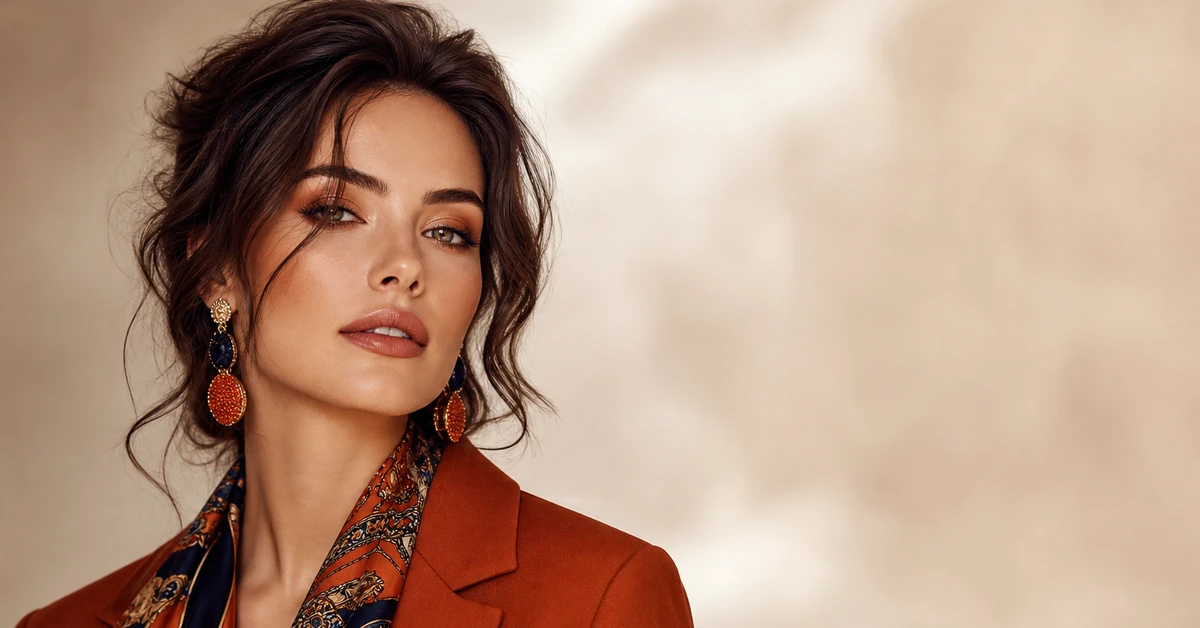
Rust is the first thing clients pull out of the wardrobe the moment the leaves turn, and it's also the color they most often wear on its own, a rust jumper with jeans, a rust coat over black, and that's the extent of it. It deserves better. Rust is one of the warmest, most generous colors you can own, sitting somewhere between burnt orange and terracotta, and it has range most people never use.
The reason it's so easy to style badly is the same reason it's so good when you get it right: rust is a strong, warm color with a definite point of view. Stand the wrong thing next to it and it turns muddy and heavy. Stand the right thing next to it, a clean teal, a soft blush, a good camel, and it glows like a conker. Same rust, completely different outcome. Once you understand what rust actually is, the pairings stop being guesswork.
What kind of color rust is
Rust is a deep, earthy red-orange: picture orange that's been knocked back with brown and a little red, named after oxidized iron, sitting somewhere around #8E3A1B to #B7410E. Its undertone is firmly warm, and it's muted rather than bright, which is what gives it that grounded, autumnal feel instead of the high-vis energy of a pure orange.
Two things follow from that warm, muted, medium-deep character. First, its complement on the color wheel is a cool blue or blue-green, which is precisely why teal, petrol and denim do something almost magical beside rust: the warm-against-cool contrast makes both colors look richer. Second, anything that shares rust's earthy, slightly dusty quality, olive, mustard, burgundy, terracotta, sits in the same world and blends seamlessly. Master those two directions, complement and family, and you've got every rust outfit you'll ever need.
It also helps to remember rust isn't a single shade. There's a lighter, more terracotta rust and a deeper, browner oxblood-rust, and where your particular piece sits nudges its best partners one way or the other. The principle holds either way: keep undertone warm and the pairings almost choose themselves.
The best colors to go with rust
Here are the ten I keep coming back to, three cool "contrast" blues, a couple of earthy greens, mustard for warmth, and a few deeper relatives for tonal dressing.
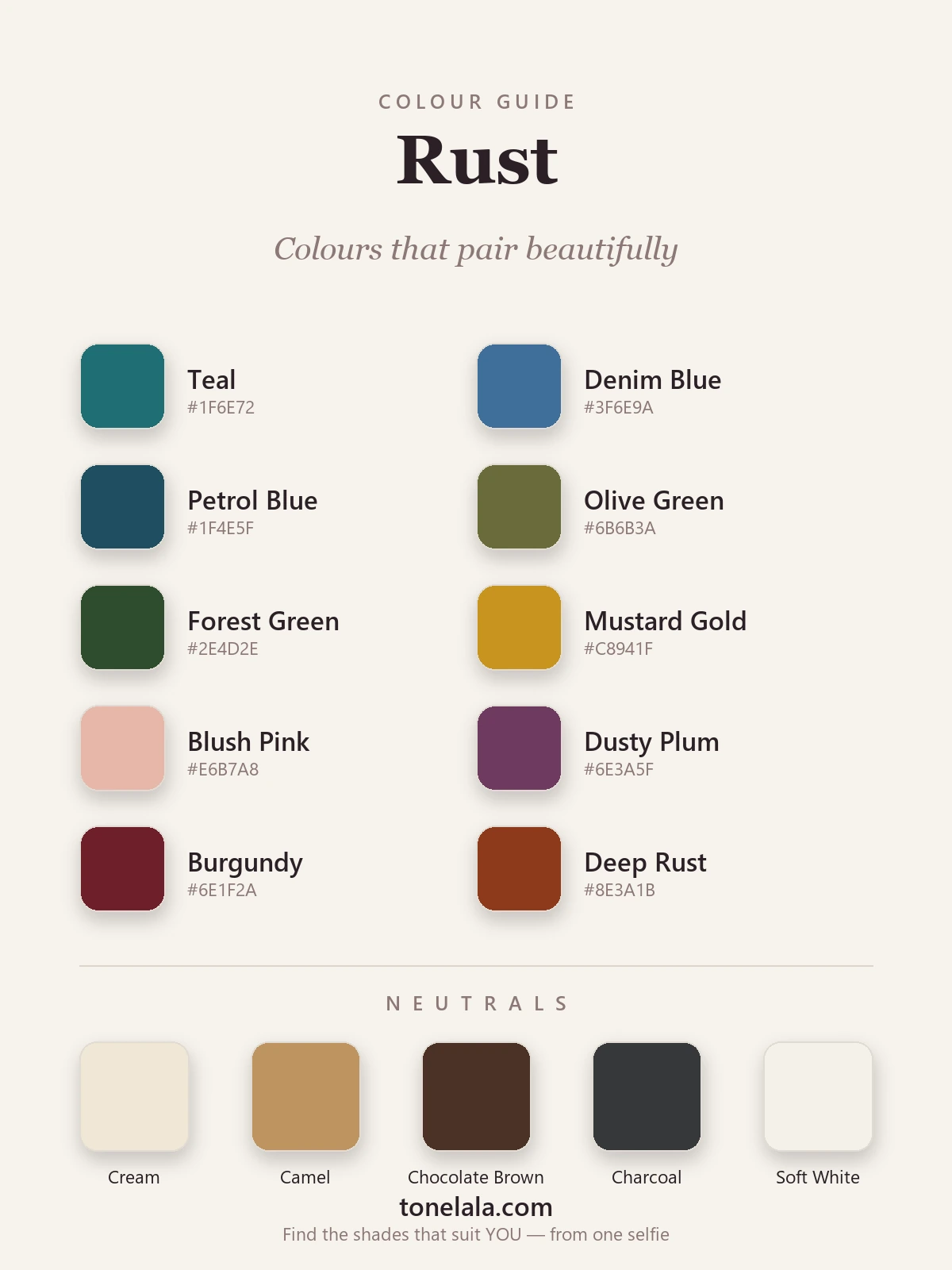
| Color | Hex | Why it works |
|---|---|---|
| Teal | #1F6E72 |
The headline pairing. A cool blue-green sits opposite rust on the wheel, so both colors look richer for the contrast. |
| Denim Blue | #3F6E9A |
The easiest complement to wear, a mid blue against warm rust is the combination that always looks effortless. |
| Petrol Blue | #1F4E5F |
A deeper, moodier blue that turns the rust-and-blue idea into something rich and a little luxurious. |
| Olive Green | #6B6B3A |
Earthy green and earthy orange share a muted, outdoorsy quality, a quietly sophisticated, very autumnal pairing. |
| Forest Green | #2E4D2E |
A deep green gives rust a proper jewel-toned contrast that feels considered rather than loud. |
| Mustard Gold | #C8941F |
Golden ochre sits right beside rust in tone, warm-on-warm dressing that looks expensive and seasonal. |
| Blush Pink | #E6B7A8 |
A warm, muted pink softens rust completely, taking it somewhere gentle and unexpectedly modern. |
| Dusty Plum | #6E3A5F |
A muted, cool-leaning purple that adds depth and a touch of the unexpected without fighting rust's warmth. |
| Burgundy | #6E1F2A |
Rust's deeper red cousin, tonal, rich and a little moody worn together, brilliant for evening. |
| Deep Rust | #8E3A1B |
Tonal dressing, a darker rust layered over a lighter one gives you depth without ever leaving the color. |
Neutrals that go with rust: Cream #EFE7D4 and Soft White #F4F1EA for warm and luxe, Camel #BE9460 for an easy tonal look in rust's own family, Chocolate Brown #4A3225 as a rich earthy "dark", and Charcoal #36383A for a grounding neutral that's kinder and more flattering than black.
Which shade of rust actually suits YOU?
Find your color season →Colors to avoid with rust
- Bright, cool fuchsia and clear cherry red. They sit on the opposite side of the undertone line from rust's warm, earthy base, so the two reds bicker rather than blend. If you want a pink, keep it warm and muted, blush, not shocking pink.
- Pure jet black, head to toe. It's not wrong, but it deadens rust's glow and tips the outfit heavy. Chocolate brown or charcoal gives you the same anchoring "dark" while letting rust keep its richness.
- Cold, icy pastels: baby blue, mint, lilac. Those clean, cool tones make rust look muddy by comparison. If you want a cool partner, go richer (teal, petrol) rather than paler.
The quick test: if a color makes the rust look browner or muddier, it's wrong. If the rust looks warmer and more glowing, you've found a friend.
Rust outfit combinations
- The statement: a rust dress with teal or petrol-blue accessories and gold jewelry. Pure complementary contrast, the one people stop you about.
- The effortless: a rust knit with mid-wash denim, cream trainers and a camel coat. Warm, easy and impossible to overthink.
- The autumnal tonal: rust trousers, a mustard jumper and chocolate-brown boots. Warm-on-warm, the outfit that looks like the season itself.
- The soft luxe: a rust skirt with a blush blouse and soft-white coat, gold hoops to finish. Gentle, modern and unexpectedly pretty for such an earthy color.
- The moody evening: rust and burgundy together with charcoal and a slick of gold. Deep, rich and quietly sophisticated.
How to wear rust for your color season
Here's the part most pairing guides skip: there isn't one rust, and the version that lights you up depends on your own coloring, not on what's hanging in the shops.
Warm, deep seasons own this color. A True Autumn or Deep Autumn looks wonderful in a rich, classic rust and can lean the pairings warmer still, more mustard, olive and camel than cool blue. A Soft Autumn wants a slightly dustier, more muted rust closer to terracotta, kept soft rather than saturated. Warm, light coloring such as a True Spring suits a brighter, more orange rust worn against clear teal and ivory. Cooler seasons aren't shut out, but they generally do best in a smaller dose, rust as an accessory or knit rather than head to toe, and may prefer a browner, deeper version near the face.
If you've ever held a rust top up and felt it either glowed or quietly drained your face, that's undertone talking, and it's almost impossible to judge reliably in your own bathroom mirror. Our color analysis guides walk through how each season reads, and a personal analysis tells you the exact version of rust, and the pairings, built for your skin, hair and eyes. If you love the color, the how to wear orange guide takes the idea further across the whole warm family.
Putting it together
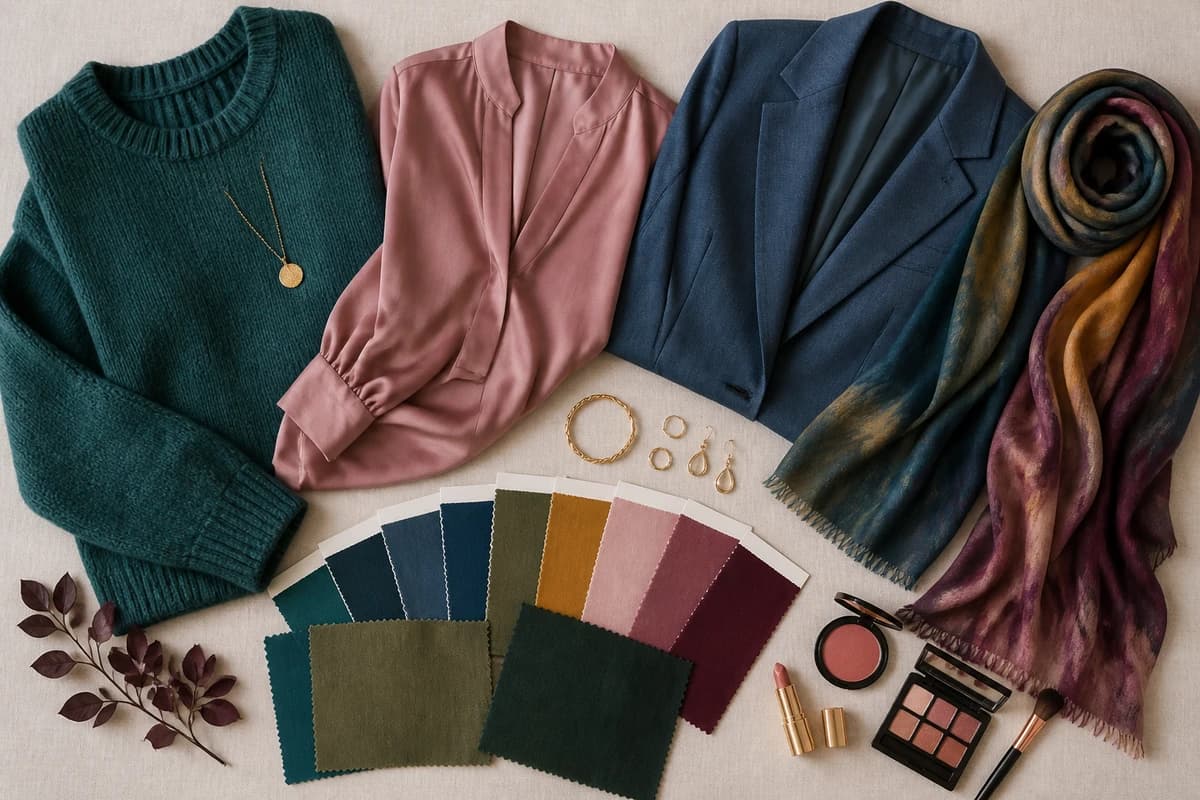
The shortest version: reach for teal, petrol or denim when you want rust to pop, olive, mustard and burgundy when you want it warm and tonal, and cream or camel to make any of it look effortless. Skip the reflexive black, keep your partners either properly cool or genuinely earthy, and let your neutrals carry the rest. Get the version of rust right for your own coloring and it stops being a one-jumper color and becomes one of the most flattering, wearable things you own, which, for such a generous shade, is exactly what it should be.
Frequently asked questions
What colors go with rust?
Rust pairs beautifully with teal, denim blue and petrol blue (its near-complements), with olive and forest green, with mustard gold, and with blush pink, dusty plum and burgundy for range. For neutrals, reach for cream, camel, chocolate brown and charcoal. The single most striking partner is teal, cool blue-green against warm rust is the classic combination.
What color best complements rust?
Teal and denim blue. Rust is a warm red-orange, so its true complement on the color wheel is a cool blue or blue-green, which is exactly why teal, petrol and denim make rust look its richest. Pair them when you want contrast and impact; soften the effect with cream or camel if you'd rather it read warm and easy than bold.
What colors should you NOT wear with rust?
Be careful with bright, cool fuchsia and clear cherry red (they clash with rust's warm, earthy base), with pure jet black head to toe (it deadens rust and looks heavy, chocolate or charcoal is kinder), and with cold, icy pastels like baby blue and mint, which can make rust look muddy. None are forbidden, but they're the pairings most likely to fall flat.
What neutrals go with rust?
Cream and soft white keep things warm and luxe, camel sits right in rust's own family for an easy tonal look, chocolate brown gives you a rich earthy 'dark', and charcoal is a grounding neutral that's kinder than black. These five do most of the heavy lifting in a rust wardrobe.
Does rust go with denim and blue?
Yes, blue is rust's complement, so it's one of the most flattering pairings there is. Mid-wash denim looks effortless with a rust knit, while a deeper teal or petrol blue turns the same idea into something richer and more deliberate. Warm-against-cool is doing the work, which is why rust and blue almost never look wrong together.
Related guides
Colors That Go With Orange
A stylist's guide to colors that go with orange, 10 pairings with hex codes, the best neutrals, what to avoid, and combinations that actually work.
Colors That Go With Charcoal
A stylist's guide to the colors that go with charcoal gray, 10 pairings plus 5 neutrals with hex codes, outfit combinations and what to avoid.
Colors That Go With Khaki
A stylist's guide to the best colors that go with khaki, navy, rust, burgundy, white and more, with hex codes, outfit combinations and what to avoid.
Colors That Go With Peach
The best colors to pair with peach, neutrals, complementary shades and combinations that flatter, with a ready-to-use palette and stylist tips.
Colors That Go With Mint Green
A stylist's guide to the colors that go with mint green, coral, navy, blush, gold and more, with hex codes, outfit combinations and shades to avoid.
Colors That Go With Maroon
A stylist's guide to the colors that go with maroon, 10 pairings and 5 neutrals with hex codes, outfit combinations, what to avoid, and how to wear it.
Prefer in person? Find color analysis near you
Browse local color analysts by city, or get the same season, palette and best-colors breakdown online from one selfie.
See your colors on a photo of you
Upload one selfie and ToneLala reveals your season, your full palette, and your best hair, makeup, jewelry and outfits, styled on you.