In a sentence: Korean personal color analysis (퍼스널컬러) reads your skin's undertone first, warm or cool, then sorts you into one of the four seasons, using the same color science as the Western system but leading with tone. Skip to the tone palette or find your season.
Korean Personal Color Analysis Explained
By ToneLalaUpdated July 7, 2026
Contents
Walk into a color studio in Seoul's Hongdae district and the first thing the analyst does is wipe your face clean, sit you under a daylight-balanced lamp, and start laying silver fabric, then gold, across your collarbone. No questions about your favorite colors, no mood board. They're answering one thing before anything else: are you warm-toned or cool-toned? In Korea that question, 웜톤 or 쿨톤, has become so common it turns up in dating-app bios and group-chat banter, not just salons.
That's the part people miss when they first meet the Korean trend. It isn't a different color science from the seasonal analysis you may already know. It's the same four seasons, the same undertone-value-chroma machinery underneath, just reorganised so that tone leads, and packaged with a clarity and cultural reach that turned a niche styling service into something close to a national pastime. Here's how the system actually works, why it spread the way it did, and how it lines up with the Western seasons.
What 퍼스널컬러 actually means
"Personal color" (퍼스널컬러, often shortened to 퍼컬) is the Korean term for the range of colors that make your complexion look clear, even and awake rather than tired or sallow. The premise is the one every color analyst works from: a color held near your face either flatters your skin or fights it, and that reaction is driven by the pigments in your skin, hair and eyes, not by taste.
Where the Korean approach has its own flavor is the order of operations. It builds outward from undertone in steps, and the vocabulary for each step is part of everyday speech:
- Tone (톤): the warm-or-cool split, the foundation everything else sits on.
- Season (계절): Spring, Summer, Autumn or Winter, the four families.
- Sub-season: finer types within each season, for people who want the precise reading.
Because the steps are named and ordered so plainly, a beginner can follow the logic without a color-theory background. That legibility is a big part of why it traveled.
Warm tone vs cool tone: the first split
Everything starts here. The analyst is sorting you onto one side of a single line.
- Warm tone (웜톤): skin with a golden, yellow or peachy cast. Gold jewelry makes it look cleaner, ivory flatters more than stark white, and warm veins on the inner wrist tend to read greenish. Warm tone covers the Spring and Autumn seasons.
- Cool tone (쿨톤): skin with a pink, rosy or bluish cast. Silver suits better than gold, pure white looks crisp rather than harsh, and wrist veins tend to read bluish or purple. Cool tone covers the Summer and Winter seasons.
You'll also hear 뉴트럴 (neutral) for people who sit close to the middle and can borrow gently from both sides. That category matters, because forcing a neutral-skinned person firmly into warm or cool is where a lot of mismatched readings come from, a point the Western 12-season system was built to solve too.
Get the tone right and you've already halved the field. Get it wrong and every season that follows is wrong, which is why a careful studio spends most of its effort here.
From tone to four seasons
Once tone is settled, two more qualities decide the season. Korean analysts use the same pair the Western system does, even if the day-to-day language leans on tone the loudest:
- Value (명도): how light or deep your overall coloring is. A light, delicate complexion versus a deep, high-contrast one.
- Chroma (채도): how bright or muted suits you. Clear, saturated color versus softened, grayed-down color.
Layer those onto the warm/cool split and the four seasons fall out:
- Spring (봄 웜), warm and bright. Fresh, clear, sunlit color: coral, apricot, warm clear yellow, light warm green.
- Summer (여름 쿨), cool and soft. Gentle, hazy color: rose pink, lavender, soft sky blue, dusty mauve.
- Autumn (가을 웜), warm and deep. Rich, earthy color: brick, mustard, olive, warm browns.
- Winter (겨울 쿨), cool and bright. Crisp, high-contrast color: fuchsia, cobalt, true red, icy shades against black and white.
Notice the symmetry. Each tone owns one bright season and one soft-or-deep season: warm splits into bright Spring and deep Autumn, cool into soft Summer and vivid Winter. That neat fourfold structure is what makes the system so quick to teach, and it's identical to the logic in our full seasonal color analysis guide.
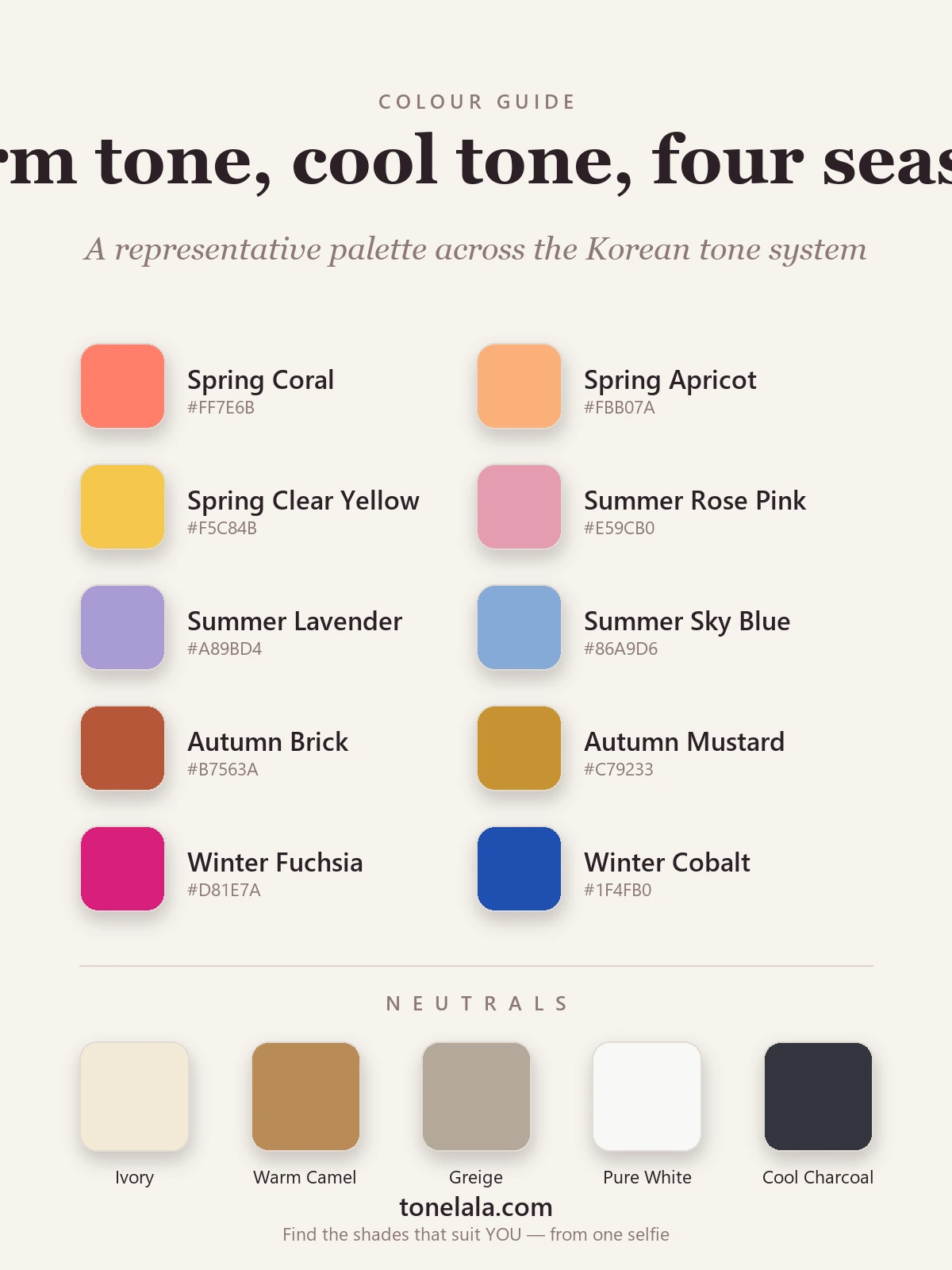
A representative tone palette
To show how the system spreads across warm and cool, here's a color or two pulled from each season, finished with neutrals that lean both ways.
| Season | Tone | A signature color |
|---|---|---|
| Spring | Warm · bright | Coral #FF7E6B |
| Spring | Warm · bright | Clear yellow #F5C84B |
| Summer | Cool · soft | Rose pink #E59CB0 |
| Summer | Cool · soft | Lavender #A89BD4 |
| Autumn | Warm · deep | Brick #B7563A |
| Autumn | Warm · deep | Mustard #C79233 |
| Winter | Cool · bright | Fuchsia #D81E7A |
| Winter | Cool · bright | Cobalt #1F4FB0 |
The neutrals: no single neutral suits everyone, which is the whole point. Warm tones reach for ivory #F3EAD6 and warm camel #B98A56; cool tones reach for pure white #F7F8F6 and cool charcoal #33353C; greige #B3A89A sits in the middle for the neutral-leaning. And the oldest tell still holds, gold flatters warm tone, silver flatters cool.
Want to know whether you're warm-toned or cool-toned?
Find your color season →Why it went viral
A niche styling service doesn't become slang by accident. A few things lined up.
First, visibility. K-pop and Korean beauty made color-matched looks aspirational and impossible to miss, idols styled precisely to their season, makeup ranges sorted by warm and cool. When your favorite artist's lip shade is described as "cool-tone winter," the vocabulary spreads with the fandom.
Second, the experience itself. An in-person studio reading in Seoul became a thing friends booked together, photographed, and posted, a personalized result you could show off. Short-form video did the rest: the moment a drape flips someone from drained to glowing is genuinely dramatic on camera, and that before-and-after is endlessly shareable.
Third, and most underrated, the language is simple. "웜톤" and "쿨톤" are easy to say, easy to apply to a friend, easy to argue about. A system you can use in casual conversation spreads far faster than one that needs a color wheel to explain, and that's how 퍼스널컬러 jumped from salons into everyday speech, then out across the world.
How it maps onto the Western seasons
If you've read about Western color analysis, none of this is foreign, it's the same map drawn with a different starting point.
The Western tradition usually leads with the season and treats undertone as one of several inputs. Korean analysis flips the emphasis: it leads with tone and arrives at the season second. Same destination, different first step. And as the Korean approach has matured, it has adopted the finer splits too, many studios now read sub-seasons (light Spring, deep Autumn, bright Winter and so on) that line up almost exactly with the Western 12-season framework.
The practical differences are mostly cultural rather than technical:
- Draping is central. Korean studios put real weight on physical fabric drapes under controlled neutral light, comparing swatches against bare skin, much like classic color draping.
- It's mainstream. Personal color sits inside everyday beauty culture in Korea, not at its fringes, so makeup, clothing and even hair color get discussed in tone-season terms.
- Undertone gets the spotlight. The warm/cool question is the headline, where Western guides often fold it into a longer checklist.
So if you already know you're a "True Autumn" in the Western system, you're a deep 가을 웜톤 in the Korean one. The names differ; the colors that flatter you don't.
How to find yours
You can make a fair start at home, in three steps, in neutral daylight, never under warm bulbs, which fake a golden undertone onto everyone.
- Settle tone first. Hold gold near your face, then silver. Whichever makes your skin look cleaner and more even points to warm or cool. Cross-check with cream versus stark white, and glance at your inner wrist, greenish veins lean warm, bluish lean cool.
- Read value. Are you naturally light overall, or deep and high-contrast? Light coloring is overwhelmed by very dark shades at the face; deep coloring carries them easily.
- Read chroma. Put a clear, bright version of a color beside a soft, dusty one. If the bright one switches your face on, you lean Spring or Winter; if the muted one feels more like you, you lean Summer or Autumn.
Here's the honest caveat, and it's the same one every studio works around: tone is genuinely hard to judge on yourself. Colored contacts, foundation, dyed hair and ordinary indoor lighting all distort the read, and we're each quietly biased about our own faces. That's exactly why the controlled studio booth exists.
If you'd rather not guess, a photo-based analysis does the same job without the booking. (That's what ToneLala does, you upload a couple of photos, the analysis reads your undertone, value and contrast, and then builds your palette on a picture of you rather than a generic swatch card.) For more background before you decide, browse the full color analysis guides, or read how the Korean four lines up with the 12-season system.
The short version
Korean personal color analysis is the seasonal system with the order rearranged: tone first (웜톤 or 쿨톤), then the four seasons, then the fine sub-seasons. It went viral because the look was aspirational, the studio reading was shareable, and the warm-tone/cool-tone language was simple enough to become slang. Underneath the trend it's the same dependable color science, and once you know your tone and season, getting dressed turns quiet, because everything in your palette already agrees with everything else.
Frequently asked questions
What is Korean personal color analysis?
Korean personal color analysis (퍼스널컬러) is a tone-based method for finding the colors that flatter you most. It starts by deciding whether your skin has a warm undertone (웜톤) or a cool undertone (쿨톤), then narrows that to one of the four seasons, Spring, Summer, Autumn or Winter, and increasingly to sub-seasons. It's the same color science as Western seasonal analysis, but the Korean version puts undertone front and center.
What is the difference between warm tone and cool tone in personal color?
Warm tone (웜톤) skin has a golden, yellow or peach cast and is flattered by gold jewelry, ivory and warm shades; it covers the Spring and Autumn seasons. Cool tone (쿨톤) skin has a pink, blue or rosy cast and is flattered by silver, pure white and cool shades; it covers the Summer and Winter seasons. Deciding warm versus cool is the first and most important step in any Korean personal color reading.
How is Korean personal color analysis different from Western seasonal color analysis?
The underlying system is the same, four seasons built from undertone, value and chroma. The difference is emphasis and culture. Korean analysis leads hard with the warm-tone/cool-tone split, uses fabric draping in carefully controlled neutral light, and is woven into mainstream beauty, makeup counters and even dating profiles. Western analysis tends to talk first about the season and treats undertone as one factor among several.
How do I find my Korean personal color at home?
Check three things in neutral daylight, never under warm bulbs. First, undertone: does gold or silver make your skin look cleaner, and do your wrist veins read greenish (warm) or bluish (cool)? Second, value: are you naturally light or deep overall? Third, chroma: does a clear, bright color switch your face on, or does a soft, muted one suit you better? Those three answers point you to a season. A draping session or a photo-based analysis settles it more reliably than a mirror.
Why did Korean personal color analysis go viral?
A few things lined up. Korean beauty and K-pop made color-matched looks aspirational and highly visible; in-person studio readings became a popular, shareable experience in Seoul; and short-form video let people show their dramatic before-and-after drapes. The warm-tone/cool-tone vocabulary is simple enough to spread as everyday slang, so 퍼스널컬러 jumped from salons into ordinary conversation.
Is Korean personal color analysis accurate?
It's as accurate as the conditions allow. Done properly, bare face, neutral light, real fabric drapes compared side by side, it's consistent and repeatable, because it reads stable properties of your skin, hair and eyes. Most disagreements come from colored contacts, makeup, dyed hair or warm lighting throwing off the undertone read, which is exactly why a controlled analysis beats guessing.
Related guides
Warm vs Cool Skin Tone: How to Tell
Learn how to tell if you have a warm, cool or neutral skin tone with simple at-home tests, plus the colors that flatter each undertone.
Warm vs Cool Undertones
A color analyst's guide to warm vs cool undertones: simple at-home tests, the neutral middle ground, and example colors with hex codes for each.
What Is My Skin Undertone
A color analyst explains what your skin undertone is, how to find it with simple at-home tests, and the colors that flatter cool, warm and neutral undertones.
Skin Tone Chart: Find Your Shade & Undertone
A color analyst's skin tone chart to find your shade (fair to deep) and undertone (warm, cool or neutral) with simple at-home tests, and your color season.
Fair Skin Tone: Undertones & Best Colors
A color analyst's guide to fair skin tone, how to spot it, read your cool, warm or neutral undertone, the seasons it suits
Best Blush for Your Skin Tone
A color analyst's guide to the best blush for your skin tone, how to pick peach, coral, rose and berry by undertone and depth, with real hex codes.
Prefer in person? Find color analysis near you
Browse local color analysts by city, or get the same season, palette and best-colors breakdown online from one selfie.
See your colors on a photo of you
Upload one selfie and ToneLala reveals your season, your full palette, and your best hair, makeup, jewelry and outfits, styled on you.