In a sentence: the best dress color is the one that matches your coloring's undertone, value and chroma, then you tune that shade up or down for the occasion, leaning richer for evening and calmer for work. Skip to the dress palette or find your season.
What Color Dress Should You Wear?
By ToneLalaUpdated July 12, 2026
Contents
A client once stood in front of three near-identical navy dresses in a fitting room, certain that navy was navy and the choice didn't matter. It mattered enormously. One was a cool, inky navy that made her skin look clear and lit; one had a warm, grayed cast that left her looking faintly tired; the third was so dark it swallowed her face entirely. Same color name on three tags, three completely different results on the same woman. That's the whole reason "what color dress should I wear" is harder than it looks, and far more answerable than most people think.
Here's how I think about it, and how I'll walk you through it. A dress sits right next to your face for the whole event, so its color is doing two jobs at once: flattering your skin, and fitting the occasion. Get the first right and you look rested and well in every photo; get the second right and you look appropriate without trying. Most people only think about the occasion. The color analyst in me wants you to start with your own face.
Start with your skin tone, not the dress
The single biggest lever is your undertone: the quiet color underneath your skin. It decides whether a dress makes you glow or makes you look like you're coming down with something. There are three readings, and you can mostly judge them yourself in daylight with no makeup on.
- Warm (gold or peach underneath): you suit coral, tomato red, golden yellow, warm teal, olive and rich rust. Gold jewelry tends to flatter you more than silver.
- Cool (pink or blue underneath): you lift in fuchsia, blue-red, emerald, sapphire, amethyst and icy pastels. Silver usually suits you better than gold.
- Neutral (a balance): you sit happily in slightly muted, balanced shades, teal, dusty rose, true red, soft plum, and you can borrow gently from both sides.
After undertone comes value: how light or deep your overall coloring is, taking skin, hair and eyes together. This is the step that explains the three navy dresses. A light-valued person glows in softer, gentler versions of a color and gets swallowed by a very dark dress; a deep-valued person carries rich, saturated shades that would overwhelm someone lighter. So a flattering dress color is really a flattering version of a color, pitched to your depth. If you want to read your own coloring properly, my guide on what colors look good on me walks through all three dials in order.
A palette of flattering dress colors
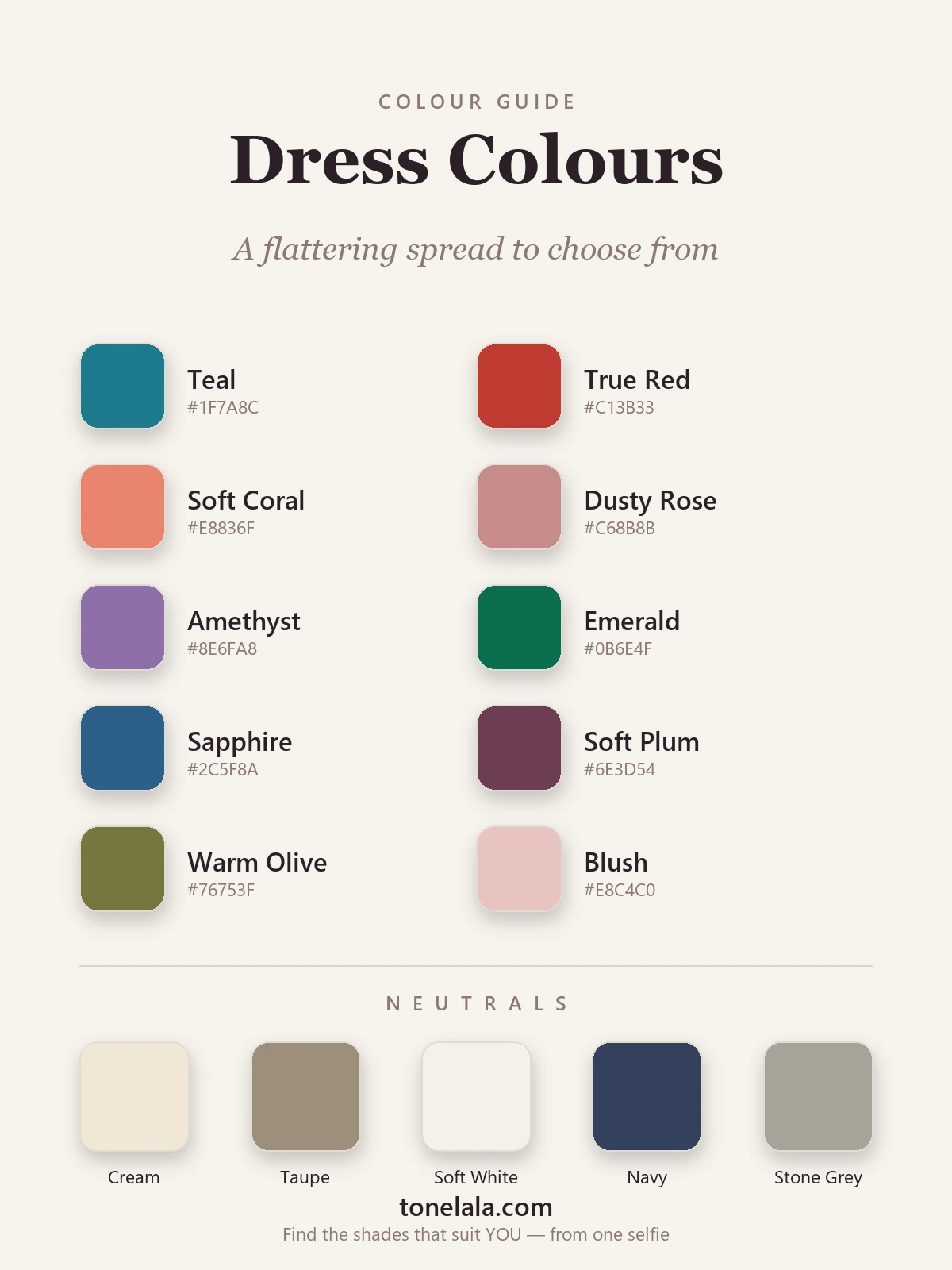
This isn't your dress palette, it's a balanced spread to show the range, with real hex codes so you can see what each color actually is. Yours will be a tuned set of these once you know your undertone, value and chroma.
| Color | Hex | When it shines |
|---|---|---|
| Teal | #1F7A8C |
A near-universal blue-green, flatters across undertones and reads polished day or night. |
| True Red | #C13B33 |
The classic statement dress; almost everyone has a flattering red, the question is which way it leans. |
| Soft Coral | #E8836F |
Warm, fresh and summery, a daytime and garden-wedding favorite for warm coloring. |
| Dusty Rose | #C68B8B |
A grown-up muted pink that photographs beautifully, lovely for soft coloring and weddings. |
| Amethyst | #8E6FA8 |
A mid purple that glows under evening light, especially on cool coloring. |
| Emerald | #0B6E4F |
A jewel-rich green for cool or bright coloring, endlessly elegant after dark. |
| Sapphire | #2C5F8A |
A clear, saturated blue that flatters widely and reads both festive and refined. |
| Soft Plum | #6E3D54 |
A deeper berry for richer palettes, quietly dramatic and slimming. |
| Warm Olive | #76753F |
The earthy, golden green warm and neutral coloring loves for daytime. |
| Blush | #E8C4C0 |
A delicate pale pink for light coloring and soft, romantic occasions. |
The neutrals: Cream #EFE7D5 and Soft White #F4F1E9 as your off-whites, Taupe #9C8E7C and Stone Gray #A7A299 as flexible mid-tones, and Navy #33415C as a flattering dark anchor that's gentler and more modern than black. A neutral dress is never a cop-out, it's the most versatile thing in the wardrobe, and getting its undertone right matters as much as any bright.
Want to know which version of these is genuinely yours?
Find your color season →Then match the dress to the occasion
Once you know your flattering family, the occasion tells you which member of it to wear. The same woman in the same season has a daytime version and an evening version of nearly every color.
- Work and interviews: calm, grounded colors that read as capable, navy, deep teal, charcoal, soft plum or a muted sapphire. Navy is the safest bet in almost any industry; it signals steadiness. Keep it tailored and matte.
- Daytime and garden events: lighter, fresher shades that suit natural light, soft coral, blush, warm olive, dusty rose, a softer teal. Daylight is honest and cool, so it flatters gentler, clearer colors.
- Evening and parties: dim, warm light loves saturation, so this is where the jewel tones come out, true red, emerald, sapphire, amethyst, deep plum. They glow under low lighting and photograph beautifully with flash.
- Wedding guest: avoid white, ivory and anything near it, and skip all-black for a daytime do. Otherwise pick a celebratory shade from your own palette, dusty rose, soft plum, sapphire, emerald or teal in a dressier fabric, that flatters you without upstaging the couple.
What about black, white and "slimming"?
Black is everyone's default and rarely anyone's best color. Pure black is a cool, deep, high-contrast color, so it genuinely flatters deep, cool, contrasted coloring, and casts a hard, aging shadow under lighter or warmer faces. If black is your reflex, try a deep navy, charcoal, forest or aubergine instead; you'll often look noticeably fresher in photos. The same logic applies to white: a crisp pure white suits cool coloring, while soft white, ivory or cream is kinder to warm skin.
On looking slimmer, depth and finish do most of that work, not the hue. A single column of one deep, matte color from shoulder to hem reads streamlined, which is why navy, charcoal, deep plum and forest are perennial favorites. But a deep shade that fights your undertone only makes you look tired, and tired never reads as flattering. Pick a deep color that still suits you.
Choosing your dress color by season
Read your undertone, value and chroma together and you've described a color season: the tidy map that turns all of this into a ready-made dress palette. A few quick examples of how it plays out:
- Spring (warm, light, bright): coral, warm turquoise, golden yellow, clear peach, fresh dresses that suit daylight.
- Summer (cool, soft): dusty rose, soft plum, mauve, slate blue, gentle, romantic, photograph beautifully.
- Autumn (warm, deep, muted): rust, warm olive, teal, deep terracotta, rich earthy dresses with weight.
- Winter (cool, deep, bright): true red, emerald, sapphire, fuchsia, pure black, high-drama jewel dresses made for evening.
If you'd like to place yourself, my color analysis guides walk through every season in detail. The Soft Summer palette is worth a read if your dresses always look best in muted, dusty shades, and the True Autumn palette if rich, earthy colors suit you and clear brights feel harsh. Read a couple and one usually starts to sound like you.
So, what color dress should you wear?
The complete answer: a dress in the color family that matches your undertone, value and chroma, and the version of that color pitched to the occasion, going richer and more saturated for evening, calmer and more grounded for work, lighter and fresher for daytime. The guesswork falls away once you know your season, because then "what color dress" stops being a question you answer dress by dress and becomes a palette you carry into every shop. A personal color analysis reads your coloring from two photos, places you in your season, and hands you the exact reds, blues, greens and neutrals that flatter you, so the next time you're standing in a fitting room holding three navy dresses, you'll know on sight which one is yours.
Frequently asked questions
What color dress should I wear for my skin tone?
Match the dress to your undertone first, then your depth. Warm, golden skin glows in coral, tomato red, golden yellow, warm teal and olive; cool, pink-based skin lifts in fuchsia, blue-red, emerald, sapphire and icy pastels; neutral skin suits balanced, slightly muted shades like teal, dusty rose and true red. Then let your depth decide how light or rich the dress should be, a light person wears the gentler version of a color, a deep person the saturated one. The right dress makes your face look rested and even from across a room; the wrong one casts gray, yellow or pinkness into your skin.
What is the most flattering dress color?
There isn't one universal answer, but the most flattering dress is whatever shares your coloring's undertone, value and chroma. That said, a few near-neutral colors flatter very broadly: teal, true red and navy each have a version that suits almost everyone, because they sit between warm and cool. The trick is choosing the right lean, a warmer or cooler, lighter or deeper version of that color for your specific coloring, rather than assuming one fixed shade works on every skin tone.
What color dress should I wear to a wedding as a guest?
Avoid white, ivory and anything close to it, and steer clear of all-black for a daytime wedding. Beyond that, pick a flattering color from your own palette in a dressier fabric: dusty rose, soft plum, sapphire, emerald or teal all photograph beautifully and read as celebratory without upstaging the couple. For an evening or black-tie wedding, a deeper jewel tone or a rich navy works; for a summer garden wedding, a soft coral, blush or warm olive feels right. Choose the version of the color that suits your undertone and you'll look polished in every photo.
What color dress should I wear to look slimmer?
Depth and matte finish do more than color alone. Deeper, less reflective shades, navy, charcoal, deep plum, forest, a rich burgundy, recede visually and read as streamlined, especially in a single column of one color from shoulder to hem. But a deep shade that fights your coloring will only make you look tired, which is the opposite of flattering. Pick a deep color that still suits your undertone, keep it tonal top to bottom, and choose a matte fabric over a shiny one.
What color dress is best for a job interview?
Reach for a calm, grounded color that reads as competent rather than loud: navy, deep teal, charcoal, soft plum or a muted sapphire. Navy is the safest, it signals trust and steadiness in almost every industry. Keep it tailored and matte, and choose the version that suits your coloring so your face looks fresh and alert rather than washed out. Save the high-chroma reds and brights for when you want to be the most memorable person in the room, not the most reassuring.
What is the best dress color for evening or a party?
Evening light is dim and warm, so saturated, rich colors come alive: true red, emerald, sapphire, deep plum and amethyst all glow under low lighting and photograph well with flash. Pick the jewel tone that matches your undertone, blue-reds and cool jewels for cool coloring, warm reds and golden greens for warm coloring, and let the dress be the whole statement with minimal accessories. A deep, rich shade in a beautiful fabric is hard to beat after dark.
Related guides
Hair Color for Your Skin Tone: The Complete Match Chart
A color analyst's chart of the most flattering hair colors for every skin tone and undertone, fair, medium, olive, tan and deep, warm and cool, plus the shades that wash you out.
Best Blush for Your Skin Tone
A color analyst's guide to the best blush for your skin tone, how to pick peach, coral, rose and berry by undertone and depth, with real hex codes.
The Monk Skin Tone Scale Explained
A color analyst explains the 10-shade Monk Skin Tone Scale, how it improves on Fitzpatrick, how to find your shade

Best Lipstick for Your Skin Tone
A color analyst's guide to the best lipstick for your skin tone, how to pick reds, nudes, pinks and berries by undertone, with real hex codes and examples.
Best Jewelry Metal for Your Skin Tone
A color analyst's guide to the best jewelry for your skin tone, when gold, silver or rose gold flatters your undertone, with the metal test and hex codes.
What Is My Skin Undertone
A color analyst explains what your skin undertone is, how to find it with simple at-home tests, and the colors that flatter cool, warm and neutral undertones.
Prefer in person? Find color analysis near you
Browse local color analysts by city, or get the same season, palette and best-colors breakdown online from one selfie.
See your colors on a photo of you
Upload one selfie and ToneLala reveals your season, your full palette, and your best hair, makeup, jewelry and outfits, styled on you.