In a sentence: The colors that go with maroon are camel, olive green, mustard gold, blush pink, dusty teal, forest green, burnt orange, navy, terracotta and dusty rose, with cream, oatmeal, warm taupe, charcoal and chocolate doing the neutral work. Skip to the full pairing palette or find your most flattering colors.
Colors That Go With Maroon
By ToneLalaUpdated July 4, 2026
Contents
Maroon is the color I see most often mislabelled in a wardrobe. A client pulls out what she calls her "burgundy" jumper, holds it to the light, and it's clearly browner and warmer than wine, that's maroon, and it wants a different set of partners. The confusion matters, because the colors that flatter a cool, purple burgundy are not quite the colors that make an earthy maroon glow.
Once you see maroon for what it actually is, a deep red with brown folded into it, the styling stops being guesswork. It behaves like a warm, dark neutral, which means it can sit quietly under camel and cream, or strike a proper contrast against olive and forest green. Most people only ever wear it with black. This guide is about everything else: the real shades, with hex codes, that make maroon look considered rather than accidental.
What kind of color maroon is
Maroon is a dark, brownish red with a distinctly warm undertone: red mixed with brown rather than the purple you find in burgundy, sitting somewhere around #800000 to #5C2A2A. That brown is the whole story. It's what separates maroon from a cool wine and decides which colors look at home beside it.
Because it's a dark, muted, warm color, maroon works a little like a neutral with the lights dimmed. Two things follow. First, its complement on the color wheel lives in the green family, so olive, forest green and dusty teal give you the most satisfying contrast. Second, anything that shares its warm, earthy quality, camel, mustard, terracotta, burnt orange, blends in almost automatically, while clean, cool, blue-based brights tend to fight it.
It also helps to remember maroon isn't a single shade. There's a warmer, brick-leaning maroon at one end and a deeper, near-chocolate oxblood at the other, and where your particular maroon sits nudges its best partners. The principle holds either way: keep the warm undertone in mind and the pairings practically choose themselves.
The best colors to go with maroon
Here's the palette I actually reach for, a few easy, warm "wins" you can wear tomorrow, plus braver options for when you want maroon to do more than behave.
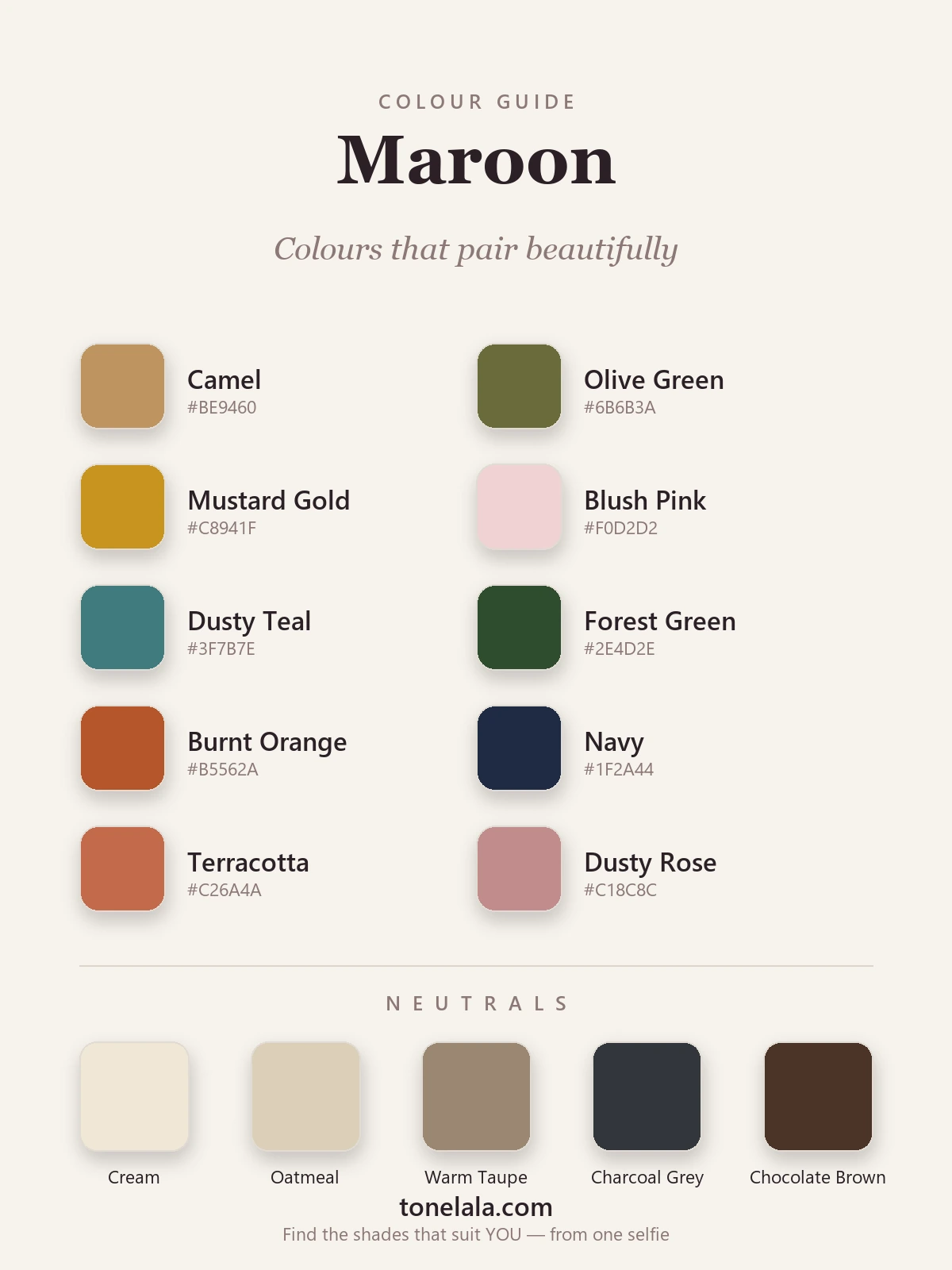
| Color | Hex |
|---|---|
Camel #BE9460 |
The single most flattering partner. Warm tan makes maroon glow and reads instantly expensive. |
Olive Green #6B6B3A |
Maroon's earthy near-complement, muted green against muted red, deeply autumnal and elegant. |
Mustard Gold #C8941F |
Warm ochre lifts maroon out of seriousness; the pairing that always looks rich and intentional. |
Blush Pink #F0D2D2 |
A soft, tonal partner from the same red family. Reads romantic and modern, never twee. |
Dusty Teal #3F7B7E |
A muted blue-green that gives cool contrast without shouting, unexpected and quietly chic. |
Forest Green #2E4D2E |
Deep green against deep maroon is the most classic contrast there is. Festive, considered. |
Burnt Orange #B5562A |
Earthy, analogous warmth, sits beside maroon like it was always meant to. Very seasonal. |
Navy #1F2A44 |
A softer, smarter "dark" than black. Two deep tones that hold hands instead of clashing. |
Terracotta #C26A4A |
Warm clay-orange that echoes maroon's brown base, tonal, sun-baked and effortless. |
Dusty Rose #C18C8C |
The grown-up blush; muted enough to live in maroon's world without competing. |
Neutrals that go with maroon: Cream #EFE7D4 and Oatmeal #DBCFB8 for warm, flattering light tones; Warm Taupe #9A8772 to sit quietly beside it; Chocolate Brown #4A3327 for a rich tonal anchor; and Charcoal Gray #33363B as your best "dark", kinder and more flattering than black.
Which shade of maroon actually suits YOU?
Find your color season →Colors to avoid with maroon
- Cool, blue-based brights. Fuchsia, icy pastels and electric blue sit on the opposite side of the undertone line from maroon's warm base, so they jar rather than harmonize. If you want a pop, keep it warm, mustard or terracotta, not magenta.
- Muddy mid-browns. A flat, grayish brown can dissolve into maroon until the outfit reads as one murky block. Lift it with camel or a clearly warmer chocolate instead.
- Pure jet black, head to toe. It's not wrong, but it deadens maroon's warmth and can age the pairing. Chocolate, charcoal or navy gives you the same anchoring effect while letting the color breathe.
The quick test: if a color makes the maroon look browner or muddier, it's working against you. If the maroon looks more like a rich, warm red, you've found a friend.
Maroon outfit combinations
A pairing on paper is one thing; a whole outfit is another. Here are four I come back to again and again, built so you can copy them straight off the page.
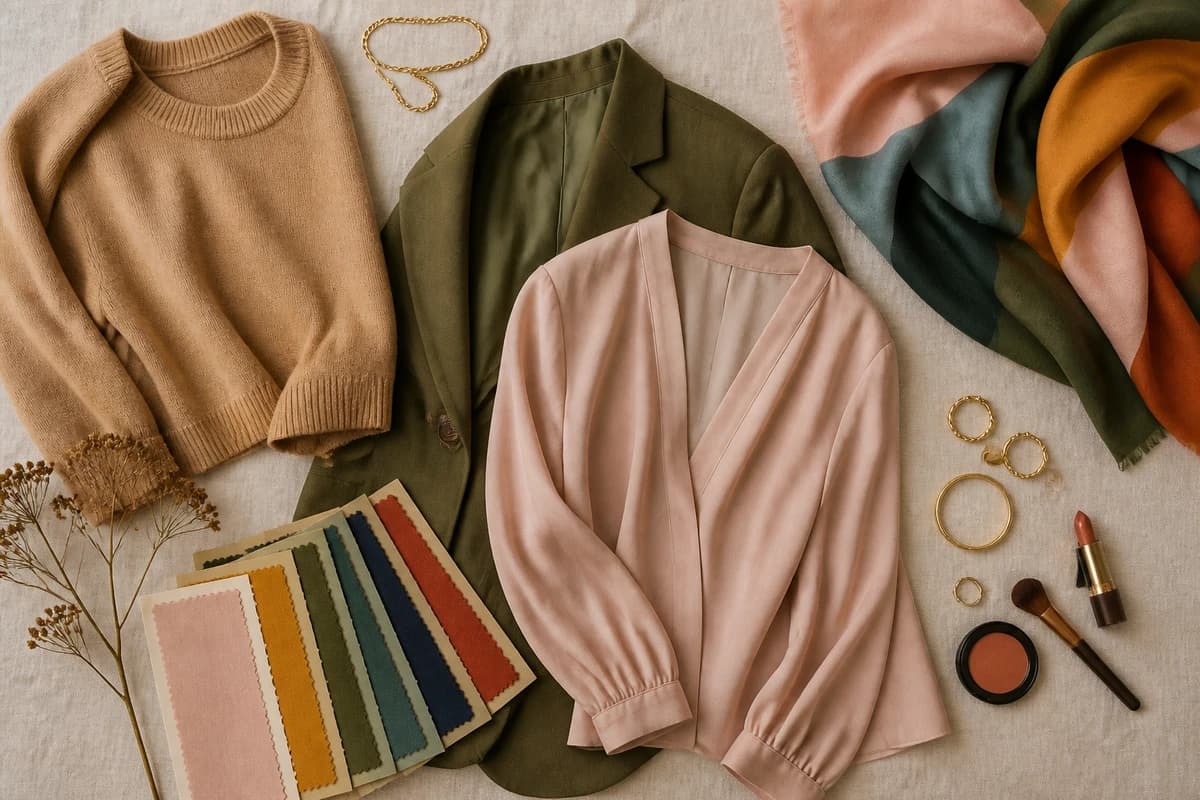
- Maroon + camel + cream. A maroon knit, a camel coat, cream trousers. The failsafe, warm, polished, the kind of outfit that looks like you tried without trying. Gold jewelry finishes it.
- Maroon + olive green. A maroon skirt with an olive jumper, or the reverse. Earthy-on-earthy contrast that feels rich rather than loud, my favorite cool-weather pairing.
- Maroon + blush + oatmeal. Maroon trousers, a blush blouse, oatmeal knit or coat. Tonal and unexpectedly soft, it takes maroon somewhere lighter and more romantic.
- Maroon + navy + gold. Maroon and navy together with a gold buckle, watch or chain. Quietly sharp, brilliant for work, and proof you never needed black.
How to wear maroon for your color season
Here's the part most pairing guides skip: there isn't one maroon. The shade that lights you up depends on your own coloring, and getting it right matters more than any pairing.
Warm, deep types, think True Autumn or Deep Autumn, wear an earthy, brick-leaning maroon beautifully; it echoes the warm depth in their coloring, and they can lean their pairings further into camel, mustard, olive and terracotta. Deep, cool-toned people like True Winter or Deep Winter usually look crisper in a slightly cooler, more wine-tinged version closer to burgundy, worn with navy and forest green rather than orange. Softer, lighter seasons tend to do best in a muted, lighter maroon closer to a deep dusty rose, kept away from the face if it's very dark.
If you've ever held a maroon top up and felt it either glowed or quietly drained your face, that's undertone talking, and it's almost impossible to judge reliably in your own bathroom mirror. Our color analysis guides walk through how each season reads, and a personal analysis tells you the exact version of maroon, and the pairings, built for your skin, hair and eyes.
Maroon vs burgundy: a quick note
Because the two get muddled so often, it's worth pinning down. Burgundy is the cooler, more purple wine red; maroon is browner and warmer. They share most of their green and neutral partners, but maroon especially loves earthy warmth, camel, mustard, terracotta, where burgundy can also carry cooler companions like plum and clear teal. If you'd like the full treatment for the cooler cousin, my colors that go with burgundy guide covers it, and colors that go with red is useful if your shade sits brighter and more true-red than either.
Putting it together
Treat maroon as a warm, rich neutral and you've already won half the battle: pair it with camel and cream for ease, navy and charcoal for sharpness, then bring in olive, forest green or mustard when you want it to genuinely sing. The one rule worth keeping is undertone, match maroon to warm, slightly earthy partners rather than clean, cool brights, and the whole outfit clicks into place. Get your shade right, lean on these ten colors, and you'll never default to maroon-and-black again.
Frequently asked questions
What colors go with maroon?
Maroon pairs beautifully with camel, olive green, mustard gold, blush pink, dusty teal, forest green, burnt orange, navy, terracotta and dusty rose. For neutrals, reach for cream, oatmeal, warm taupe, charcoal gray and chocolate brown. Because maroon leans warm and earthy, warm partners like camel, mustard and terracotta sit most naturally beside it, while gold flatters it more than silver.
What color best complements maroon?
Maroon is a brown-based red, so its complement on the color wheel sits in the green family, and olive or forest green gives you the most satisfying contrast. If you want something easier than a head-on clash, camel is the single most flattering everyday partner, and navy is the most reliable smart-but-not-black pairing.
What colors should you NOT wear with maroon?
Be careful with cool, blue-based brights like fuchsia or icy pastels, they fight maroon's warm, earthy undertone and the pairing reads slightly off. Muddy mid-browns can blur into maroon so the outfit looks flat, and pure jet black tends to deaden its richness. Swap black for chocolate, charcoal or navy and the whole look lifts.
What neutrals go with maroon?
Cream and oatmeal are the kindest light neutrals, warmer and far more flattering than stark white. Warm taupe sits quietly beside it, chocolate brown gives a rich tonal anchor, and charcoal gray is your best 'dark', softer and kinder than black. These five carry most of a maroon wardrobe.
Is maroon the same as burgundy, and do they pair with the same colors?
They're close cousins but not identical, burgundy is a cooler, more purple wine red, while maroon is browner and warmer. That warmth nudges maroon's best partners towards earthy tones: camel, mustard, olive, terracotta and burnt orange flatter maroon especially well, whereas burgundy can also take cooler companions like plum and teal. If your shade looks more brick than wine, treat it as maroon and lean warm.
Related guides
Colors That Go With Charcoal
A stylist's guide to the colors that go with charcoal gray, 10 pairings plus 5 neutrals with hex codes, outfit combinations and what to avoid.
Colors That Go With Khaki
A stylist's guide to the best colors that go with khaki, navy, rust, burgundy, white and more, with hex codes, outfit combinations and what to avoid.
Colors That Go With Peach
The best colors to pair with peach, neutrals, complementary shades and combinations that flatter, with a ready-to-use palette and stylist tips.
Colors That Go With Mint Green
A stylist's guide to the colors that go with mint green, coral, navy, blush, gold and more, with hex codes, outfit combinations and shades to avoid.
Colors That Go With Turquoise
A stylist's guide to the colors that go with turquoise, 10 pairings and 5 neutrals with hex codes, outfit ideas, what to avoid
Colors That Go With Terracotta
The colors that go with terracotta, teal, sage, cream, navy, denim and more, with hex codes, an outfit for each pairing, shoes and jewelry, and shades to avoid.
Prefer in person? Find color analysis near you
Browse local color analysts by city, or get the same season, palette and best-colors breakdown online from one selfie.
See your colors on a photo of you
Upload one selfie and ToneLala reveals your season, your full palette, and your best hair, makeup, jewelry and outfits, styled on you.