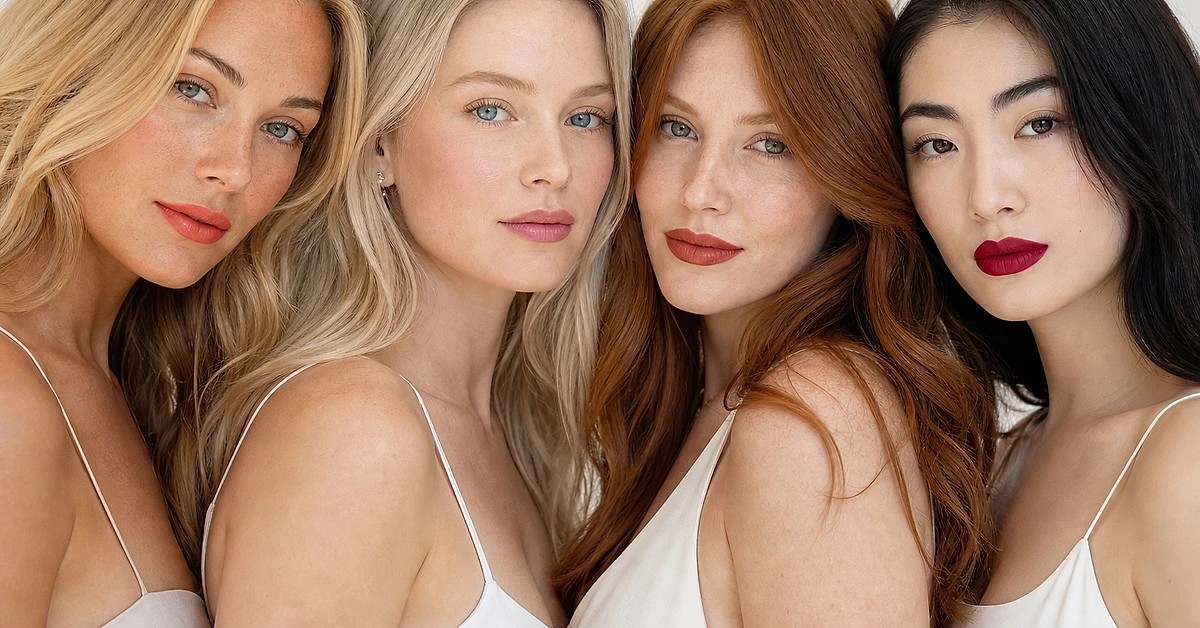
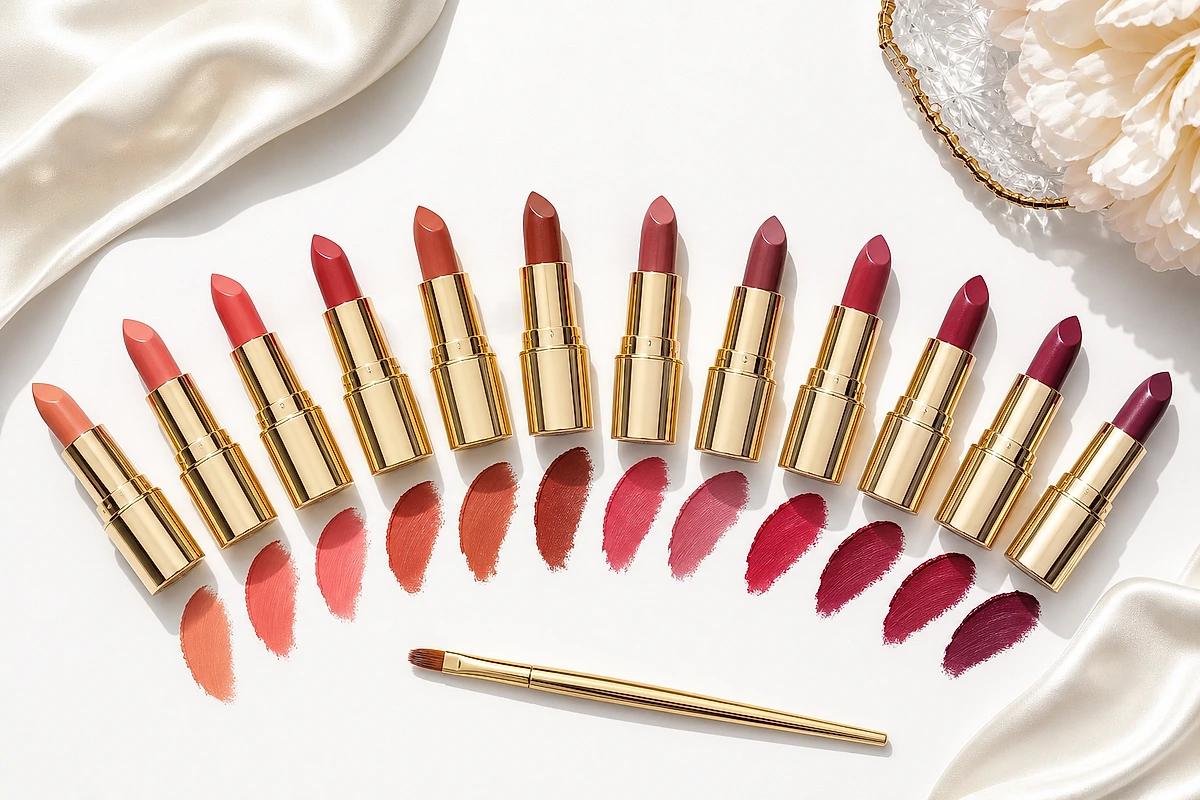
In a sentence: your lipstick should share your season's temperature (warm for Spring and Autumn, cool for Summer and Winter) and its depth and clarity: clear corals and warm pinks for Spring, rose and mauve for Summer, brick and terracotta for Autumn, blue-red and berry for Winter. Skip to the chart, your season, or find your season from a photo.
Best Lipstick Shades for Every Color Season (All 12 Seasons)
By ToneLalaUpdated November 2, 2026
Contents
Seasonal color analysis reached a mass audience with Carole Jackson's Color Me Beautiful, first published in 1980, which sorted people into four seasons: Spring, Summer, Autumn and Winter. The twelve-season system used today splits each of those into three, and lipstick is where the differences between them are easiest to see. Two reds held to the same face can do opposite things: one makes the skin look clearer, the other makes it look tired or sallow.
This guide gives lipstick shades for all twelve seasons: an everyday shade, a red, a nude and a bold option for each, with hex codes and the shades that fight each season. Most ranking guides cover only the four main seasons, so the sub-season detail is where this page differs. If you know your season, jump to it. If you don't, the seasonal color analysis guide explains the system, and the best lipstick for your skin tone guide approaches the question from skin tone rather than season.
The three rules
- Temperature. Warm seasons (Springs and Autumns) wear orange-, peach- and brown-based lips. Cool seasons (Summers and Winters) wear blue-, pink- and berry-based lips. This is the rule that decides whether a red flatters or drains you, and the ranking guides put it first.
- Depth. Light seasons wear lighter, sheerer lips; Deep seasons can carry full-strength dark ones. A Light Summer in a deep plum looks overwhelmed; a Deep Winter in a sheer nude looks unfinished.
- Clarity. Bright seasons wear clear, saturated shades; Soft seasons wear muted, grayed ones. A Soft Autumn in a neon coral looks garish; a Bright Spring in a dusty rosewood looks dull.
When all three match, the lipstick looks like a deeper or brighter version of your own lips rather than something applied on top.
How to find your season for lipstick
If you don't know your season, you can narrow it down with lipstick alone. Oriflame's guide uses the same three steps (undertone, value, chroma), and each can be checked with two lipsticks:
- Undertone. Swatch a coral and a blue-red side by side on your lips in daylight. The one that makes your skin look even and your eyes brighter tells you warm or cool.
- Depth. Compare a light pink with a deep berry or brick. If the deep shade looks natural rather than heavy, you are likely a Deep season; if the light one looks finished rather than washed out, a Light season.
- Clarity. Compare a clear, bright shade with a muted, dusty one in the same color family. If the bright one looks right, you are likely a Bright season; if the dusty one does, a Soft season.
Style Identity and Color Maxxing both add a teeth check: the right shade makes teeth look whiter, the wrong one makes them look more yellow or gray. It is a useful tiebreaker between two close shades.
The lipstick chart by season
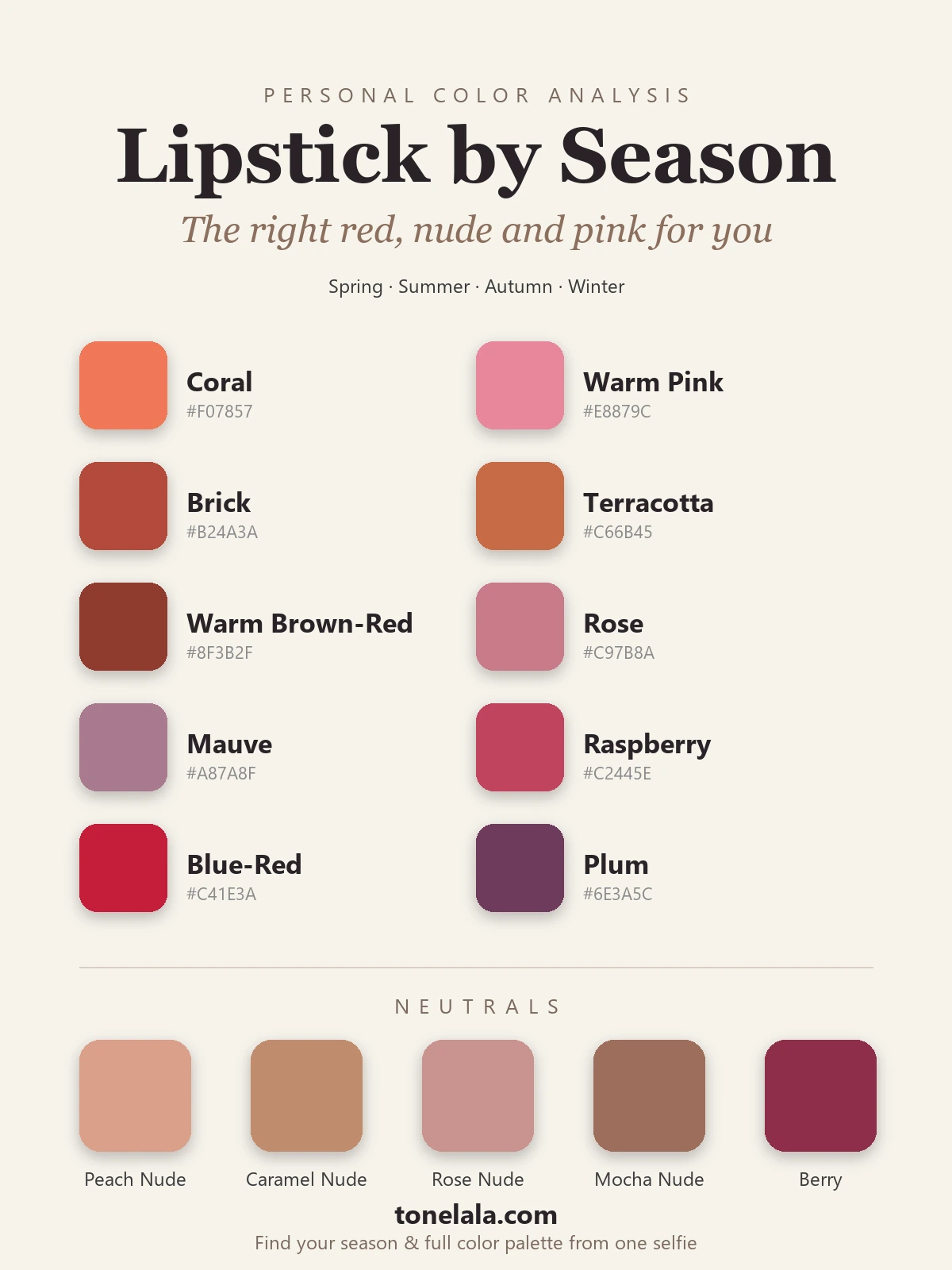
None of the ranking lipstick-by-season guides we checked publish hex codes, so these are here to help you compare swatches on screen.
| Shade | Hex | Seasons |
|---|---|---|
| Coral | #F07857 |
True Spring, Bright Spring, Light Spring (sheer) |
| Warm Pink | #E8879C |
Light Spring, True Spring, Light Summer (cooler version) |
| Brick | #B24A3A |
True Autumn, Deep Autumn |
| Terracotta | #C66B45 |
Soft Autumn, True Autumn |
| Warm Brown-Red | #8F3B2F |
Deep Autumn, True Autumn |
| Rose | #C97B8A |
Light Summer, True Summer, Soft Summer |
| Mauve | #A87A8F |
Soft Summer, True Summer, Soft Autumn (warmer) |
| Raspberry | #C2445E |
True Summer, Bright Winter, True Winter |
| Blue-Red | #C41E3A |
True Winter, Bright Winter, Deep Winter |
| Plum | #6E3A5C |
Deep Winter, True Winter, Soft Summer (sheer) |
Nudes and the fifth bold: Peach Nude #D9A08A (Springs), Caramel Nude #C08C6E (Autumns), Rose Nude #C9948F (Summers), Mocha Nude #9E6E5C (Deep Autumn, neutral and olive skin) and Berry #8E2F4A (Winters, deeper Summers).

Free E-Book
How to Look Younger With the Right Colors
Color Analysis
Know Your Colors Before Your Next Shopping Trip
A personal color analysis from one selfie, ready in minutes.
Lipstick by season
Each season below has an everyday shade, a red, a nude, a bold option and the shades to skip. The links go to the full palette and, where we have one, the makeup guide for that season.
Spring (warm and clear)
- Light Spring: everyday sheer peach or warm pink; red as a sheer coral-red tint rather than a full matte; nude a light peach nude; bold a clear light coral. Skip deep berries, plum and brown-reds, which swamp light coloring. More in Light Spring makeup.
- True Spring: everyday clear coral or warm pink; red a tomato red; nude a warm peach nude; bold a full-strength coral. The season that wears coral best. Skip mauve, blue-red and anything dusty. More in True Spring makeup.
- Bright Spring: everyday vivid coral or hot warm pink; red a clear poppy red; nude a warm nude with some color in it, since very sheer nudes look washed out; bold the brightest coral-pink you can find. Skip brown-reds and muted rosewoods. More in Bright Spring makeup.
Summer (cool and soft)
- Light Summer: everyday soft rose or cool pink; red a soft rose-red, never brick; nude a pink-beige rose nude; bold a sheer raspberry. Skip orange corals, warm browns and heavy plum. More in Light Summer makeup.
- True Summer: everyday a clear rose; red a cool raspberry-red; nude a pink-beige nude; bold soft berry. Skip anything with orange in it and very dark vampy shades. More in True Summer makeup.
- Soft Summer: everyday mauve or dusty rose; red a muted berry-red with a little gray in it; nude a mauve-rose nude; bold soft plum or rosewood. Skip bright fuchsia, clear reds and peach. The Soft Summer makeup guide covers the full face.
Autumn (warm and rich)
- Soft Autumn: everyday terracotta-rose or rosewood; red a soft brick; nude a caramel or rose-brown nude; bold warm mauve. Skip bright coral, clear tomato red and cool berry. More in Soft Autumn makeup.
- True Autumn: everyday terracotta or burnt coral; red brick, the season's signature; nude a caramel nude; bold warm brown-red. Skip blue-reds, fuchsia and pale pinks. More in True Autumn makeup.
- Deep Autumn: everyday deep brick or cinnamon; red a warm brown-red; nude a mocha nude; bold an oxblood with brown in it. Deep Autumn can wear a dark lip as long as it is warm. Skip cool plum, blue-red and frosted finishes. More in Deep Autumn makeup.
Winter (cool and clear)
- True Winter: everyday raspberry or cool berry; red a true blue-red at full strength; nude a cool rose nude; bold deep berry. Skip brick, coral and warm browns. Jackie Wyers picks MAC Ruby Woo for this season. More in True Winter makeup.
- Bright Winter: everyday hot pink or raspberry; red a clear cherry red; nude a cool pink nude with visible color; bold fuchsia. The highest-chroma season wears the brightest lips. Skip muted mauves and brown nudes. Wyers' picks here are MAC Feels So Grand or Ruby Woo, and Style Identity's is Clinique Pop in Cherry Pop. More in Bright Winter makeup.
- Deep Winter: everyday deep berry or wine; red a dark blue-red; nude a deep rose nude; bold plum. The mistake for Deep Winter is going too soft. Skip sheer nudes, dusty pinks and orange-reds. Wyers' pick is MAC Diva, a deep burgundy. More in Deep Winter makeup.
We have not tested the named products; they are listed so you can compare shades in a store.
Red lipstick by season
The temperature rule settles most of it. Warm undertones suit orange- or brown-based reds (brick, tomato, coral-red); cool undertones suit blue-based reds (cherry, cranberry, raspberry-red). Neutral undertones can try a balanced true red against both. Olive skin often suits a warm brick if the olive leans warm, and a cranberry if it leans cool.
Depth and clarity then pick the exact red: a sheer coral-red tint for Light Spring, a brick for True Autumn, a dark brown-red for Deep Autumn, a clear cherry for Bright Winter, a dark blue-red or burgundy for Deep Winter.
Can Summers wear red?
This is the question guides disagree on most. House of Colour includes reds in its Summer range, a cherry and a matte raspberry. Season Approved says red is not part of the core Summer palette but can be worn if it is muted. Oriflame gives Summer no red at all. The practical answer: a cool raspberry or rose-red usually works on True and Light Summers, and a muted berry-red on Soft Summers; a clear, high-contrast blue-red is more of a Winter shade.
Can Autumns wear pink or berry?
Also contested. Une Femme says Autumns should avoid bluish and bright, splashy pinks but allows a warm peachy pink. Oriflame and Color Maxxing say to limit blue-based berries. The Concept Wardrobe allows Soft Autumn soft, deep berry tones. The common ground is that any pink or berry for an Autumn needs warmth in it: a peachy pink, a brick-rose or a brown-berry rather than a cool fuchsia.
Finding your nude
Nudes go wrong more often than reds, because a nude shows the wrong temperature against the skin right next to it. Season Approved puts it simply: a warm nude can look orange on cool skin, and a cool nude can look ashy on warm skin.
- Springs: peach and warm pink-beige.
- Summers: rose and pink-beige.
- Autumns: caramel, warm rose-brown and terracotta-nude.
- Winters: cool rose or a deeper mauve-rose. Season Approved goes further and says Winter has no true nude, because very pale lips look washed out against high-contrast coloring.
- Neutral and olive skin: rose-brown and mocha.
Choose a nude close to your natural lip color or slightly deeper. One paler than your lips tends to look chalky. Season Approved suggests wearing a nude over a lip liner one shade deeper than your natural lip, which gives the shape back without adding color. If a nude makes you look ill, check the temperature before the depth.
Lip liner
Few guides cover liner. Color Me Beautiful sells its lipsticks in pairs with a liner from the same color family, and Season Approved suggests a liner one shade deeper than your natural lip under a nude. A warm liner under a cool lipstick, or the reverse, shows as a ring once the lipstick wears off, so keep liner in your season's temperature too.
Finish and formula
Finish changes how strong a color looks. Sheer and satin finishes soften a shade, which suits Light and Soft seasons; a full matte intensifies it, which suits Deep and Bright seasons. The same blue-red as a sheer tint on a True Winter and as a full matte on a Light Summer gives two different results, and both are the wrong depth.
Guides disagree on the soft seasons. For Soft Autumn, The Concept Wardrobe recommends matte and says gloss and shimmer can overwhelm the face, while Season Approved suggests satin or cream. For Deep Winter, Season Approved suggests satin or a creamy matte. If you are a Soft season and a full matte looks heavy on you, a satin is the safe middle.
Testing a lipstick in the store
- Swatch on your lips, or on a fingertip held next to your lips, not on the back of your hand.
- Look in daylight by the store entrance; store lighting is usually warm and changes how reds read.
- Compare two shades at once rather than judging one on its own.
- Use the teeth check: the shade that makes your teeth look whiter is usually the right temperature.
Where to start
Buy three lipsticks in your season's family before anything else: one everyday shade, one red and one nude. Springs: coral, a tomato or coral-red, and a peach nude. Summers: rose, a raspberry-red, and a rose nude. Autumns: terracotta, a brick, and a caramel nude. Winters: berry, a blue-red, and a cool rose. Add a bold shade once you know which of the three you wear most.
If you don't yet know your season, a photo-based analysis reads undertone, depth and clarity from one selfie, which tells you which of the twelve rows above is yours.
Frequently asked questions
What lipstick color suits my color season?
Springs suit clear coral, peach and warm pink; Summers suit rose, mauve and soft raspberry; Autumns suit brick, terracotta and warm brown-red; Winters suit blue-red, fuchsia, berry and plum. Within each family the sub-season sets the depth and brightness: Light seasons wear the lighter versions, Soft seasons the muted ones, Deep seasons the darkest and Bright seasons the most saturated.
What is the best red lipstick for cool undertones?
A blue-based red with no orange in it, such as a cherry, cranberry or raspberry red. Winters can wear it at full strength; Summers usually look better in a softer raspberry or rose-red. Orange-based reds tend to make cool skin look sallow.
What is the best red lipstick for warm undertones?
An orange- or brown-based red: brick, tomato, warm coral-red or a warm brown-red. Springs suit the clearer tomato and coral reds, Autumns the deeper brick and terracotta reds. Blue-based reds can make warm skin look gray.
What lipstick suits a Deep Winter?
Saturated cool shades: blue-red, deep berry, wine, plum and fuchsia. Deep Winter coloring has the depth and contrast to carry a dark or bold lip, and the usual mistake is going too soft; sheer nudes and dusty pinks can disappear. Jackie Wyers' MAC pick for Deep Winter is Diva, a deep burgundy.
What lipstick suits a Soft Autumn?
Muted warm shades: rosewood, soft brick, terracotta-rose, warm mauve and a caramel or rose-brown nude. Bright coral and clear tomato red tend to overpower it. Guides split on finish: The Concept Wardrobe recommends matte, while Season Approved suggests satin or cream.
What nude lipstick suits my undertone?
Warm undertones suit peach, caramel and warm rose-brown nudes; cool undertones suit rose, pink-beige and mauve nudes; neutral and olive undertones suit rose-brown and mocha nudes. A nude close to your natural lip color, or a little deeper, usually looks more natural than one paler than your lips, which can look chalky.
Can Summers wear red lipstick?
Guides disagree. House of Colour gives Summers their own reds, such as a cherry and a matte raspberry. Season Approved says red is not in the core Summer palette but is wearable if it is muted, and Oriflame gives Summer no red at all. If you try one, choose a cool raspberry or rose-red rather than a clear blue-red or any orange red.
Can I wear a lipstick from another season?
Yes. A neighboring season's shade often works if it shares two of your three qualities, for example a True Summer rose on a Soft Summer. Shades from the opposite season, such as a clear coral on a Soft Summer or a dusty mauve on a Bright Winter, are the ones that usually look wrong.
Do nude lipsticks follow the same undertone rules?
Yes, and nudes show the wrong temperature more than bright colors do. Season Approved notes that a warm nude can look orange on cool skin and a cool nude can look ashy on warm skin.
Can Winters wear nude lipstick?
Season Approved says Winter has no true nude, because the season's high contrast makes very pale lips look washed out. Most other guides simply give Winters a cool rose or deeper mauve-rose as their everyday shade instead of a beige nude.
Related guides

Best Lipstick for Your Skin Tone
A color analyst's guide to the best lipstick for your skin tone, how to pick reds, nudes, pinks and berries by undertone, with real hex codes and examples.
Soft Autumn Makeup: Best Shades for Lips, Eyes & Cheeks
Soft Autumn makeup guide: 10 best lip, blush and eye shades with hex codes, plus foundation, bronzer, liner, mascara, nails, and the cool, frosted colors to skip.

Deep Winter Makeup: Best Shades for Lips, Eyes & Cheeks
A makeup artist's Deep Winter guide, your foundation undertone, the 10 best lip, eye and blush shades with hex codes, and the warm tones to skip.

Deep Autumn Makeup: Best Shades for Lips, Eyes & Cheeks
A makeup artist's Deep Autumn guide, 10 best lip, blush & eye shades plus 5 base tones with hex codes, the right foundation undertone, and what to skip.
Best Blush for Your Skin Tone
A color analyst's guide to the best blush for your skin tone, how to pick peach, coral, rose and berry by undertone and depth, with real hex codes.

Types of Skin Tones Explained
A color analyst explains the types of skin tones, depth (fair to deep) and undertone (warm, cool, neutral), how they differ, and how to find yours.
Prefer in person? Find color analysis near you
Browse local color analysts by city.